


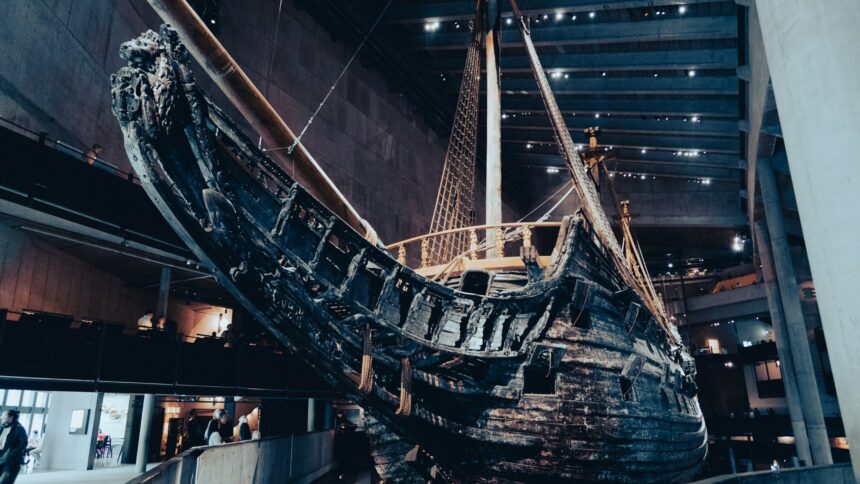
On Sunday, the tenth of August 1628, the Swedish warship Vasa cast off below the royal palace in Stockholm late in the afternoon. A salute was fired once the last line came free. She had covered about 1,300 metres of harbour when she heeled to port and the sea found the lower gundeck, whose gunports stood open. No enemy was near her. The openings that sank her had been cut to the design her own shipwrights worked from, a design the king had approved.
That afternoon is the measuring stick I would set against any business partnership in Alberta, because its lesson is plain and easily forgotten. A rival firm can take a contract or a year of margin. The hole that sends a firm to the bottom is usually cut from inside, by partners who each believed they were improving the ship.
Key facts
- The Vasa Museum in Stockholm records that the warship Vasa sank on 10 August 1628 after sailing about 1,300 metres, when water entered gunports left open on the lower gundeck.
- According to the Vasa Museum, the Vasa was raised on 24 April 1961, after 333 years underwater.
- The Vasa Museum’s account of the 1628 inquest states that no one was officially blamed or punished for the sinking and that all of those questioned were eventually promoted.
- The Dictionary of Canadian Biography records that James Lougheed’s attempt to dissolve his Calgary law partnership with R. B. Bennett without Bennett’s agreement ended in a bitter separation in 1922.
- National Bank of Canada reported on 21 July 2026 that 47% of 504 mid-market business owners in Western Canada, surveyed from 4 to 20 May 2026, expect to retire within 10 years.
Why the Vasa inquest ended with nobody blamed
The detail that ought to unsettle any partner happened weeks before she sailed. In early July, with Vice Admiral Klas Fleming watching at the quay, thirty men were set running back and forth across the upper deck to see how she rolled. After a few trips she was heeling so badly that the demonstration was stopped for fear she would capsize where she was moored. The ship’s master, Jöran Matsson, later testified that Fleming’s response was to wish aloud that the king were home.
She sailed anyway.
The day after she went down, the Council of State began looking for the men responsible. Captain Söfring Hansson was jailed and swore that the crew had been sober and the guns properly lashed. The builders answered that they had worked to Master Henrik’s design, which the king had approved. When it was over, in the museum’s words, “no one was officially blamed or punished,” and every man questioned was eventually promoted.
The verdict reads to me as an honest ledger. When a partnership fails from inside, the books usually show a long column of small entries, each defensible on the day it was made, and a total that nobody signed for. She lay on the bottom until 24 April 1961, and in all those years the accounting never improved.
How a Calgary law partnership came apart in 1922
Alberta has its own version, and it sailed from Calgary. In 1897 James Lougheed, a lawyer by then more interested in politics than in practice, and the man whose sandstone mansion still carries his name in Calgary, took R. B. Bennett into his firm. The Legal Archives Society of Alberta records the terms Bennett negotiated: 20% of income up to $3,750 and 30% beyond it, raised to 35% in the second year. The terms were careful about money, and the firm ran on them for twenty-five years.
By March 1922, the Dictionary of Canadian Biography records, Bennett was spending much of his time on the Eddy company’s affairs in Hull, Quebec, and was thinking of giving up the partnership himself. Lougheed moved first. While Bennett was in England on a Privy Council appeal, Lougheed set out to dissolve the firm without his partner’s agreement. Bennett hurried home and placed the firm’s assets in receivership; Lougheed formed a new partnership, and Bennett counterclaimed for $50,000 in damages.
The suit was still unsettled when Lougheed died on 2 November 1925. The old firm split three ways, and Bennett’s group kept most of the important clients, among them A. E. Cross and Patrick Burns. Each man had opened his own gunport, one by drifting toward other work and the other by acting alone while his partner was abroad, and each believed he was protecting what he had built. No competitor in Calgary could have done to that firm what its two senior partners did to it.
The timber was good; the successor firms still exist more than a century later as Bennett Jones LLP and Parlee McLaws LLP. Few Alberta partnerships that break this way leave anything so sound behind.
What Western Canadian owners are planning for the next decade
The reason it matters now sits in a survey released in Edmonton on 21 July 2026. National Bank of Canada, working with Angus Reid, asked 504 owners of firms with $3 million to $100 million in annual revenue across Alberta, British Columbia, Saskatchewan and Manitoba about their plans. Of that group, 47% expect to retire within 10 years, and 68% plan to sell or transfer the business.
Two further figures belong side by side. Among owners planning a sale or transfer, 98% say they know which advisors they would need. More than a third, 36%, have not yet engaged any specific advisor to guide the handover. Knowing whom to call and calling are separate entries in the ledger, and only the second one costs anything.
A succession is the season when every port in the hull stands open at once, and a family firm has more ports than most. Innovation, Science and Economic Development Canada’s 2023 survey found members of one family held majority ownership of 25% of small and medium-sized enterprises. A buyout formula left alone for twenty years is exactly the kind of opening a succession exposes.
None of those openings is cut by an enemy. The Vasa’s builders were competent men working to a plan their patron had signed. What saves a firm is the stability test, run early and believed when it fails. Put the hard questions on the deck while the owners are still at the quay: who buys whom out and at what price, and who decides when the partners cannot agree. Then watch how far she leans.
The Vasa failed her test at the quay in July and sank in August, and no partnership has ever been saved by the month in between.