
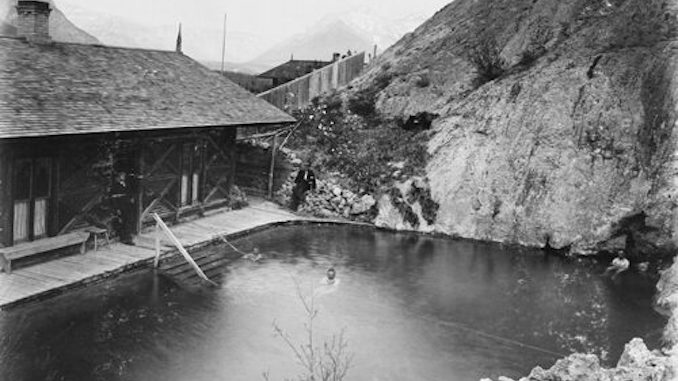

In 1883 the Canadian Pacific Railway was pushing its track through the Bow Valley, and three of the men working that line had a day to spare and a hunch worth chasing. They had heard there was warm water somewhere on the lower slopes of the mountain above Banff. What they found, and what they did next, ended up inventing something Canada did not yet have. Canada’s national park idea began with three railway workers and a hole in the ground.
A ladder made from a tree
The three men were Frank McCabe and two brothers, Tom and William McCardell. Following the smell of sulphur and a drift of steam, they came to an opening in the hillside, a vent in the rock with warm mist pouring steadily out of it.
Getting in was not simple. The spring sat inside a cave, and the only way down was through that steam hole in the roof. The men felled a tree, trimmed it into a rough ladder, and William McCardell climbed down it into the dark. At the bottom he found a domed chamber, stalactites hanging in the fog, and a pool of warm mineral water sitting inside the mountain. The hot springs themselves were not new. What was new was what was about to happen to them.
A fight over a hole in the ground
The three workers understood at once that warm water in the mountains was worth money. A spring like this could anchor a spa, a resort, a paying business, and in the 1880s a mineral bath was genuinely fashionable among people with means and time.
The trouble was that they were not the only ones who had the thought. Rival claims piled up over who had really found the springs and who held the right to build on them. The squabble grew tangled enough that it landed in front of the federal government, and the government, looking at a valuable natural asset being fought over by private claimants, made a decision that changed the country.
The reserve of 1885
In 1885, rather than hand the springs to any of the competing claimants, the government set the land aside. It created the Hot Springs Reserve, declaring the area protected from sale, settlement, and squatting. The springs would not belong to a developer. They would be held, instead, for everyone.

From reserve to national park
That reserve did not stay small. By 1887 its boundaries had been pushed out dramatically, to something approaching 300 square miles, and the protected area was given a name. It was called Rocky Mountains Park, and it was the first national park in Canada and one of the first anywhere. The familiar name came later. Today it is Banff National Park, and the Canadian national parks system traces its origin to that decision about a contested cave.
What the site is now
The Cave and Basin did not fade into a footnote once the park was made. It became a destination in its own right.
A bathhouse and pavilion were built around the springs, and the handsome stone-and-timber structures visitors see today largely date from around 1912 to 1914. People came for decades to soak in the mineral water and take in the mountain air. The site is now the Cave and Basin National Historic Site, designated in 1981 and operated by Parks Canada as the place where the national park story is told, on the spot where it began.
The smallest resident of all
There is one more thing worth knowing about the Cave and Basin, and it is very small. The thermal waters here are home to the Banff Springs snail, a tiny snail found only in a handful of warm springs on Sulphur Mountain, all of them in this one corner of Banff. It was assessed as endangered in 2000. The same warm water that set off a national park system also shelters a creature found almost nowhere else.
Canada learned to keep its best places by accident. Three railway workers found warm water, could not agree on who owned it, and pushed a government into holding it for everyone. The vent in the rock where William McCardell went down the felled tree can still be seen at the Cave and Basin.