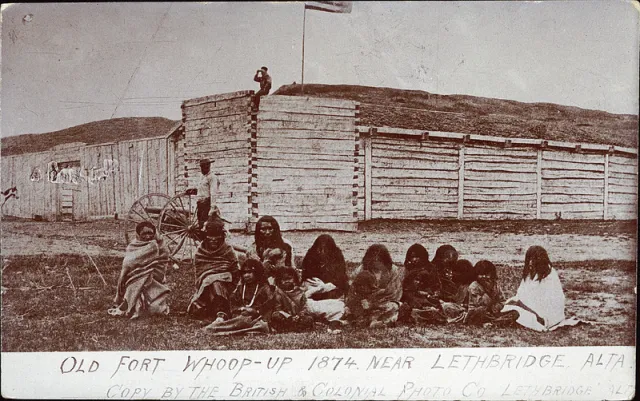
A short distance from the reconstructed Fort Whoop-Up Interpretive Centre in Lethbridge sits the actual ground where the second iteration of the original fort stood. The 1870 rebuild of Fort Whoop-Up, the post Hamilton and Healy put up after the first fort burned, has its own separate heritage designation as the Fort Whoop-Up Archaeological Site. The two designations are easy to confuse. One protects the historical importance of the operation. The other protects the physical evidence still in the ground.
Two designations, one whisky fort
A common mistake. Visitors think Fort Whoop-Up has one heritage record. There are actually two distinct entries.
- The Fort Whoop-Up National Historic Site of Canada designation recognises the whole operation and its place in Alberta history.
- The Fort Whoop-Up Archaeological Site designation, administered by the Alberta Register of Historic Places under ID 10972, protects the physical archaeological deposit on the original ground.
The archaeological designation came later, on June 17, 1986, according to the Canadian Register of Historic Places.
What the ground still holds
The archaeological record is the point of the second designation. This column does not list individual finds, because the sources checked do not itemize them.
Why this kind of evidence matters
The standing reconstruction in Lethbridge is useful for visitors and for school groups, but it does not contain primary evidence. Everything inside it is interpretation. The archaeological site is where the primary evidence lives. If a researcher in 2080 wants to understand what the whisky trade physically looked like on the ground, the archaeological site is the only thing in southern Alberta that can answer the question.
Why Alberta protects archaeological sites that have nothing visible to see
Two reasons, in order of weight.
The first is research. Archaeological sites are the only direct physical record of trade and daily life that nobody wrote down. The whisky trade was thinly documented in writing for obvious reasons. The ground is the only honest archive.
The second is succession. New techniques in archaeology come on line every decade. Sites that are protected now can be re-investigated with better tools later. Once a site is destroyed, no future technique can recover what it held.
Why invisible sites still deserve protection
Most Albertans walk past archaeological sites every day without realising it. The Fort Whoop-Up Archaeological Site is one of many similar deposits in southern Alberta, catalogued through Alberta Culture and the Archaeological Survey of Alberta. The work does not generate headlines because there is nothing to photograph. The work matters because the ground is the only place where some chapters of Alberta history are still written down. You do not need a standing building to have a heritage site worth protecting. Sometimes the dirt is the document.
Listed on the registry. The Fort Whoop-Up Archaeological Site appears on the Canadian Register of Historic Places as Site ID 10972 and was designated a Provincial Historic Resource on June 17, 1986.
Related reading from the series. Fort Whoop-Up and the whisky trade that brought the Mounties to Alberta. Fort Macleod and the first NWMP outpost in southern Alberta.
Related from Alberta Tribune: The Century Old Dam That Still Waters Southern Alberta