

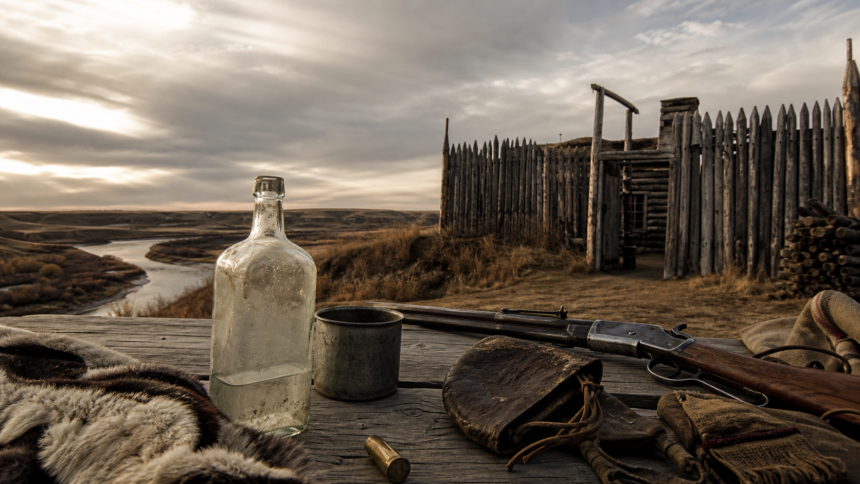
The single most consequential building in southern Alberta in the early 1870s was a private whisky fort run by two American traders out of Fort Benton, Montana. Fort Whoop-Up opened at the confluence of the St. Mary and Oldman Rivers in 1869 under partners Albert B. Hamilton and John J. Healy. It traded watered-down whisky, repeating rifles, and trade goods for buffalo robes and furs from Indigenous communities. Within four years, the social damage was severe enough that Ottawa created the North-West Mounted Police specifically to shut down the trade. Modern Alberta law enforcement, in a straight line, traces back to this one fort.
Hamilton and Healy set up shop
The original 1869 post was called Fort Hamilton after the senior partner. It burned the first winter, in early 1870, and Hamilton and Healy rebuilt it on a slightly different footprint and called the rebuilt fort Whoop-Up. The site was strategic. It sat at the river junction, in a piece of country the Blackfoot Confederacy had long used for buffalo hunting and travel, and it was on the American whisky trade routes pushing north from Fort Benton along what is now Highway 4. The post was profitable almost immediately.
The trade itself
The whisky operation was simple, ugly, and effective.
- A barrel of trade whisky was diluted with water, tobacco juice, red pepper, and whatever else was on hand.
- Buffalo robes were the primary trade good, with horses, furs, and ammunition coming in behind.
- Disputes were settled with the repeating rifles the fort also sold, which made the wider country far more dangerous than it had been before.
The trade hit the Blackfoot Confederacy hard. Mortality rates in some camps climbed sharply during the winter of 1872-1873. The wider effect was a collapse in the social fabric of communities that had functioned for centuries before Hamilton and Healy showed up.
Why Ottawa created the NWMP
The Cypress Hills Massacre in June 1873, in which a group of American wolf hunters killed roughly twenty Assiniboine in what is now southwestern Saskatchewan, was the breaking point. Ottawa had been studying the whisky trade for two years. After Cypress Hills, the federal government passed the legislation creating the North-West Mounted Police, and the new force was given a specific operational mandate. Get to southern Alberta. Shut down the American whisky forts. Establish law where there was none. The Mounted Police arrived at Fort Whoop-Up in October 1874. They found the fort largely abandoned. Hamilton and Healy had seen the writing on the wall and pulled out ahead of the force.
What happened to the site
The post continued in reduced operation for several more years under different management before closing. The buildings deteriorated and eventually disappeared. A reconstruction was built at a different location near Lethbridge in the 1960s and serves today as the Fort Whoop-Up Interpretive Centre. The original site, at the confluence of the rivers, is archaeological.
Fort Whoop-Up was designated a National Historic Site of Canada on October 28, 1963. It is listed on the Canadian Register under ID 18984.
Reading the whisky trade era honestly
Here is the heritage buff opinion. The standard Alberta story sometimes treats Fort Whoop-Up as a colourful frontier curiosity. The redcoats arrive, the whisky traders leave, everything ends well. That summary leaves out the part that actually mattered. The whisky trade caused serious damage to the Blackfoot Confederacy, the Tsuut’ina Nation, the Stoney Nakoda, and other Indigenous communities of southern Alberta. That damage is part of the historical record and worth saying directly. The arrival of the NWMP did, in fact, shut down the trade. It also brought its own complicated layer of consequences to the country. Both things are true at the same time. The site itself is one of the most important pieces of southern Alberta heritage because it forces the conversation to include both stories.
Listed on the registry. Fort Whoop-Up appears on the Canadian Register of Historic Places as Site ID 18984 and was designated a National Historic Site of Canada on October 28, 1963. A reconstruction operates today as the Fort Whoop-Up Interpretive Centre in Lethbridge.
Related reading from the series. The Fort Whoop-Up Archaeological Site and what the ground still holds. Fort Macleod and the first NWMP outpost in southern Alberta.