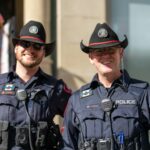


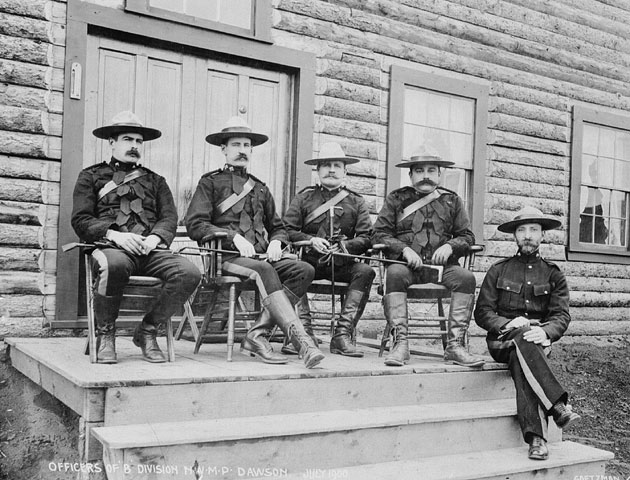
When the North-West Mounted Police arrived in southern Alberta at the end of the famous 1874 March West, they did not arrive at a city. They arrived at a piece of empty prairie on the Oldman River. They built the first NWMP post in what is now Alberta on that ground, named it after their commanding officer, and the town of Fort MacLeod grew up around it. The post is the launching point for the entire history of the Mounted Police in the west and for almost everything that became the modern Royal Canadian Mounted Police.
The March West and where it ended
The NWMP march out of Manitoba in July 1874 has been told a hundred ways. The short version. Roughly three hundred officers and men, six hundred horses, ammunition, supplies, and a complete lack of accurate maps moved roughly thirteen hundred kilometres across the southern prairie in a forty-five day push. The force was sent on the explicit mandate to establish law in the country and shut down the American whisky trade out of Fort Whoop-Up.
The force split during the final phase of the march. The main column under Assistant Commissioner James F. Macleod continued southwest and reached the Oldman River in early October 1874. Macleod selected a site on a cottonwood-covered island in the river for the first post. Construction started immediately. The post was operational within weeks.
Why this location got picked
Macleod chose the spot for a short list of practical reasons.
- The island gave defensive geometry that an open prairie post would not have.
- The cottonwood gave fast access to building material.
- The river itself was reliable water.
- The location sat within easy patrol distance of Fort Whoop-Up.
- Local Indigenous trails converged in the area, making the post a natural junction.
The first winter was hard, the forage was tight, and the buildings were rough. By the spring of 1875 the post was the operational headquarters for NWMP work across all of southern Alberta. Inspector Cecil Denny ran patrols south to the international border. Inspector Leif Crozier handled the relationship with the Blackfoot Confederacy. Macleod himself negotiated personally with Chief Crowfoot of the Siksika and other leaders, work that would lead directly to Treaty Seven in 1877.
Treaty Seven and the post
Treaty Seven was signed at Blackfoot Crossing in September 1877. The Treaty involved the Siksika, Kainai, Piikani, Tsuut’ina, and Stoney Nakoda Nations. Macleod was the federal negotiator. Fort Macleod served as the operational base for the Treaty preparations and for the immediate post-Treaty period of relationship management.
The Treaty has its own long and complicated subsequent history, and the post is implicated in that history. Heritage interpretation at Fort Macleod has worked over the last twenty years to include Indigenous voices in the standard narrative, and the modern interpretation of the site is more honest than it was in the past.
The post and the town
The town of Fort MacLeod grew up around the NWMP post almost immediately. The post was rebuilt and relocated several times within the broader area as the country changed and as the NWMP outgrew the original island site. A reconstructed Fort Macleod operates today as the Fort Museum of the North-West Mounted Police and First Nations Interpretive Centre.
The site was designated a National Historic Site of Canada on May 25, 1923. It is listed on the Canadian Register under ID 1140.
A heritage buff take on the first western post
Here is what most Albertans never get told about Fort Macleod. The post was the first piece of federal infrastructure of any kind in what would become Alberta. Before this post there were fur trade outposts, missions, Métis settlements, Indigenous nations, and American whisky forts. There was no Canadian government presence on the ground south of Edmonton. The federal authority that runs through this province today, from policing to taxation to land tenure, traces a direct administrative line back to a wooden post on the Oldman River that was built by Mounted Police officers in late 1874. That sequence is worth knowing, because it explains why Alberta’s relationship with Ottawa has the texture it has. The federal presence arrived after the rest of the country was already organising itself, and the early version of that presence was the Mounted Police.
Listed on the registry. Fort Macleod appears on the Canadian Register of Historic Places as Site ID 1140 and was designated a National Historic Site of Canada on May 25, 1923. The reconstructed site operates today as the Fort Museum of the North-West Mounted Police.
Related reading from the series. Fort Whoop-Up and the whisky trade that brought the Mounties to Alberta. Fort Calgary and how a police post became a city.