
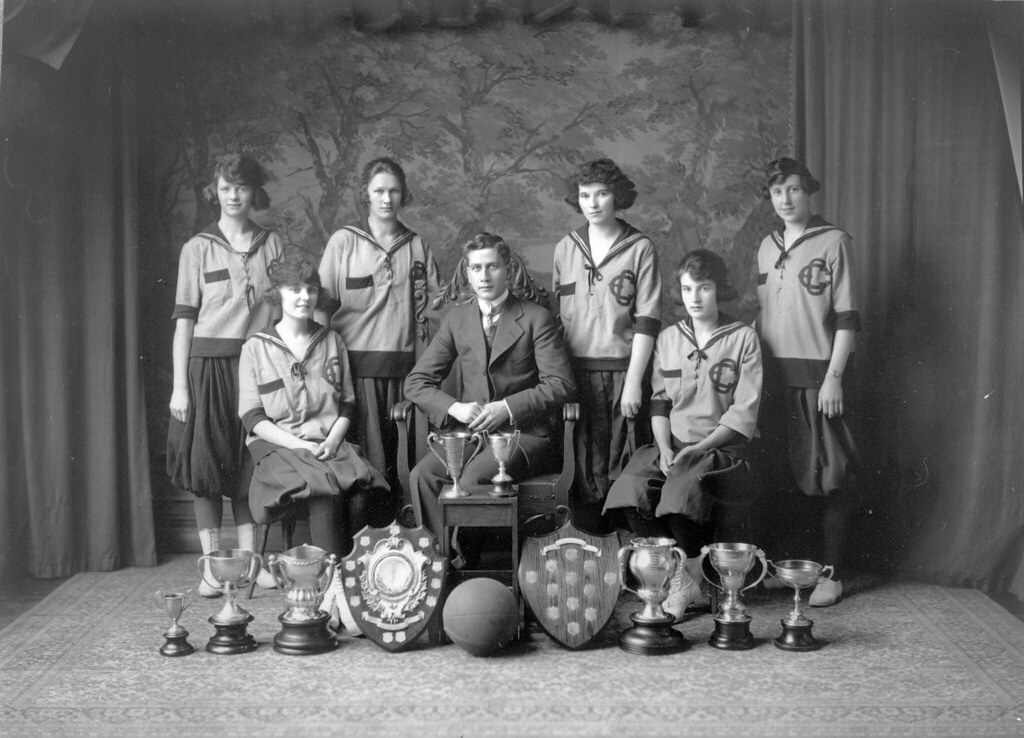

Somewhere in Edmonton’s past is a basketball team that won so consistently for so long that the record barely sounds real anymore. Between 1915 and 1940, the Edmonton Commercial Graduates, known to everyone as the Grads, lost only about 20 games. Total. Across twenty-five years.
Clerks and Typists by Day
The players weren’t full-time athletes in any sense the term carries today. They were clerks, typists, and shop girls with jobs across the city, women who worked a full day and then showed up at night to practice under coach Percy Page, who ran the program with a discipline that seems to have mattered as much as any single player’s talent. There was no scholarship pipeline, no professional contract waiting at the end of it. Just a gym, an evening slot after work, and a coach who apparently didn’t tolerate sloppiness.
Whatever Page was building, it worked. The Grads won the Underwood International Trophy seventeen years running and never once had to give it back. When the team folded in 1940, the trophy simply stayed with them, handed over for good rather than returned to whatever body had been minting it as an annual prize.
A Winning Percentage That Doesn’t Look Real
Run the numbers and the Grads finished with a winning percentage sitting around 95%. For comparison, the strongest teams in the WNBA today typically land somewhere in the 60s to 70s percent range across a season, and those are considered dominant runs. The Grads held that pace for a quarter century, not a single standout year.
Part of how they proved it was by leaving Alberta entirely. The team crossed the Atlantic three times for international competition, playing against clubs that had never seen anything like their pace or their passing. In 1928, they beat a French team 109 to 20, a scoreline that reads more like a typo than a real final until you remember whose name was on the winning side.
Olympic Games Without a Medal
The Grads also played exhibition basketball at the Olympics through the 1920s and 1930s, and won every match they played there. Women’s basketball hadn’t yet been made an official medal event, so none of those wins came with anything to hang around a neck. They won anyway, repeatedly, in front of international crowds who had no reason to expect a team from Edmonton to be the best thing on the floor.
James Naismith, the inventor of basketball itself, watched them play and later called them “the finest basketball team that ever stepped on the floor.” That’s about as strong an endorsement as the sport’s own founder could offer, and it came directly from watching a roster of working women from Edmonton dismantle opponents on two continents.
A Story Most Albertans Never Heard
Ask around Edmonton today and most people, even committed sports fans, draw a blank on the Grads. No banner hangs in most arenas, no jersey number gets retired in casual conversation the way it might for a men’s hockey club from the same era. The record sits there anyway, twenty-five years, one trophy kept for good, a winning percentage that modern professional teams would consider a fantasy.
The road trips alone tell part of the story. Crossing the Atlantic three times in an era before commercial air travel meant days at sea each way, arriving in unfamiliar cities to play teams that had never seen their style of passing, then turning around and doing it again for the next tour. There was no team charter, no per diem in the modern sense, just a group of women who’d arranged time off from their day jobs to represent Edmonton on foreign courts.
The Underwood Trophy itself became something like a running joke among the teams that kept trying to take it from them. Seventeen consecutive years is long enough that an entire generation of challengers came and went without ever managing to dislodge the Grads from the top of the standings, and by the time the trophy was formally handed over for good in 1940, nobody seriously expected any other outcome.
It’s worth picturing the actual scene for a moment, a gymnasium somewhere in Edmonton on a weeknight in the 1920s, women still in their work clothes filing in after closing up shop counters and typing pools across the city, running drills under a coach who expected exactly the standard they delivered. The Grads didn’t have anyone filming that for posterity. They just kept winning until the records themselves became the only proof left.