

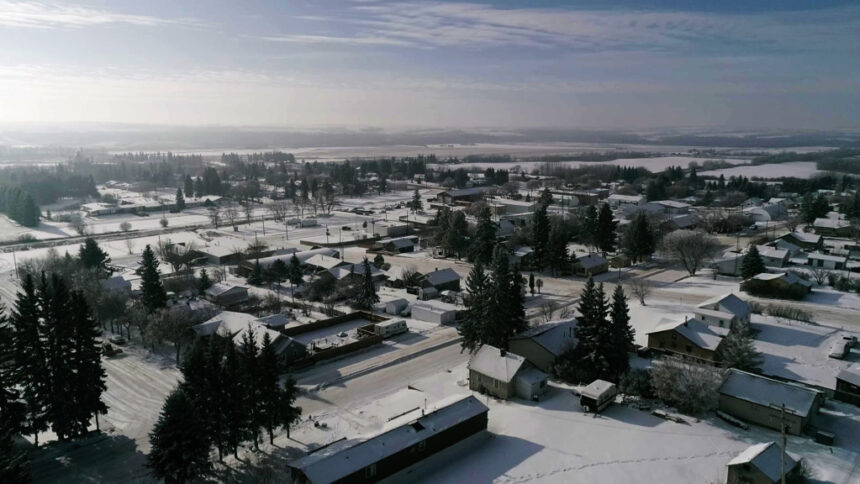
Fort de l’Isle is the kind of Alberta heritage site you can stand on without realising it. There is nothing to see. The post was small, operated for only a short window, and left no above-ground remains. It sits in farm country near Myrnam, on the North Saskatchewan, with one cairn and no signage you would notice from a county road. Yet it is one of the oldest officially recognised fur trade sites in northeastern Alberta. That gap between obscurity and historical weight is the whole story.
Fort de l’Isle in one paragraph
The North West Company established Fort de l’Isle in 1799. Source is the Alberta Register of Historic Places, ID 11562. It served as a forward post for fur collection on the middle stretch of the North Saskatchewan River, was abandoned within a relatively short window, and was given Provincial Historic Resource status on June 15, 1976. That is the entire dossier. The site is archaeological.
Why operators were already in northeastern Alberta by 1799
Eleven years after Fort Chipewyan. Five years after Fort Augustus. Four years after the first Fort Edmonton. By 1799 the North West Company had laid down a working trade network across northeastern Alberta that included multiple small satellite posts feeding the larger hubs. Fort de l’Isle is one of those satellites. The company did not wait for permission to be there. It did not wait for a treaty. It read the canoe routes, identified the trade catchment, and built a structure.
A pattern that still drives the province
The operator-first sequence is the deepest pattern in Alberta economic history.
- Fur traders arrived before colonial government.
- Cattle ranchers arrived before formal land tenure.
- Oilfield operators arrived before modern royalty frameworks.
- Tech, agtech, and clean energy operators are repeating the same sequence in different sectors right now.
The province does not get built by waiting. It gets built by people who put a post on the ground and let the rest of the system organise itself around the work that was already happening.
What sits on the site today
Empty agricultural field. Quiet, unremarkable country. No interpretive signage at the road. A heritage designation that most Albertans, including most Albertans living near Myrnam, have never heard of. The Provincial Historic Resource status means the site is legally protected from disturbance even though there is nothing visible to disturb.
A heritage buff opinion on small-site recognition
Here is the part of the heritage system that does not get enough credit. Fort de l’Isle is exactly the kind of site that would have been quietly bulldozed in most provinces. Alberta picked it up in 1976, gave it formal protection, and left it alone. That is good policy. You do not protect a heritage site because it is beautiful. You protect it because the country needs the proof of what came before. A small forgotten post near Myrnam tells you that operators have been writing the geography of this province for longer than the province has existed. That is worth a cairn.
Listed on the registry. Fort de l’Isle appears on the Canadian Register of Historic Places as Site ID 11562 and was designated a Provincial Historic Resource on June 15, 1976.
Related reading from the series. Fort Augustus and Fort Edmonton, the rival posts that founded the capital. Fort White Earth and shared palisades in hard country.