

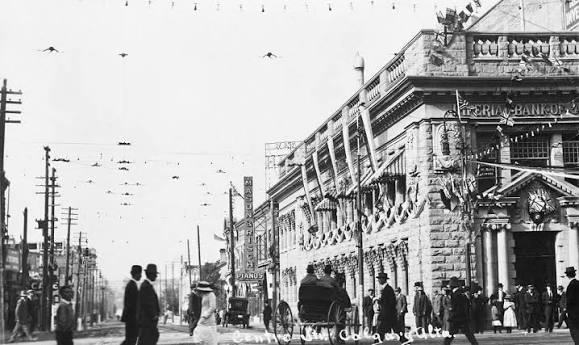
Sandstone, in a frontier town, is a statement. It is heavier than brick, harder to work with, and more expensive to install. When the Imperial Bank of Canada built its Calgary branch on Stephen Avenue in 1886 and 1887, the building announced that the railway-era town had crossed a financial threshold. A real bank was building a real branch. The architecture was the proof.
The architects who designed it
The Imperial Bank hired Toronto firm Darling and Pearson for the design. Frank Darling and John Pearson were one of the leading commercial architecture firms in Canada in the late nineteenth century. Their work included the Bank of Montreal head office, several major Toronto institutional buildings, and dozens of commercial buildings in cities across the country. The Calgary branch is one of the smaller examples of their commercial work and one of the earliest surviving.
The design is restrained classical. Two storeys of cut sandstone, deep window reveals, pilasters at the corners, a deep cornice line, and a banking hall at street level with offices above. The vault was located in the rear of the ground floor with stone walls thicker than the exterior cladding. The building was intended to look permanent, defensible, and serious.
The 1886 fire context
- The Stephen Avenue fire of November 1886 had wiped out the south side of the avenue immediately before the Imperial Bank construction.
- The city’s new fire bylaw required new commercial construction to use brick or stone.
- The Imperial Bank construction was one of the first major sandstone projects on the avenue under the new bylaw.
- The Bank’s choice of cut stone rather than brick set the architectural tone for the next twenty years of Stephen Avenue development.
What the building did for early Calgary
Banking infrastructure shaped early Calgary in ways that get underestimated. Before 1886, the local commercial economy operated mostly on cash, scrip, and informal credit. Once the Imperial Bank opened a permanent branch on Stephen Avenue, the cattle industry, the railway construction industry, and the growing commercial trade could conduct business through formal credit channels. Mortgages on town lots became routine. Cheque-based commerce replaced cash-based commerce within a few years.
The Imperial Bank merged with the Canadian Bank of Commerce in 1961 to form the modern CIBC. The 1886 Calgary building survived under different ownership and use over the following century. It was given Provincial Historic Resource designation on March 15, 1977, and is listed on the Canadian Register of Historic Places as Site ID 8081.
A heritage buff opinion on early Calgary banking
Here is the part of the Stephen Avenue story that does not get told as often. The architectural character of the avenue is what most people remember. The financial infrastructure underneath the architecture is what made the avenue commercially viable. The Imperial Bank Building is the most direct physical evidence of when Calgary got serious money.
The cattle industry was already large by 1886. The railway was already running. The settler economy was expanding. None of that could scale further without banking infrastructure. The arrival of a permanent Imperial Bank branch in cut sandstone was the moment when external capital decided Calgary was a real market worth servicing. Every later financial institution in the city traces back through that decision.
The building is still standing on Stephen Avenue today. The exterior is essentially unchanged from 1887. If you walk past it, you are looking at one of the oldest bank buildings west of Winnipeg, in continuous use through most of its history. The architecture of confidence really does get built in stone.
Related reading from the series. Stephen Avenue and how Calgary built its sandstone spine. The Hunt House and the oldest building still standing in downtown Calgary.