

There is a fence around Elk Island National Park, and it is the only one of its kind in the country. Canada has forty-some national parks and this is the single one enclosed on every side, a page-wire line running the whole boundary, put up to keep animals in rather than people out. Most Albertans drive past it on Highway 16 on the way to a lake without a second glance. Behind that fence is a bison herd that exists because of a construction schedule that ran late in 1909.
Key facts
- The Government of Canada purchased the Pablo-Allard plains bison herd from Montana in 1907 and shipped the animals by rail to the Elk Island federal preserve east of Edmonton, per Parks Canada.
- A total of 708 bison were delivered across seven shipments between 1907 and 1912, the largest being 410 head in 1907.
- Buffalo National Park was established near Wainwright on 5 June 1909 at 583 km2, and roughly 325 bison were moved there from Elk Island that year.
- Parks Canada records that approximately forty bison remained at Elk Island after that move and became the founding stock of the present plains herd.
- Parks Canada states that more than 2,500 plains and wood bison have been sent out from Elk Island to rebuild herds elsewhere, including 44 wood bison sent to Alaska on 13 April 2026.
The animals were meant to be somewhere else entirely
Elk Island was never supposed to hold bison. It had been set aside in 1906 as a federal elk preserve, 42 square kilometres of aspen and muskeg with a fence around it, and when Ottawa bought one of the last large plains bison herds on the continent in 1907 the park was chosen as a holding yard, nothing more. The permanent home was to be a much larger property near Wainwright, and the animals were to be moved south as soon as the fencing there was finished.
The fencing was not finished. Two full years passed before Buffalo National Park was established on 5 June 1909, and in that time the bison did what bison do to a fence built for elk, which is to say they tested it, repeatedly, in a bush thick enough that a man on horseback cannot see forty feet. When the roundup finally came and roughly 325 animals went south, some number of them could not be found. Parks Canada’s own chronology puts that number at approximately forty.
It is worth being careful here, because this figure gets repeated at forty to seventy and it is not settled. Parks Canada says approximately forty in one place and between thirty and fifty in another, and those two documents were written by the same organization about the same animals. The honest version is a few dozen. The precise version does not exist, and it never will, because the entire point is that nobody could count them.
The herd that was properly organized did not survive
Now follow the two herds forward, because the comparison is the whole lesson. Buffalo National Park near Wainwright had everything the other did not. Space, 583 square kilometres of it. Federal attention. A plan. By 1925 it held 8,832 bison, which was more animals than the range could carry, and between 1925 and 1928 somewhere between six and seven thousand were shipped north to Wood Buffalo. Disease followed the crowding. Funding did not follow the disease. The park closed in 1940, was formally struck off the list in 1947, and the land became a military base, which it remains.
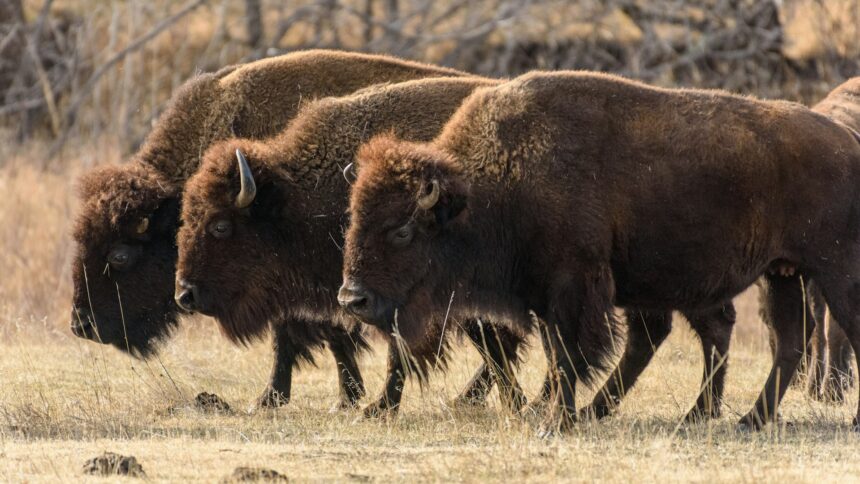
The forty that were never caught are still there, north of the highway, on the wrong side of a fence built for elk. Their descendants have been sent to Scotland in the 1920s, to Alaska, to Sakha in the Russian far east, and to conservation herds across this continent, more than 2,500 animals out the gate over a century, every one of them descended from stock that stayed behind because a crew ran late. In April of this year another forty-four wood bison went to Alaska.
What a fence is actually for
There is a habit of reading these stories as luck, and luck is in them, but it is not the useful part. The useful part is that a small, cheap, poorly suited enclosure with modest ambitions outlasted a large, well-funded, properly planned one, because the small one was never asked to hold more than it could. Buffalo National Park failed from success. Elk Island endured from being overlooked. Anybody who has watched a well-intentioned programme in this province grow past the thing it was built to do will recognize the shape of it.
The park is 194 square kilometres now, extended twice, carrying roughly 600 plains bison north of the highway and 400 wood bison south of it, kept apart by a road. Parks Canada gives no census year with those figures, which is its own small comment on how closely the country watches the place. Alberta is not short of stories like this one, and it is short of people writing them down while the records still exist, which is the same complaint that applies to the Alberta badlands and half the rail grades in the province.
Pull off at the park gate some evening in late September. The bulls will be down near the fence line, breathing steam, standing on the exact ground their great-grandparents refused to leave.