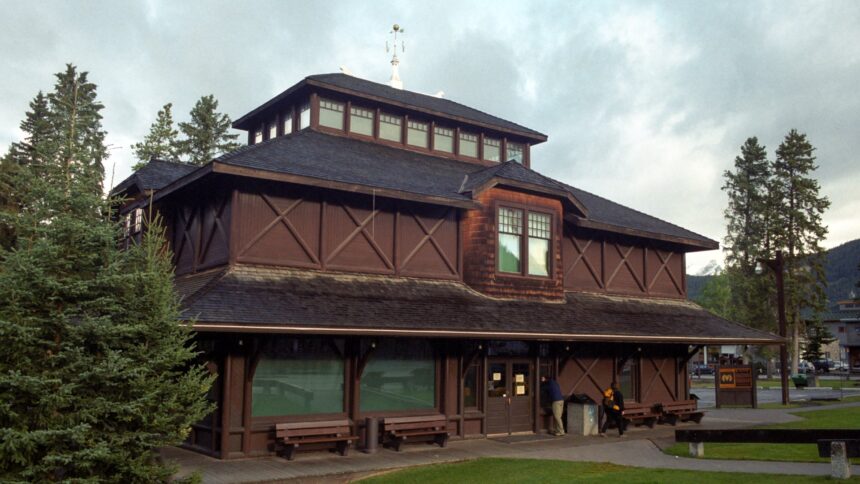
The walls of the Banff Park Museum are faced in crossed logs, and above them the roof climbs in tiers of shingle to a lantern at its peak. Parks Canada notes that the shape is described locally as a railway pagoda. Inside, a cantilevered truss system carries the second floor, which leaves the main space open, and the lantern lights both gallery levels.
The collection is older than the building. By Parks Canada‘s account the museum began in the summer of 1895 and moved into its present home in 1903, a building the federal government put up to designs by John Stocks, an engineer in the territorial public works office. The first inventory ran to 1,340 items, among them 259 birds, 814 plants, 201 mineral samples and 8 mammals. Parks Canada says display furniture arrived in quantity when Macoun’s staff took down the Canadian pavilion after the 1893 Exhibition.
Key facts
- The Banff Park Museum was designated a National Historic Site of Canada on June 17, 1985, according to Parks Canada.
- The Museum of Natural History building in Banff National Park dates to 1903 and is the oldest surviving building in the town of Banff, according to the Canadian Register of Historic Places.
- Norman Bethune Sanson served as curator of the Banff Park Museum from 1896 to 1932, according to Parks Canada.
- Parks Canada lists the museum’s early artifacts, dated from 1891 to 1932, among the features that contribute to its heritage value.
The Logs Are a Facing on a Wood Frame
The Canadian Register of Historic Places describes a two-storey wood-frame building, and Parks Canada’s history calls the walls a crossed-log veneer. Read together, the two records say the logs dress a frame and do not carry it. That is a modest fact, and it explains why the building looks like a lodge and behaves like a carpenter’s job.
Parks Canada adds that the quality of the materials and the workmanship show the building was meant as a showpiece for the park. The register calls the design rustic and Swiss in manner, and it describes the building as the first structure the federal government put up for Canada’s first national park.
Sanson Kept the Collection for 36 Years
Norman Sanson became curator in 1896 and stayed until 1932, which is 36 years. He collected actively. Harlan Smith of the National Museum in Ottawa wrote a handbook to the museum, and the two men worked together on exhibits. After Sanson retired he was not replaced, and Parks Canada says that is why what visitors see now is largely the museum as it stood around 1914.
That decision, or the lack of one, is what the designation protects. Parks Canada’s statement lists the original interior finishes, the early artifacts and the way the exhibits are arranged and presented, all of it reflecting the museum practice of 1914.
The Cases Should Stay as They Are
The designation names exhibit collections and cases, curatorial tools, display furniture and reading room furniture as things worth keeping. That is a better argument than age. What a visitor sees is a Victorian and Edwardian way of collecting, arranged to the standard of its day, and nobody should mistake it for current science. Its value is that it survived whole, and a refreshed display would erase the evidence.
Any change to the cases should have to meet the test the designation sets. Interpretation should also tell visitors plainly which parts are original and which are later, so that the display reads as a record and not as decoration. The designation calls the place a museum of museums, and it only stays one if its cases are left to say what they said in 1914.
The lantern still drops its light over the open floor, onto cases and specimens arranged for the museum’s standards of 1914.
Related from Alberta Tribune: Rossdale Power Plant Still Carries Its Building Dates In White Bands · The Banff Cave Where Canada’s National Parks Were Born · Alberta Main Streets Still Park the Way Wagons Did