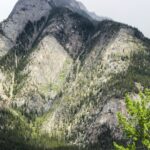
What remains of the Sulphur Mountain Cosmic Ray Station is a concrete foundation and the level platform cut into rock around it. The Canadian Register of Historic Places puts the site at 2,383 metres, close to the summit of Sulphur Mountain in Banff National Park, and says the foundation can be reached only on foot.
The station was designated a National Historic Site of Canada on June 12, 1982. The building had been dismantled the year before. The register’s own wording is that official recognition refers to the building on its footprint, which means Canada commemorated a structure that was already gone.
Key facts
- Parks Canada‘s Directory of Federal Heritage Designations records the Sulphur Mountain Cosmic Ray Station as a National Historic Site of Canada designated on June 12, 1982, at an altitude of 2,383 metres.
- The Canadian Register of Historic Places states that the National Research Council of Canada built the station between January 1956 and January 1957 as one of nine Canadian cosmic ray monitoring stations.
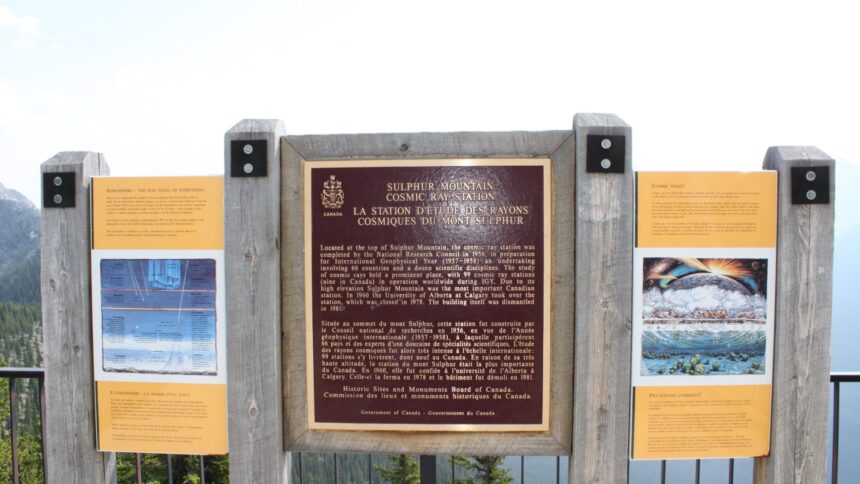
- The Historic Sites and Monuments Board plaque states that a university took over the station in 1960, that it ceased operating in 1978, and that the building was dismantled in 1981.
- The Canadian Register of Historic Places states that the University of Calgary ran the laboratory from 1960 to 1978 and that the original building was enlarged to hold upgraded monitoring equipment.
Canada Ran Nine Cosmic Ray Stations and This One Counted Most
The station belonged to the International Geophysical Year of 1957 to 1958, an undertaking the plaque puts at 66 countries and a dozen scientific disciplines. Cosmic rays had a prominent place in it, with 99 stations running across the globe and nine of them in Canada. The plaque says Sulphur Mountain was the most important Canadian station because of its elevation.
The plaque says the National Research Council completed the building in 1956, while the register gives January 1956 to January 1957 for construction, and Parks Canada’s directory gives 1956 to 1957. Those are close but not identical.
Two Universities Appear in the Record
In 1960 a university took over from the National Research Council. The plaque calls it the University of Alberta at Calgary, and the register and Parks Canada’s directory call it the University of Calgary. The station closed in 1978, and the building and equipment were removed in 1981. By the Tribune’s count the building stood for 25 years, from the start of construction in 1956 to its removal in 1981, and the designation has since lasted longer than that.
Everything inside that building, including the instruments, is gone. The register lists what the designation protects instead: the site’s altitude, the view to the adjacent Sulphur Mountain Weather Station and along the summit ridge, the remains of the switchback trail, and the legibility of the foundation and platform.
A Slab and a Plaque Cannot Explain a Neutron Monitor
Preserving a foundation is a defensible choice. A slab on a mountain top is cheaper to keep than a building, and the register is specific about which remains matter. What the designation cannot do is tell a visitor what happened here.
The plaque text, as transcribed by the Historical Marker Database, mentions no instrument. It says the Historic Sites and Monuments Board erected the marker in 1982 and places it on Sanson Peak, reached by the gondola or a 5.5-kilometre trail. Parks Canada should add a panel that shows the building as it stood, names the neutron monitor, and says in plain words what it counted and why a station at 2,383 metres counted it better than one in a valley. Without that, a national historic site is a rectangle of concrete in the rock.
The plaque carries the story in two languages on a wooden frame, and the register lists the weather station next door as part of the view the slab is meant to keep.
For another Banff-area heritage story, see the Banff railway pagoda and its 1914 museum cases.
Related from Alberta Tribune: The Banff Cave Where Canada’s National Parks Were Born · Alberta’s Heritage Day Has Been Optional Since 1990