

In the 1880s the Canadian Pacific Railway had a problem that sounds almost pleasant. It had just laid track through some of the most spectacular mountain scenery on earth, and almost nobody was riding the trains to see it. The railway’s general manager, William Cornelius Van Horne, settled on a famous solution. If the scenery cannot be exported, he is said to have remarked, the tourists will be imported. The Banff Springs Hotel was how he did it.
A hotel built to fill a railway
The plan was direct. The CPR would build grand hotels in the mountains, fill them with wealthy travellers, and let the train tickets follow. Banff was the centrepiece. The railway had good reason to choose the spot. A few years earlier, in 1883, CPR workers had stumbled onto mineral hot springs on the slopes nearby, and a resort built around mountain air and warm water was an easy sell to the comfortable classes of Montreal, Toronto, New York, and London.
Those same springs had already prompted the federal government to set aside a small protected reserve in 1885, the seed of what grew into Banff National Park, the first national park in the country. The railway and the park rose together, and the hotel sat at the centre of both.
The first Banff Springs Hotel opened in 1888. It was a five-storey wooden building designed by the American architect Bruce Price, it could hold roughly 280 guests, and it cost in the neighbourhood of $250,000.
The hotel with its back to the view
Here the history blends into legend, and the legend is too good to leave out. As the story is told, the construction crew worked from plans that were not clearly marked for direction, and the hotel went up facing the wrong way. The kitchen and the staff areas looked out on the river and the mountains. The paying guests looked out on the trees. When Van Horne arrived and saw what had happened, the accounts agree on his reaction without quite agreeing on his exact words, and few of them are printable in full. Later additions were oriented to give guests the view they had paid for. How literally true the tale is has softened with retelling, but every great hotel deserves one story told at the front desk, and this is Banff’s.
Fire, stone, and the hotel you see today
The wooden hotel did not last. In April 1926 fire destroyed it, a common fate for the great timber hotels of the era. A stone tower beside it, begun in 1911 and finished in 1914, was spared, and what was built around that tower is the hotel visitors photograph today.
A castle in the Rockies
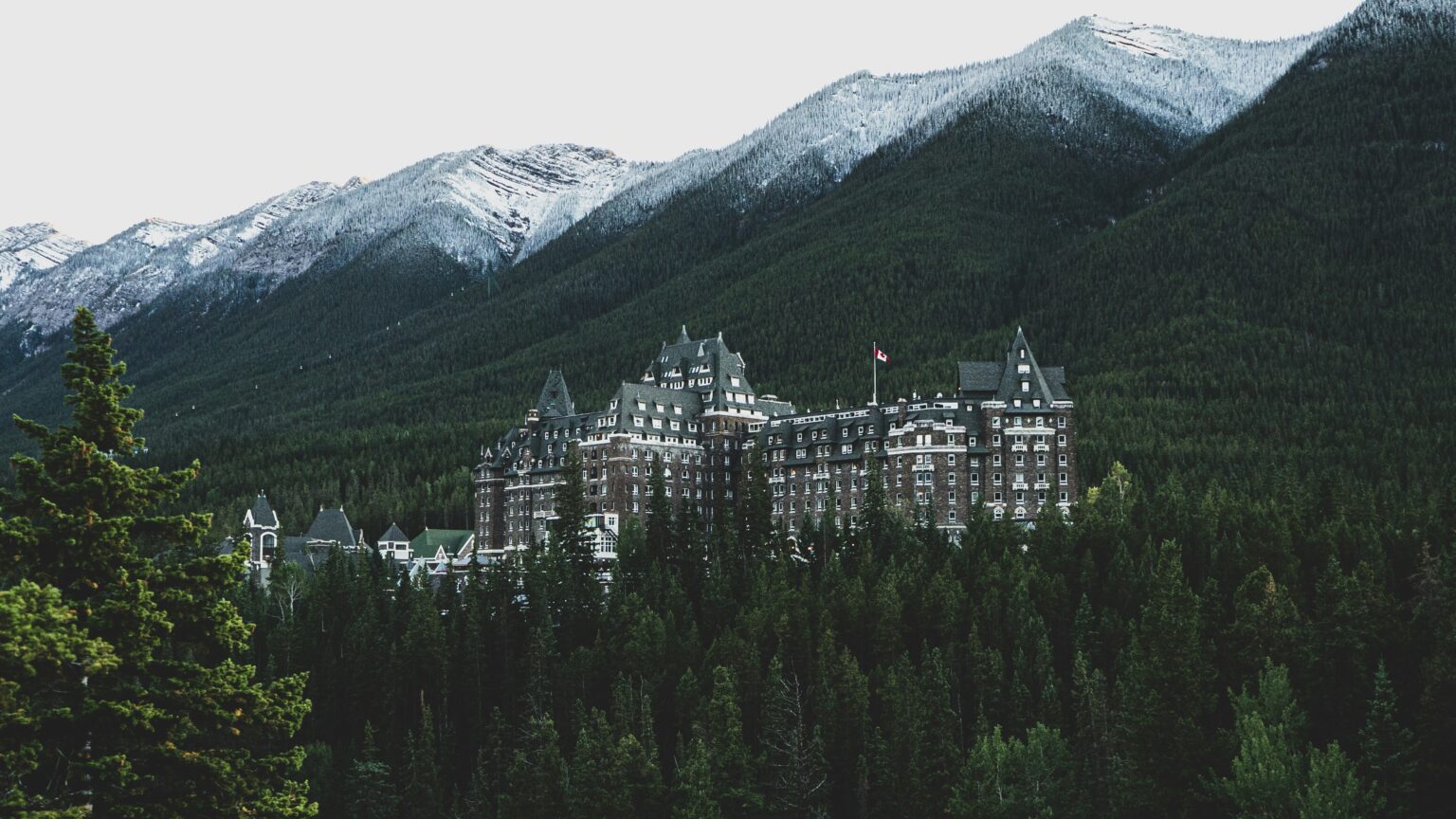
The stone hotel went up in the Scottish Baronial style, all turrets and steep roofs, which is how it earned the nickname the Castle in the Rockies. Walter Painter designed the central tower. After the fire, the main block and two wings were built in 1927 and 1928. The finished result looks less like a hotel than like a fortress that someone decided to make extremely comfortable.
The ghosts at the front desk
No hotel this old escapes a ghost story, and the Banff Springs has gathered more than most. Staff and guests have traded tales for decades of a bride on a staircase and a helpful bellman who retired long ago and never quite left. These belong firmly to folklore. They endure anyway, because a castle is expected to have a few, and because a good story checks in and never checks out.
What the gamble actually built
The Banff Springs Hotel was designated a National Historic Site of Canada in 1988, and Van Horne’s idea left a legacy larger than a plaque. The hotel helped turn a rail line through the mountains into one of the most visited landscapes in the country, and it helped make tourism a permanent Alberta industry rather than a seasonal novelty.
A great deal of what the province now takes for granted, the simple assumption that the world will travel a long way to see Alberta, traces back to a railway executive who decided that if he could not move the mountains to the tourists, he would move the tourists to the mountains. More than 135 years later, the trains and the travellers are still arriving.