

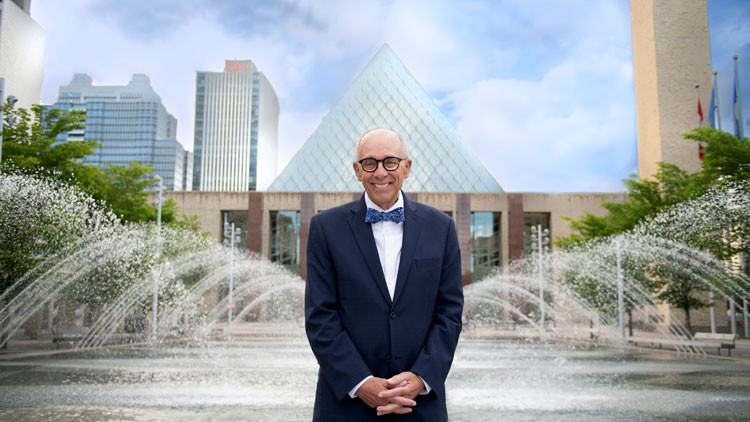
Stephen Mandel spent nine years as Edmonton’s mayor and left the city with new light rail lines, a downtown arena, and a substantially expanded cultural sector. Mandel, inducted into the Alberta Order of Excellence in 2024, built his approach to civic leadership on the same instincts he developed running a family real estate business, treating city hall as a place for building consensus and getting projects finished rather than talking about them.
From Windsor Real Estate to Edmonton City Hall
Stephen Mandel was born July 18, 1945, in Windsor, Ontario, to David and Bessie Mandel, whose family had immigrated from Romania. His father worked in business, and his mother, a former schoolteacher, taught her children to treat people fairly and with an open mind. After earning a Bachelor of Science in Business Administration from Miami University in Ohio in 1968, Mandel switched to political science at the University of Windsor, where he met Lynn Matheson, a dancer and teacher who would become his wife. He completed his master’s degree in political science in 1972 and moved to Edmonton the same year to run his father’s recreational vehicle business, later building it into the Mandel Group, a residential and commercial real estate company he led as president.
Nine Years Building Edmonton’s Infrastructure
After a recession nearly ended the family business in the early 1980s, Mandel semi-retired at 55 in 1999, then ran for Edmonton city council in 2001, winning the Ward 1 seat and building a reputation as a close reader of city budgets. In 2004, he was elected the city’s 34th mayor, and its first Jewish mayor, defeating three-term incumbent Bill Smith. Over three terms, from 2004 to 2013, Mandel’s council approved a record volume of infrastructure, including new and expanded light rail transit lines, major roadway upgrades, the city’s first new recreation centres in more than 30 years, and redevelopment of the Blatchford and Quarters neighbourhoods. He also guided the $480 million downtown arena project to completion and helped negotiate the Big City Charter with the province, giving Edmonton and Calgary more control over local decisions.
An Advocate for Arts and Social Programs
Mandel treated arts funding as core city business rather than an afterthought, establishing stable funding through the Edmonton Arts Council, creating the city’s Poet Laureate Program, and launching the annual Mayor’s Celebration of the Arts. He helped bring the new Art Gallery of Alberta downtown and supported the relocation of the Royal Alberta Museum. He also directed attention toward homelessness, safe communities and support for survivors of domestic violence, and worked with Premier Ed Stelmach on the Municipal Sustainability Initiative and the Capital Region Board. Mandel and his wife Lynn remain longtime supporters of Ballet Edmonton and the Nina Haggerty Centre for the Arts, which supports artists with developmental disabilities.
A Career That Continued Past City Hall
After choosing not to seek a fourth term as mayor in 2013, Mandel served as Alberta’s Minister of Health from 2014 to 2015 at Premier Jim Prentice’s request, winning a by-election to take the role. From 2017 to 2023 he served as the second Chancellor of Concordia University of Edmonton, and he later served on the Alberta Health Services Board. Mandel holds honorary degrees from the University of Alberta, Concordia University of Edmonton and MacEwan University, along with the Queen Elizabeth II Diamond Jubilee Medal and the Alberta Centennial Medal. He and Lynn continue to live in Edmonton, where he remains involved with arts and social organizations he helped build during his years at city hall.