

An old animal is owed patience. Anyone who has kept a horse into its late years knows how it goes: the teeth wear first, the weight comes off slower than you notice, and the day you decide about the end has to be chosen by the animal’s condition and never by the number of winters it has lived.
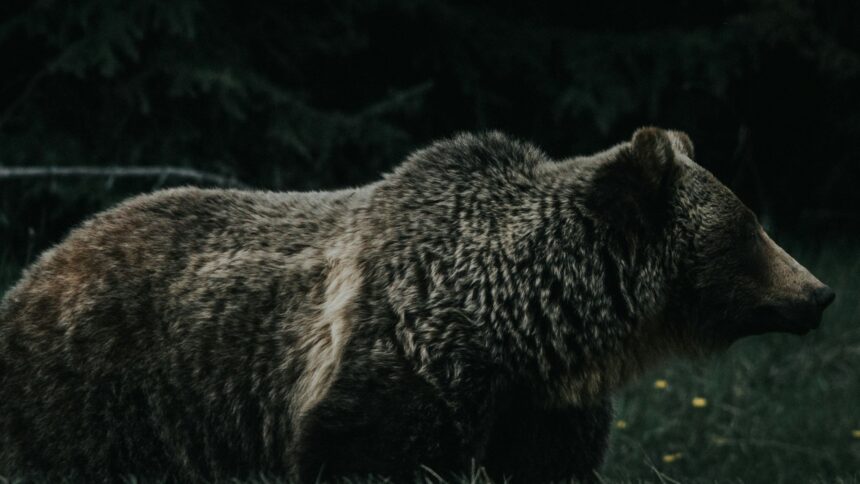
Bear 122 is old. The grizzly the Bow Valley calls The Boss is believed to be in his mid to late twenties, against a usual lifespan of twenty to twenty-five for a wild grizzly, and he has spent those years across something like 2,000 square kilometres of Banff, Yoho and Kootenay. He has survived collisions with trains. He has fathered, by the common account, a good share of the park’s cubs.
This week it became public that his end has been discussed.
Key facts
- An internal Parks Canada email dated April 2025, released through an access to information request and made public on September 23, 2026, said wildlife staff had begun preparing for a possible scenario in which Bear 122 would be lethally removed.
- Parks Canada asks visitors in Banff National Park to give bears, wolves, cougars and coyotes 100 metres of space, according to its Safely view wildlife page updated May 23, 2024.
- Parks Canada states that feeding, enticing or disturbing wildlife in a national park is illegal and can bring fines of up to $25,000, per its Banff National Park regulations page updated August 20, 2026.
- The Town of Banff and Parks Canada have run a Fruit Tree Replacement Program since 2015 that swaps bear-attracting fruit trees for native species at no cost to homeowners, according to the Town of Banff.
Parks Canada has not decided to kill Bear 122
The email is seventeen months old. It was written in April 2025 by a Parks Canada wildlife specialist, and it said the agency had begun to prepare its management and emergency teams for “the possible scenario where we need to lethally remove 122.” The reasons reported with it were his advanced age, his declining condition and a high level of habituation to people, and wildlife staff are said to have noticed worn teeth when they collared him this year.
No decision has followed. Parks Canada’s wildlife ecologist David Laskin has called lethal removal “an extraordinarily rare management tool,” and said there is a great deal the agency can do before it comes to that. That is the right order of things. Preparing for a hard day is not the same as choosing it, and an agency that plans for the worst case with an old male grizzly in a park full of visitors is doing its job.
What matters is what the plan is allowed to rest on. Age alone is not a reason.
The pressure on an old bear comes mostly from the people watching him
Habituation is a polite word for what we have done to him. A bear becomes used to people because people give him no choice, pulling onto the shoulder of the Bow Valley Parkway, stepping out of the car, walking closer for a better frame, until the jam of vehicles is part of his range as much as the avalanche slopes are. Parks Canada asks for 100 metres. It asks that nobody feed, entice or disturb a wild animal, and it attaches a fine of up to $25,000 to the rule. The Town of Banff has spent years replacing the crabapple and fruit trees that draw bears into backyards, and Canmore pays residents to take theirs out. Those rules and programs exist because the ordinary habits of people who love the mountains are, for a bear, the most dangerous thing in them.
There is a contempt hidden in the crowding, even when it looks like affection. It treats the animal as scenery, a thing that owes us a sighting, and it forgets that the bear was here first and will pay for our closeness with his life. Readers will remember the young grizzly that climbed a fence built to stop him. The old one has learned the same lesson the other way, that people are a feature of his country he cannot leave.
An old wild animal should be judged on evidence and not on age
If he turns on a person, or if his condition falls to real and visible suffering, the decision will be a hard one and it will have to be made. It should be made on the evidence of that day, written down, and explained to the public that has watched him for a quarter century. Until then the duty is ours as much as the agency’s: keep the distance, keep the food and garbage locked away, keep the fruit off the trees, and let a sighting end when he walks into the timber, without following him for one more look.
Give him the room, and let him grow old.
Frequently asked questions
How old is Bear 122, The Boss?
He is believed to be in his mid to late twenties, against a usual lifespan of twenty to twenty-five years for a wild grizzly. Wildlife staff noticed worn teeth when they collared him this year. He has survived collisions with trains and, by the common account, fathered a good share of the park’s cubs.
Is Parks Canada going to kill Bear 122?
No decision has been made. An internal email dated April 2025, released through an access to information request and made public on September 23, 2026, said wildlife staff had begun preparing for a possible scenario in which Bear 122 would be lethally removed, citing his advanced age, declining condition and a high level of habituation to people. Parks Canada wildlife ecologist David Laskin has called lethal removal “an extraordinarily rare management tool,” and said there is a great deal the agency can do before it comes to that.
How far must visitors stay from bears in Banff National Park?
Parks Canada asks visitors to give bears, wolves, cougars and coyotes 100 metres of space. Feeding, enticing or disturbing wildlife in a national park is illegal and can bring fines of up to $25,000.
How large is The Boss’s territory?
He has spent his years across something like 2,000 square kilometres of Banff, Yoho and Kootenay. The Bow Valley calls him The Boss because he is the dominant grizzly there.
What is Banff’s Fruit Tree Replacement Program?
The Town of Banff and Parks Canada have run it since 2015. It swaps bear-attracting fruit trees for native species at no cost to homeowners, cutting one more reason for bears to come into town.