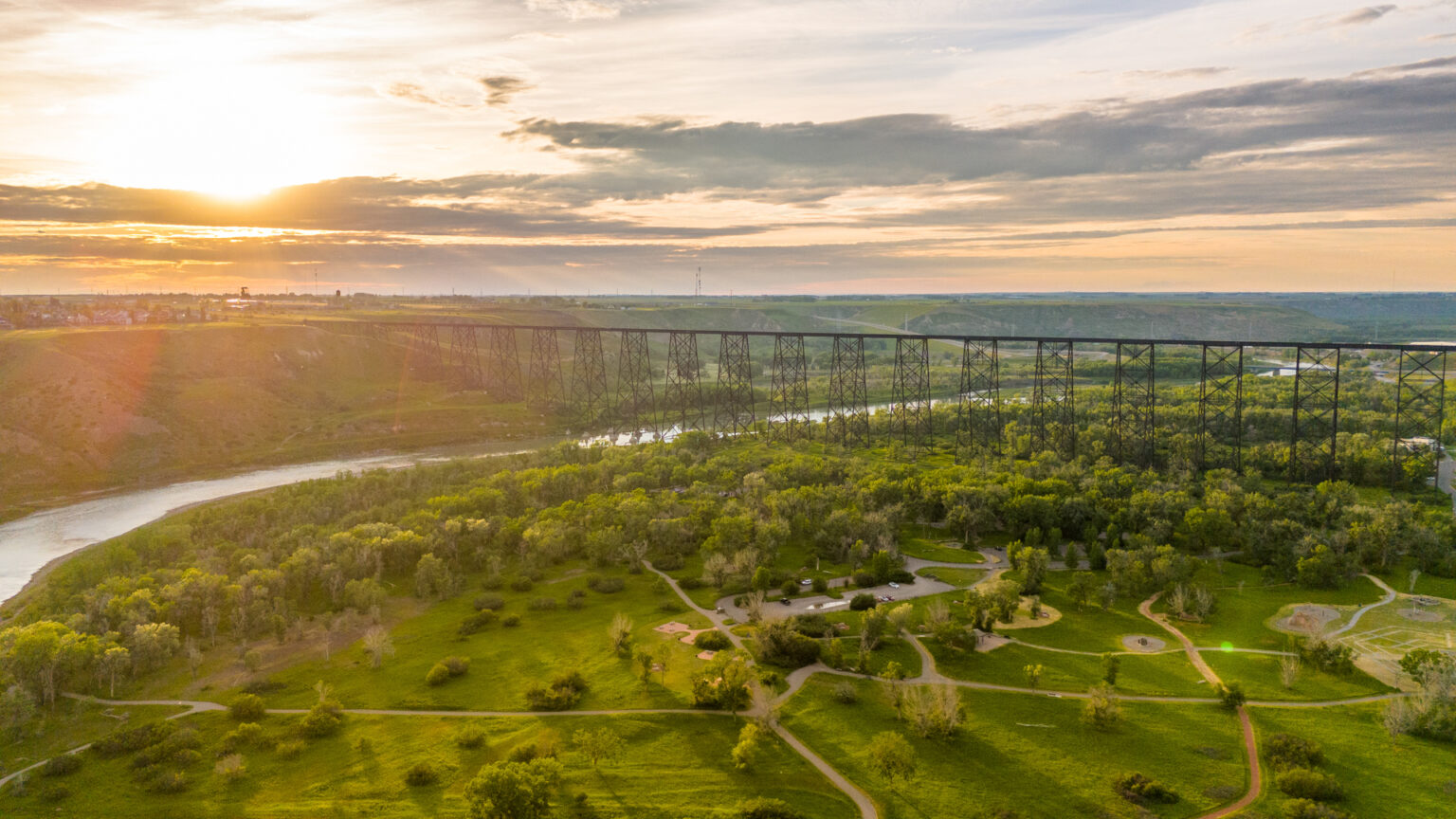

In 1907 the Canadian Pacific Railway began a steel bridge across the Oldman River valley at Lethbridge; by 1909 it was carrying trains. Parks Canada puts the finished viaduct at more than 1,600 metres long and 95 metres high, and in 2005 named its construction a national historic event as the longest and highest of its kind in Canada.
The railway wanted longer trains over the Crowsnest Pass Route, and a straighter, higher crossing was the way to get them. Nobody in 1907 was building a monument.
Key facts
- The Canadian Pacific Railway built the Lethbridge Viaduct across the Oldman River valley from 1907 to 1909, according to Parks Canada.
- Parks Canada describes the viaduct as more than 1,600 metres long and 95 metres high, and designated its construction a national historic event on August 3, 2005.
- The Canadian Society for Civil Engineering records 33 braced, riveted steel towers carrying 44 plate girder spans of 20.4 metres, 22 spans of 30.1 metres and one truss span of 50.9 metres.
- Parks Canada states that the viaduct greatly increased the capacity of the Crowsnest Pass Route by allowing longer trains and shorter travel times.
The viaduct was built for freight and it kept working
Parks Canada says the crossing greatly increased the capacity of the Crowsnest Pass Route by allowing longer trains and shorter running times. That was the whole brief. The steel came from the Canadian Bridge Company of Walkerville, Ontario, according to the Canadian Society for Civil Engineering, and went up in a valley Parks Canada describes as swept by violent winds, with dry soils and extreme temperatures.
One detail shows how the engineers read the site. The track runs between the main girders instead of on top of them, a layout the Canadian Society for Civil Engineering says was chosen so the steel shields the trains from the wind. Canadian Pacific Kansas City still maintains the structure and still runs trains across it.
A two-year build is a fair measuring stick for public projects today
Set those dates beside any large Alberta project now and the gap is plain, but the comparison has to be fair. A railway answering to one board and one purpose did not run the consultation, review and appeal steps a public project must, and some of those steps exist for sound reasons.
Granting that, two years from first work to first train is still the distance the argument rests on. Every crossing, pipeline and transmission line proposed today should be able to say which of the steps added since 1909 changed the outcome and which only added time.
A bridge built in two years has been carrying trains for 117 years.
Updated October 7, 2026. Removed unsourced claims about household electricity and income tax in 1909 and a scale claim the sources do not support.
Related from Alberta Tribune: Champion Alberta Hauled Every Building To The Railway In 1910 · The Alberta Coal Town Named After the Company That Built It · The Wagon Route That Fed Calgary Before the Railway Came