
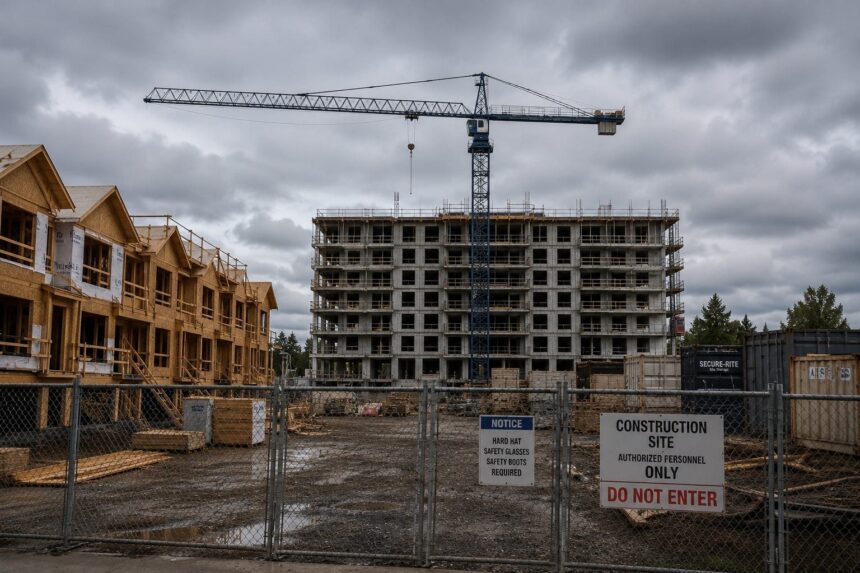
The federal government is now discussing measures that many are describing as a condo bailout. The latest proposal would see governments purchase thousands of unsold condominium units and convert them into affordable housing while also providing financial support intended to keep housing projects moving. Supporters see it as a practical way to increase housing supply and prevent projects from stalling. Critics see it as government stepping in to support a market that has become increasingly difficult to sustain.
I see it differently.
Before Canadians debate whether governments should bail out the condo market, they should ask a much simpler question: why is a bailout needed in the first place?
The answer is that governments at every level have spent years making housing more expensive, more complicated, and more difficult to build. Municipalities have steadily increased development charges and fees. In many Canadian municipalities, development approvals that should take months can now take years. In some cases, projects can spend five to seven years navigating approvals before a shovel ever enters the ground. That delay creates uncertainty, drives away investment, and adds significant costs long before a home is built. While each individual requirement may appear reasonable on its own, together they have created a system that has become increasingly disconnected from the realities of building homes.
The result is that government-imposed costs now account for a significant portion of the price of a new home. In many Canadian cities, those costs represent a substantial share of the final purchase price and, in some cases, can approach 30 percent. When projects spend years waiting for approvals, financing costs continue to accumulate while builders wait for permission to proceed. Those costs do not disappear. They are ultimately passed on to the homebuyer.
What many Canadians don’t realize is that much of the infrastructure required for new communities, including roads, sidewalks, stormwater systems, water lines, parks, and other services, is front-funded by developers long before homes are sold. Those costs don’t disappear either. They become part of the final price paid by homebuyers, making affordability increasingly difficult to achieve.
At the same time, the federal government continues to push increasingly ambitious building requirements through its proposed Net Zero building code agenda. While these standards have not yet been adopted across the country, Ottawa continues to advocate for their implementation. The stated goal is reducing emissions and improving energy efficiency. In my view, these requirements make homes more expensive without delivering meaningful financial benefits to homeowners. Canadians are already struggling to qualify for mortgages and manage rising living costs. Adding thousands or even tens of thousands of dollars to the price of a new home in pursuit of policy objectives may look good in a government announcement, but it does little to improve affordability for the families trying to enter the housing market.
To be clear, government policy is not the only factor affecting housing affordability. Interest rates, labour shortages, material costs, population growth, and economic uncertainty have all played a role. However, government policy has unquestionably contributed to the affordability and supply challenges we face today, and it is one of the few factors governments have direct control over.
None of this should be surprising.
For years, builders, developers, economists, and housing advocates have warned that escalating fees, excessive bureaucracy, lengthy approval timelines, and growing regulatory burdens would eventually reduce housing supply. Those warnings were largely ignored. Today, many projects that would have been financially viable a decade ago simply no longer work. Developers are not cancelling projects because they suddenly forgot how to build housing. They are cancelling projects because governments have steadily increased the cost and risk associated with construction.
Now, after helping create these conditions, governments are proposing that taxpayers fund solutions to the very problems government policy contributed to.
That is where I have a problem.
Taxpayers have already paid once through higher housing costs driven by taxes, fees, regulations, delays, and compliance requirements. Now they are being asked to pay a second time through government programs designed to stabilize a housing market that government intervention helped distort in the first place.
I have never been a supporter of bailouts, regardless of who benefits. I did not support corporate welfare during financial crises, and I do not support governments using taxpayer dollars to subsidize private-sector outcomes today. My position is no different when it comes to municipalities using public funds to subsidize downtown office conversions. Good public policy should create fair conditions for everyone, not selectively transfer risk from private interests to taxpayers when government policies fail to deliver the intended results.
What makes this particularly frustrating is that the solution is neither complicated nor mysterious. If governments genuinely want to improve housing affordability and increase supply, they should focus on removing the obstacles they have spent years creating. Reduce approval timelines. Eliminate unnecessary red tape. Lower development charges. Simplify regulations. Focus on outcomes instead of process.
Housing affordability cannot be regulated into existence. Every new fee, every new delay, and every new requirement ultimately gets paid for by the people trying to buy a home. Governments often speak about affordability as though it can be achieved through announcements, targets, and strategies. In reality, affordability improves when homes can be built efficiently, predictably, and at a reasonable cost.
The irony of today’s condo bailout discussion is that it highlights a much larger problem. Governments are now considering spending taxpayer dollars to address challenges that many of their own policies helped create. Instead of asking Canadians to pay twice, first through higher housing costs and then through bailout programs, they should be asking themselves a different question.
Canadians don’t need another housing program. They don’t need another subsidy, another strategy, or another taxpayer-funded solution to a problem government helped create. They need governments willing to remove the barriers that have made housing harder and more expensive to build in the first place.
Housing affordability will not be restored through bailouts. It will be restored when governments stop standing in the way of the people and companies trying to build the homes Canadians need.