


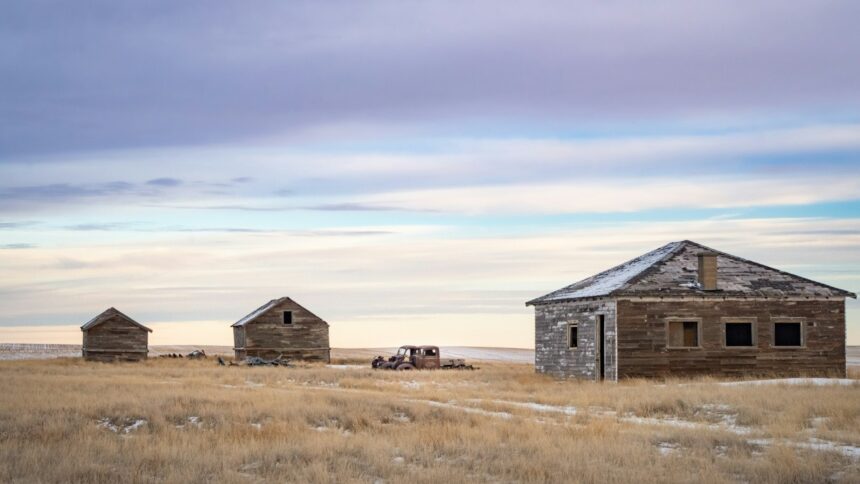
Land outlasts every family that argues over it. On an old Alberta farm the argument usually happens at the kitchen table, the long one built for more people than ever lived in the house, and for years it happens mostly in what nobody at that table is willing to say.
Statistics Canada counted how often it ends with nothing on paper. Of the 41,505 farms it found in Alberta in 2021, 14.0% reported a written succession plan. By our arithmetic, roughly 35,700 did not. On those places, the question of who takes over the land, and the debt that sits against it, was still being settled the old way, by silence and by whoever outlives whom.
Silence is a plan. It is a poor one.
Key facts
- Statistics Canada’s 2021 Census of Agriculture counted 41,505 farms in Alberta, which was 21.9% of all farms in Canada.
- According to Statistics Canada’s Alberta agriculture profile, published June 15, 2022, 14.0% of Alberta farms reported a succession plan in 2021, up from 8.5% in 2016, and only Saskatchewan posted a higher rate.
- Nationally, the share of farms reporting a succession plan rose from 8.4% in 2016 to 12.0% in 2021, Statistics Canada reported on May 11, 2022.
- Pantaleon Candidus, a theologian born Pantaleon Weiss at Ybbs an der Donau in Austria in 1540, published the fable of the lion, the bear and the fox as number 60 of his 150 Latin verse fables, Centum et quinquaginta fabulae, in 1604.
Why a fable from 1604 still fits an Alberta farm family
The story is older than the province by a long way. A lion and a bear come upon a young deer at the same moment. Neither will give it up, so they fight over the carcass until both of them drop from exhaustion, and a fox that has been watching the whole contest walks in, takes the deer and leaves. Nothing in the fable punishes the fox. It is simply the one animal that stayed out of the fight.
Pantaleon Candidus put the tale into Latin verse in 1604 and closed it with a moral a farmer would grasp faster than a scholar. Saepe alter alterius fruitur laboribus. Often one man enjoys what another man worked for. The same year, King James commissioned the translation that would give English readers a plainer line from the Gospel of John. One soweth, and another reapeth.
Fables are evidence of a kind. A story survives four hundred years only because people keep acting it out, generation after generation, and nobody bothers to retell a warning that has stopped coming true. This one is still coming true on quarter sections from Foremost to Fort Vermilion.
What the old harvest table says about who ends up with the farm
The prairie farm was built on a shared table. When threshing crews worked the fields, they were fed where they worked, and the women of the farm, often with girls helping, cooked for them on wood stoves and served them at long tables or through a window. In 1917 somebody photographed Tom Whittle and his harvest crew at lunch near Foremost. The print was kept in the Glenbow archive in Calgary.
Look at what that arrangement taught. The people who ate were the people who had worked, and the food came from the same ground the work had gone into. Nobody who skipped the harvest got a plate at noon. It was a moral order before it was a meal.
The breakup of a farm family runs that order backward, and it usually begins with a son who stayed to farm. His sister moved to Calgary years ago, and she and the others expect an equal share of something only one of them has worked. A Sunday dinner gets missed, then a Christmas. The parents mean to settle it and do not, because settling it means saying out loud that fair and equal are different words. Then one of them dies, and the land that fed a threshing crew in 1917 goes to a sale because no one can buy out anyone else, and the buyer is a stranger who never sat at that table and never had to.
Some of the people who have never fed a crew call the result consolidation, as if the land had simply rearranged itself into larger pieces. That word carries a certain contempt. It treats a family that came apart as a line in a trend, a problem for somebody else to tidy, when it was a failure of nerve inside a kitchen that the family could have fixed with a pen. Anyone who watched a big crop still sitting outside the bin this fall knows how much a single farm family carries at harvest. Multiply that by a generation and you have the weight nobody wants to put on paper.
The number is moving the right way, and that deserves to be said without grudging. In 2016, 8.5% of Alberta farms reported a written plan. By 2021 it was 14.0%, and only Saskatchewan did better. More families are sitting down with an accountant and a lawyer before the funeral rather than after it. They are deciding who farms, who is paid out and on what schedule, and they are writing it down while the people who built the place are still alive to say what they meant. That is the harder labour, harder than harvest, because it asks a parent to tell one child that the land goes to another and to explain why, and it asks the child who leaves to accept money in place of dirt. Most of the other 86% have simply not done it yet. They still believe there will be time, the way every lion and every bear in every version of that fable believed there would be one more round.
Whatever a family will not write down, the fox eats.