


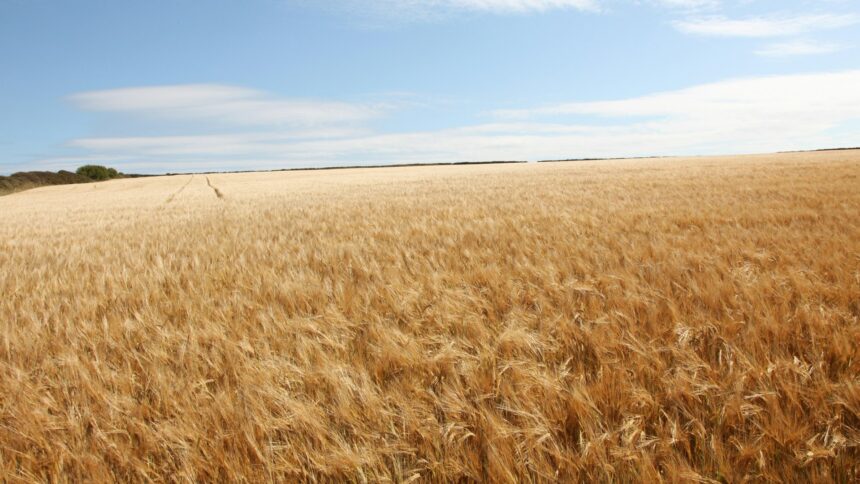
On 3 December 2019, Alberta Agriculture recorded 89.7% of the provincial crop in the bin and roughly a tenth of it still under snow. In the Peace region that year, about 32% of the acres never came off at all. That was a poor crop caught by a poor fall. What is sitting out there this September is the reverse, and the reverse costs more. The crop report covering conditions to 1 September 2026 puts provincial harvest at 10%, against a five-year average of 23% for the same point on the calendar. The crop underneath that 10% is a good one, which is exactly what makes the number expensive.
The yield estimate and the harvest figure come from different editions of the same report, six days apart in publication, and the distance between them is where this year gets decided.
Key facts
- Alberta Agriculture and Irrigation reported provincial harvest at 10% complete in the Alberta Crop Report covering conditions to 1 September 2026, against a five-year average of 23% and a ten-year average of 17%.
- The Alberta Crop Report to 1 September 2026 recorded dry peas at 53% harvested, barley at 20% and spring wheat at 6% province wide.
- The previous edition from Alberta Agriculture and Irrigation, covering conditions to 25 August 2026, estimated provincial dryland yields for the major crops 20% higher than the five-year average and 9% higher than the ten-year average.
- The Alberta Crop Report to 1 September 2026 rated pasture 39% good to excellent against a five-year average of 29%, and tame hay 47% good to excellent against a five-year average of 31%.
- Alberta Agriculture and Food’s freezing date tables in Agdex 075-2, revised January 1998, give Grande Prairie Airport an average first fall frost date of 14 September and Medicine Hat Airport an average of 23 September.
Why the yield figure and the harvest figure come from two different reports
Alberta Agriculture and Irrigation publishes its crop report roughly six days after the conditions date it covers, so a reader is always looking at a photograph rather than a window. The edition covering 25 August 2026 carried the yield work. It put provincial dryland yields for the major crops 20% better than the five-year books and 9% better than the ten-year. The South region landed close to 60% over the five-year benchmark it sets for itself, and the North West came in 1% under. The edition covering 1 September 2026 carried harvest progress and left the yield estimates where they were. Setting the two beside each other is fair. Presenting them as one reading is not, because the earlier one was taken while nearly all of that grain was still upright.
There is a plain banking word for a number like the 25 August yield estimate. It is a receivable. It counts, it is real, and it is not money until it clears. Standing grain is a receivable; grain in a bin is cash. On 1 September 2026 Alberta had converted 10% of it.
What the Peace region stands to lose against a frost date written down in 1998
The regional split in the 1 September 2026 report runs the wrong direction. The South, which gets the longest fall in the province, has 27% of its acres off. Central is at 12%. The Peace sits at 3%, the North West at 1%. Those last two have the least time and have done the least work, which is no comment on anybody’s operation; it is a description of rain.
Alberta Agriculture and Food published freezing date tables under Agdex 075-2, revised in January 1998, putting the average first fall frost at Grande Prairie Airport on 14 September and at Medicine Hat Airport on 23 September. Nine days separate them. By our own arithmetic, when that crop report went out on 8 September the Peace was 3% harvested with six days left to its long-run average frost date, while the South was 27% harvested with fifteen days left to its own. Those tables are twenty-eight years old and autumn has moved later since they were printed. They still describe the shape of the thing, which is that the slowest harvest in the province is running inside the province’s shortest autumn.
The feed side has already started to move. Pasture rated good to excellent fell 8 points in a single week to 39%, and tame hay fell 5 points to 47%, both measured to 1 September 2026. Each still sits above its five-year mark, 29% for pasture and 31% for tame hay. That is a better position than most Septembers and a worse one than seven days earlier.
What 2016 and 2019 already told Alberta about crop left standing
Alberta has run this experiment twice inside ten years and written down the answer both times. After the 2016 season, provincial reporting still counted about 460,000 acres of that crop unharvested as late as 16 May 2017, or roughly 186,000 hectares by our own conversion, after a winter spent outdoors. Three years later, on 3 December 2019, the province was 89.7% finished and conceding that about a tenth of the crop would wait for spring.
Neither of those years was short of grain in September. Both were short of days. The loss in a fall like that rarely arrives as a lost crop. It arrives as a downgrade, as drying charges, as tough grain moved at a discount because it had to move at all. Volume survives. Quality and price do not, and those two are the only reason a 20% yield estimate was worth anything in the first place.
What bothers me is the speed of the forgetting. Every one of these autumns produces the same discussion about drying capacity and on-farm storage, and every one of them closes the moment the snow goes and the next crop goes in clean. Short memory is the most expensive input this province buys, and it has never once appeared on an invoice.
A good crop is only a good year once it is in the bin; until then it is weather with a number attached.