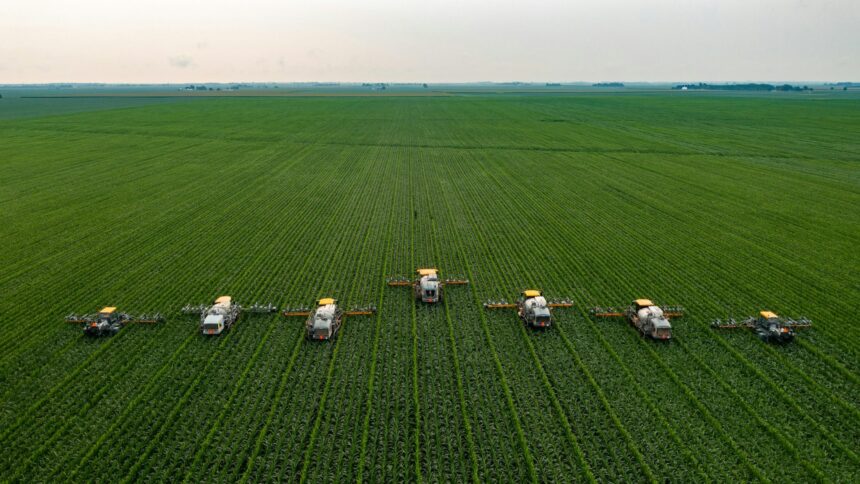
A farm is the least sentimental business in the province. Between the 1941 and 1951 censuses, the count of tractors on Canadian farms went from 159,752 to 399,683, according to Statistics Canada’s century of tractor data. Nobody held a vigil for the horse. The machine did more work per hour and per dollar, and that settled it.
Artificial intelligence now meets the same habit, and the early numbers read like reluctance. In Statistics Canada’s second-quarter 2026 analysis of AI use by businesses, agriculture, forestry, fishing and hunting had the lowest rate of any industry, at 4.5%, against 19.2% for all Canadian businesses. The survey ran from April 1 to May 6, 2026, and asked about the previous 12 months. Read that figure as a verdict on farmers and it says they are slow. Read it against the record and it says they have not yet been shown a reason.
Key facts
- Statistics Canada reported that 4.5% of businesses in agriculture, forestry, fishing and hunting used artificial intelligence in the 12 months before its April 1 to May 6, 2026 survey, the lowest of any industry, against 19.2% across all Canadian businesses (analysis released June 11, 2026).
- Statistics Canada’s Census of Agriculture counted 159,752 tractors on Canadian farms in 1941 and 399,683 in 1951 (published May 31, 2023).
- In 2021, 90% of Alberta field crop farms used GPS, and 96% of those farms used it for tracking or guidance such as auto-steer, per Statistics Canada (published April 11, 2023).
- In 2021, 34% of Alberta field crop farms that used GPS generated yield maps from a combine yield monitor, up 8% from 2017, per Statistics Canada.
- Among Canadian field crop farms using GPS, the share varying fertilizer rates fell from 28% in 2017 to 23% in 2021, per Statistics Canada.
Farmers have never needed convincing, only proof
The adoption record is no story of resistance. By 2021, 90% of Alberta field crop farms used GPS, and 96% of the farms using it put it to work on tracking or guidance, the auto-steer that holds a line across a quarter section. Yield maps, which come off a combine yield monitor and need someone willing to read the output, reached 34% of Alberta field crop farms using GPS, up 8% from 2017, in Statistics Canada’s look at high-tech farm management.
The same data shows farmers walking away from things. Variable-rate fertilizer application slipped from 28% of GPS-equipped field crop farms across Canada in 2017 to 23% in 2021. The release does not say why, and a reason would be a guess. The direction is plain enough. Where a tool earned its keep, use climbed. Where it did not, operators dropped it.
A tool that sells itself in a demo and loses to a spreadsheet in October gets shelved. That is the filter AI has to pass, and it is a better one than any survey headline.
The 4.5% measures a narrower thing than the farm does
The Tribune has already looked at why the survey undercounts. A column on the rural and urban AI adoption gap set the 9.9% rural rate against 21.0% for urban businesses and argued that machine learning already runs inside guidance systems, calving cameras and marketing services that a farmer never labels as AI. That holds. It also leaves the harder question standing, which is what a deliberately chosen AI tool would have to do to earn a place on the operation.
A model sees the field and the operator knows the land
Software that studies crop images and soil moisture readings and spots patterns can save a producer hours in a wet June, and that deserves to be said plainly. The best case for AI in agriculture is a sharper second opinion on ground too big to walk every week. Farmers already pay for second opinions from agronomists, dealers and neighbours, and a cheaper one with a good record will find buyers. But a quarter section has a wet corner and a thin hilltop, and the person who farms it knows which is which without a sensor, because that knowledge was bought with seasons. A model sees pixels and probabilities.
The software never signs the note at the bank.
The tractor’s history has a human edge, too. Dan Specht spent 61 years with John Deere and sent more than 500 toy tractors from his Strathmore basement to auction in 2023, as the Tribune reported in its story on the Specht collection. Each toy copies a machine that first had to beat the one before it.
Four things AI has to prove before it gets a season
The test is old, and a farmer can apply it without a consultant in the yard.
- It has to pay back inside a crop year or two, measured against the price of the inputs it says it will save.
- It has to work on the connection the farm actually has, and rural upload speeds still trail the national median, as the Tribune showed in its look at rural Alberta internet speeds.
- It has to hand the decision back to the operator with its reasoning visible.
- It has to leave the data about the farm belonging to the farm, the ownership point behind the Tribune’s column on the 1947 Leduc lesson for AI.
None of that needs a mandate or a subsidy. Tools that meet it will spread the way guidance did, one cab at a time, until the 4.5% looks like a number from another decade.
A farmer owes the land a decision made with open eyes. Whatever the tool, that part has never been for sale.