

A chuckwagon at rest is a plain thing, a wooden box on four wheels with a canvas cover stretched over hoops, built to carry flour, coffee and a stove across open range. Park one beside the track at Stampede Park in the week after the grounds empty, and it looks like what it was before anyone thought to race it, a kitchen that followed the herd.
Somebody had to look at that kitchen and see a spectacle. That somebody was Guy Weadick, a trick roper born in Rochester, New York, in 1885, who came to Calgary in 1912 with an idea for a frontier show. The loudest ten days in the city’s calendar began with his pitch, and with four ranching and business men willing to put their money behind a stranger.
Key facts
- Guy Weadick organized the first Calgary Stampede from September 2 to 7, 1912, with $20,000 in prize money, according to the Calgary Stampede’s historical record.
- Four Calgary backers, Pat Burns, George Lane, A. E. Cross and A. J. McLean, guaranteed $100,000 to fund the 1912 Stampede, according to the Calgary Stampede’s historical record.
- The Calgary Industrial Exhibition merged with the Stampede in 1923 to form the Calgary Exhibition and Stampede, and chuckwagon racing was introduced that year.
- The Calgary Exhibition and Stampede board dismissed Guy Weadick in 1932, and a court later awarded him $2,750 plus legal costs on a claim of $100,000.
How a travelling showman sold Calgary its biggest party
The first Stampede did not happen in July. It ran six days in September 1912, when the harvest was coming in and the evenings were already turning cool, and it drew riders from Western Canada, the United States and Mexico. The prize money was the lure. Twenty thousand dollars was far more than other rodeos of the day were offering, and it brought the best hands on the continent to a young city that had never hosted anything close to it.
The backers, remembered now as the Big Four, were practical men. George Lane ran the Bar U. Pat Burns had built a meat and ranching business out of hard miles. A. E. Cross, whose house still stands in Inglewood, knew the value of a crowd. They put a $100,000 guarantee behind a performer with a rope and a horse, and the crowds came.
Weadick went away after 1912, and the idea waited, the way a road waits for someone to use it again. He returned in 1919 for a Victory Stampede honouring soldiers home from the war. By 1923 he and E. L. Richardson had joined the rodeo to the Calgary Industrial Exhibition, and the combined event became an annual fixture. That same summer Weadick put the chuckwagons on the track. The kitchen that followed the herd became the race Calgary still argues about every July.
Why the man who built the Stampede was let go in 1932
The Depression reached the exhibition board as it reached every farm and shop in the province. Money was short, the show lost ground, and in 1932 the board dismissed the man whose idea it was. Weadick sued for $100,000. The court awarded him $2,750 and his legal costs, a small sum set against the size of what he had built.
He stayed away for twenty years. It is easy to read that as a feud and move on, but the longer view is kinder to everyone. Institutions forget their founders in lean seasons. The test comes when the weather turns, and in 1952 Calgary passed it. Weadick rode in the Stampede parade that year as an honoured guest, back at the front of the event he had started four decades earlier. He died in December 1953.
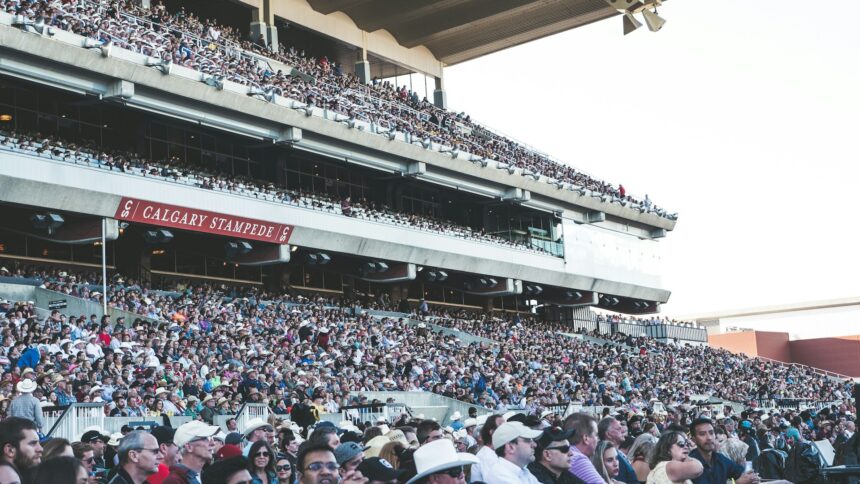
The Stampede has carried his name forward since, through the Guy Weadick Award it established in 1969. The event he pitched as a single week in September drew a record 1,477,953 visits in 2024, and many of those visitors could not tell you who first imagined it.
What one showman says about the province that kept him
Alberta has always been built in part by people who were not born here and chose to stay. Weadick came as a performer from upstate New York and left a city its signature summer. None of the Big Four was born in what became Alberta either, and each of them put his money into ground he had picked. The pattern repeats in every generation, in every town with a founder whose name is on a street sign and nowhere else.
A heritage worth keeping is mostly made of names like his, names that sit just under the surface of something everyone knows. The grandstand fills, the horn sounds, and four wagons break from the barrels in a cloud of dust, each one a descendant of the plain wooden box that once rolled slowly across the grass behind a herd.