


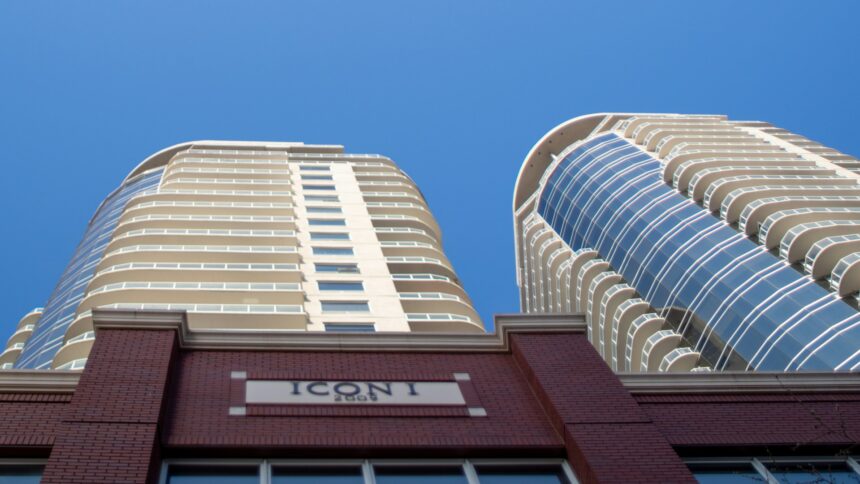
Saturday open house in a Calgary condo tower. Two young buyers at the kitchen island. They read the feature sheet twice.
Because the number on it starts with a two.
The benchmark price for an apartment condo in the City of Calgary was $299,000 in June 2026. That is the Calgary Real Estate Board’s own figure. A first home under $300,000, in a city of well over a million people, in the middle of a national housing crisis.
Say it slow. It still counts.
Key facts
- The Calgary Real Estate Board reported a June 2026 benchmark price of $299,000 for apartment condominiums in the City of Calgary, down 8.95% from $328,400 in June 2025.
- The Calgary Real Estate Board put the June 2026 total residential benchmark price for the city at $572,500, down about 2% from $584,600 a year earlier.
- The Canadian Real Estate Association forecast on July 15, 2026 that the national average home price will be $686,710 in 2026, up 1.1% from 2025.
- In the same July 15, 2026 update, its second forecast revision of the year, the association forecast 463,336 MLS sales nationally in 2026, down 1.4% from 2025.
Why Calgary condo prices went down while the country waited
No luck in it. No miracle either.
The board’s June report says it plain. High-density supply is pushing on apartment prices. Builders put up towers. The towers filled the listings. Buyers got choices.
That is how a price comes down. More units than buyers. No program required, and no ribbon.
Now the math. The national average price on the association’s forecast is $686,710. By our arithmetic, the Calgary condo benchmark is about 44% of that. The federal minimum down payment on a $299,000 home is 5%, which comes to $14,950. That is a used pickup. That is a number a young electrician can save.
Condos are the headline. The rest of the market tells the same story. The whole-city benchmark, every home type blended together, was $572,500 in June. Down about 2% in a year. By our arithmetic, that is more than $114,000 under the national average the association expects for 2026. A family that needs a yard still has a shot here. In plenty of big Canadian cities that same family is still renting and still waiting on a price that never comes down to meet them.
Who pays when the price falls
Be fair about it. A falling benchmark is good news for the buyer and bad news for the owner who bought a condo at $328,400 a year ago. Those owners did nothing wrong. They are carrying about $29,400 of paper loss, by our arithmetic, on the benchmark unit.
But a market with room in it beats a market with lineups. Ask anybody who has bid against a dozen strangers for a starter home back east which problem they would rather have. Nobody picks the lineup.
What keeps a first home within reach in Calgary
The rest of Canada keeps trying to fix housing from a podium. Ottawa announces. Ottawa sets targets. Meanwhile the national sales forecast just got cut again, and the average price is still forecast to rise toward $700,000.
Calgary’s answer came out of the ground. Cranes and concrete. That is why the province keeps showing up at the front of the pack while the rest of Canada stalls.
The advantage is not permanent. Supply that shows up today was approved and financed years ago. If costs climb or the crews leave for the next boom, the price climbs right back with them. A starter home at $299,000 exists here because somebody kept building when building got harder, and every young worker who picks Calgary over a city that priced them out of their own hometown is proof the formula works. Keep the cranes up and the formula keeps paying out.
Everybody else is still talking.