


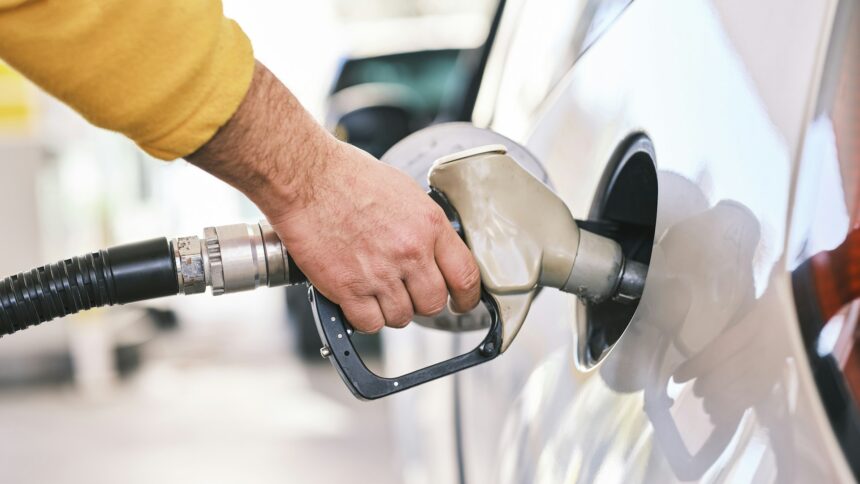
$0.13 a litre. That is what Alberta charges in fuel tax on gasoline on 9 September 2026, the full rate, on a morning when Brent crude traded at US$102.05 a barrel. The province’s own Fuel Tax Relief Program takes that $0.13 to zero whenever West Texas Intermediate averages US$90 a barrel or more over the measuring window. West Texas Intermediate printed near US$92.50 that same day. The rate did not move, because the relief due on 1 July 2026 was replaced by a one-time payment of $100 per eligible adult, and a payment does not adjust when the price does.
Key facts
- Alberta Treasury Board and Finance sets the provincial fuel tax on gasoline and diesel at $0.13 per litre, falling to $0 per litre when West Texas Intermediate averages US$90 per barrel or more, per its Fuel Tax Relief Program fact sheet of March 2024.
- The Government of Alberta replaced the fuel tax relief scheduled for 1 July 2026 with a one-time Alberta Energy Rebate of $100 per eligible adult, announced on alberta.ca on 17 June 2026.
- Alberta’s 2026-29 Fiscal Plan, tabled 26 February 2026, sets provincial revenue sensitivity at $680 million for each US$1.00 per barrel change in West Texas Intermediate.
- Alberta’s 2026-27 First Quarter Fiscal Update and Economic Statement of 27 August 2026 raised the 2026-27 West Texas Intermediate assumption to US$73.50 per barrel from US$60.50 in Budget 2026.
- The Department of Finance Canada extended the suspension of the federal fuel excise tax of $0.10 per litre on gasoline and $0.04 per litre on diesel to 31 January 2027, announced 2 September 2026.
The September price move is transit risk rather than barrels taken off the market
About 20.9 million barrels a day of crude oil and petroleum products crossed the Strait of Hormuz in the first half of 2025, close to 20% of global petroleum liquids consumption, on the United States Energy Information Administration’s count in an analysis updated 3 March 2026. A cargo routed through that water carries insurance and scheduling costs that climb with the odds of interference, and those costs sit inside every barrel priced off Brent. Through the first week of September the traffic kept moving and the price kept climbing, which is what a risk premium looks like when no volume has gone missing.
Brent also first settled above US$100 on 12 March 2026, its first close above that mark since August 2022. Anyone dating the US$100 barrel to September is six months late, and the error matters, because a barrel that crossed US$100 in March has been feeding royalties for two quarters already.
The royalty gain lands on a fiscal year average and not on a single day’s price
Alberta budgeted West Texas Intermediate at US$60.50 a barrel for 2026-27 when the fiscal plan was tabled on 26 February 2026. The first quarter fiscal update of 27 August 2026 raised that to US$73.50 a barrel and turned a forecast deficit of $9.4 billion into a forecast surplus of $2 billion. The published sensitivity in the 2026-29 Fiscal Plan is $680 million of provincial revenue for each US$1.00 a barrel change in West Texas Intermediate.
Run that against the day. West Texas Intermediate near US$92.50 is US$19.00 above the updated assumption, and US$19.00 at $680 million a dollar comes to roughly $12.9 billion. Our arithmetic, and a figure nobody should spend. The sensitivity is written against a full fiscal year average, so $12.9 billion is what 2026-27 would be worth if that average held for another seven months. It is not what 9 September earned. Bitumen royalties are struck against project revenues and costs and reach the treasury months after the barrel leaves the lease.
Alberta does not sell Brent either. Western Canada Select for September delivery settled US$14.80 a barrel under West Texas Intermediate on 4 August 2026, and that discount moves on pipeline space and refinery demand rather than on anything in the Persian Gulf.
Two written fuel tax rules are running on different clocks this month
The federal excise tax of $0.10 a litre on gasoline and $0.04 a litre on diesel has been suspended since 20 April 2026 and was set to return on 8 September. On 2 September the Department of Finance Canada extended the suspension to 31 January 2027. That $0.10 did not come back this week.
The provincial $0.13 never left. Alberta’s formula is quarterly, set by the average of the 20 trading days of West Texas Intermediate ending on the 16th of the month before each quarter, and it reprices on 1 January, 1 April, 1 July and 1 October. Relief was due on 1 July 2026. The government paid the Alberta Energy Rebate instead, $100 to each eligible adult, announced 17 June 2026 and open to claims until 30 September 2026.
Check the size of the swap. The province puts average Alberta fuel use at roughly 2,000 litres a year, or 500 litres a quarter, and 500 litres at $0.13 is $65. Our arithmetic, and it lands on the province’s own figure. So $100 beat $65 over that quarter. Timing is where the two approaches differ. A formula reprices every ninety days with nobody deciding anything. A payment is decided once and then holds still while the price moves.
A US$100 barrel runs four clocks at four speeds, and only one of them moves in days. Anyone reading the price as a single verdict is watching one gauge on a panel of four.
West Texas Intermediate printed US$92.39 on 4 September 2026 and US$94.24 on 8 September 2026, both above the US$90 line that takes the provincial tax to zero. The window runs twenty trading days and it is not finished. The rate Albertans pay from 1 October 2026 is being set now, by prices already cleared. That window closes on 16 September 2026.