

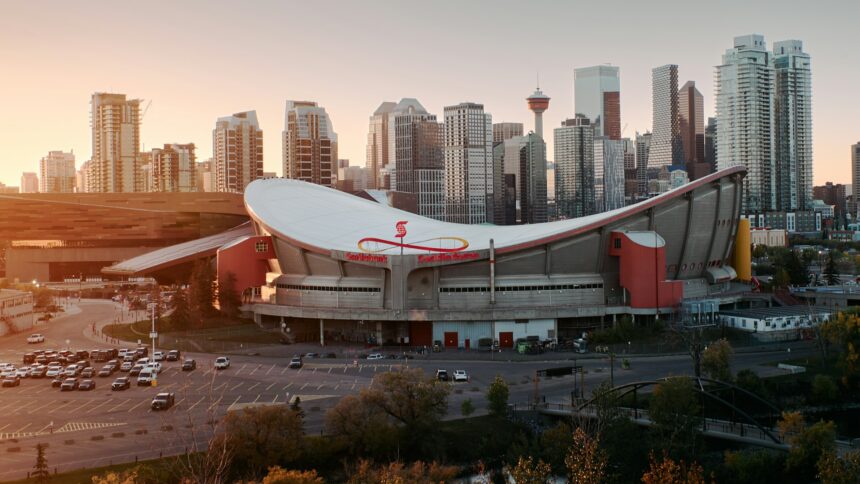
The Saddledome cost $70 million or about $97 million, depending on who kept the books. CANA, the construction firm on the project, puts the figure at $70 million, with another $30 million spent on renovations in 1995. Global News has reported roughly $97 million.
Neither number bought a spare roof. The Saddledome roof opened with the building on Oct. 15, 1983, and it has been doing the same hard job ever since, carrying concrete panels on steel cables pulled tight. Everything worth knowing about the building’s last season comes back to that net.
Key facts
- A 2025 structural health monitoring study of the Scotiabank Saddledome describes its roof as a hyperbolic paraboloid cable net laid on a 6 metre grid and carried on 32 bearings (2025 structural health monitoring study of the Saddledome roof).
- The same 2025 study sets the roof’s suspended load limit at 22,700 kilograms (2025 structural health monitoring study of the Saddledome roof).
- The 2025 study records a maximum downward deflection of 216 millimetres, against a monitoring threshold of 195 millimetres (2025 structural health monitoring study of the Saddledome roof).
- The Calgary Flames play their final game at the Scotiabank Saddledome on April 10, 2027, against the Vancouver Canucks (National Hockey League schedule).
How the saddle shaped roof holds itself up
A hyperbolic paraboloid curves down in one direction and up in the other, which is where the saddle comes from. Build it from cables and you get two families of steel pulling against each other. One set hangs and carries the weight. The other arches across it and keeps the net from fluttering or lifting in wind. Precast concrete panels sit on top of the grid, and the whole pull runs out to the edge of the roof and down through the bearings into the structure below.
Global News reported in 2023 that the roof carries 391 panels of about 5 tons each on 118 kilometres of cable. Nothing in that system is decorative. Every cable is working, all the time.
What the roof monitoring found
That is the weakness as well as the elegance. A 2019 assessment by the engineering firm Entuitive found no redundancy between the cables, meaning the net has no spare path to share load if one strand gives trouble. Safety netting went up under the roof in 2022.
The monitoring study put numbers on the movement. Maximum downward deflection reached 216 millimetres. The threshold was 195.
Twenty-one millimetres is less than an inch. On a roof with no backup cables, it is also the difference between a building behaving as designed and a building telling you something. The 22,700 kilogram suspended load limit matters for the same reason, because every concert rig and scoreboard hangs off that net.
The building has taken other punishment too. In the 2013 flood, water reached row 8, according to Ken King, then president of the Flames.
Why replacement beats another round of repairs
Calgarians have every right to be fond of the place. Fondness does not add cables. Scotia Place is scheduled to open in fall 2027 with about 18,400 seats, and the city has said it will demolish the Saddledome after the new arena opens, without setting a date.
The money around the new building deserves the same scrutiny as the old roof. The City of Calgary’s own Scotia Place pages give two figures for the city’s share, $537.3 million on the FAQ page and $515.3 million on the financial contributions page. A $22 million gap on a public project needs a single number from city hall and a line explaining how it got there.
Until demolition, the monitoring should keep running and keep publishing. The last game is April 10, 2027, and the load limit applies to every event booked before it.
Frequently asked questions
How does the Saddledome roof hold itself up?
The roof is a hyperbolic paraboloid cable net laid on a 6-metre grid and carried on 32 bearings, as a 2025 structural health monitoring study describes it. One family of steel cables hangs and carries the weight, while another arches across to keep the net from fluttering or lifting in wind. Precast concrete panels sit on the grid, and the whole pull runs out to the roof’s edge and down through the bearings into the structure below. Global News reported in 2023 that the system carries 391 concrete panels of about 5 tons each on 118 kilometres of cable.
Why did 216 mm of deflection against a 195 mm threshold matter?
The 2025 monitoring study recorded a maximum downward deflection of 216 millimetres against a monitoring threshold of 195 millimetres, a difference of 21 millimetres, or less than an inch. The margin matters because a 2019 assessment by the engineering firm Entuitive found no redundancy between the cables, meaning the net has no spare path to share load if one strand gives trouble. Safety netting went up under the roof in 2022, and the study sets the suspended load limit at 22,700 kilograms, which governs every concert rig and scoreboard hung off the net before the final game.
When does the Saddledome close and what replaces it?
The Calgary Flames play their final game at the Scotiabank Saddledome on April 10, 2027, against the Vancouver Canucks, according to the National Hockey League schedule. Scotia Place is scheduled to open in fall 2027 with about 18,400 seats, and the city has said it will demolish the Saddledome after the new arena opens, without setting a date. The Saddledome opened on Oct. 15, 1983, with the building costing $70 million by builder CANA’s account or roughly $97 million as reported by Global News.
What is the $22 million gap in the city’s Scotia Place figures?
The City of Calgary’s own Scotia Place pages give two figures for the city’s share: $537.3 million on the FAQ page and $515.3 million on the financial contributions page. A $22 million gap on a public project needs a single number from city hall and a line explaining how it got there. Until demolition, the roof monitoring should keep running and keep publishing, and the 22,700-kilogram load limit applies to every event booked before the last game.