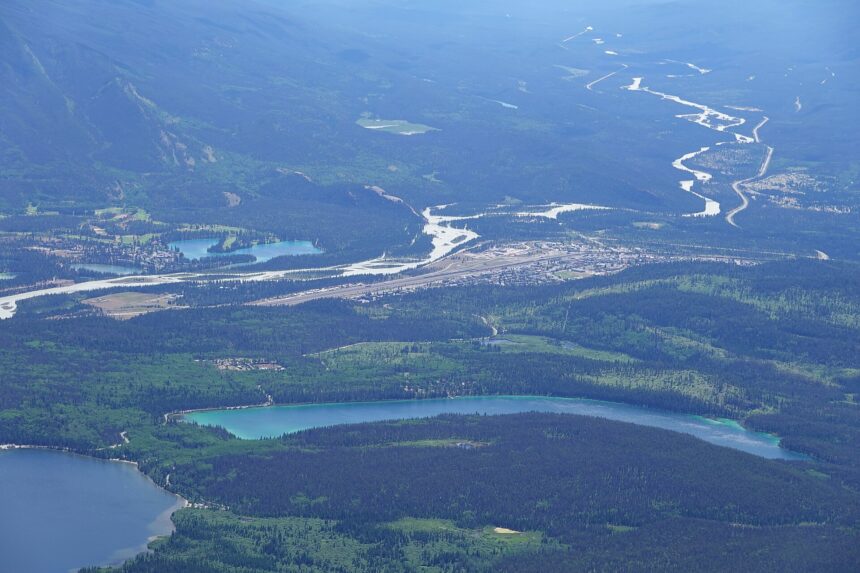
The Patricia Lake Habbakuk model was 60 feet long, about 18 metres. A one-tenth scale model of the aircraft carrier the British Admiralty had in mind would have run 200 feet, so the hull built near Jasper in 1943 came in at less than a third of that length, 30 feet wide and about 19.5 feet high, roughly 9 by 6 metres. The model and the research and testing around it cost $150,000, according to Susan Langley’s 1986 account in the Canadian history of science journal Scientia Canadensis.
What was Project Habbakuk? It was a wartime plan to build aircraft carriers out of reinforced ice for the Atlantic, and the National Research Council of Canada built and ran its test hull on Patricia Lake in Jasper National Park.
The idea came from Geoffrey Pyke, a British inventor whose name stuck to the material, and Canada carried the engineering. Dr. C.J. Mackenzie led the National Research Council effort, Dr. C. Niven oversaw construction, and Dr. W.H. Cook adapted the refrigeration. Labour came from a nearby camp of conscientious objectors.
Key facts
- The National Research Council of Canada built a Habbakuk test model 60 feet long and 30 feet wide on Patricia Lake near Jasper between February and April 1943, according to Susan Langley in Scientia Canadensis (1986).
- The Patricia Lake model and its related research and testing cost $150,000, according to Susan Langley’s 1986 paper.
- Dr. Herman Mark of the Brooklyn Polytechnic Institute found that adding 4% to 10% wood pulp to ice greatly increased its strength, according to Susan Langley’s 1986 paper.
- Divers documented the Habbakuk remains in 1985 on a slope about 15 metres off the south shore of Patricia Lake, at depths of 26 to 43 metres, according to Susan Langley’s 1986 paper.
How pykrete and the Patricia Lake Habbakuk model worked
Ice is strong in compression and weak almost everywhere else, and it cracks and creeps under steady load. Pykrete was the fix proposed for the full ship: wood pulp frozen into the ice at 4% to 10% acts like the gravel in concrete, binding the mass and slowing cracks. The Patricia Lake hull worked on a second principle that mattered just as much, because ice only stays a structure while something keeps pulling heat out of it, so the model was built around its cooling plant.
The plant sat in a machinery chamber 30 feet by 10 by 10 at the core of the hull, feeding three fan chambers that pushed cold air through a nest of ducts in the floor and walls. Brine was tried first and dropped after the joints leaked. Around that plumbing, crews laid timber walls, caulked them with pitch between February 15 and 21, sheathed floor and walls in asphalt the next week, and froze ice on in layers, the first between March 1 and 6 and the second, 27 inches thick, by March 20. By April 10 the machinery was running.
Why the ice carrier project stopped in 1943
The engineering held long enough to prove the hull could be kept frozen. The arithmetic didn’t hold. A full-size ship was estimated at £17 million, about $70 million, which Langley’s sources put at less than half the cost of a conventional carrier, and the Canadian War Committee approved an initial $1 million toward one. Mackenzie still recommended ending the work in May 1943, because the timeline and costs had become impractical.
The need went away at the same time. Longer-range aircraft, centimetric radar and air bases in Iceland closed the stretch of mid-Atlantic where convoys had no air cover, which removed the job the carrier was meant to do. By June 1943 the refrigeration equipment had been taken out, and the hull was left to melt. A post on the Alberta’s Historic Places blog puts its weight at “roughly 1,000 tons,” a figure Langley’s paper doesn’t give.
Canada ran other wartime science in odd corners of the province, from chemical testing at Suffield to the high-altitude work recorded at the cosmic ray station on Sulphur Mountain. Jasper itself had seen federal labour schemes a decade earlier, when relief workers cut the Icefields Parkway.
What remains of Habbakuk on the Patricia Lake bottom
The wreck lies on a steep east-west slope about 15 metres off the south shore, from 26 metres down at its shallow southwest corner to 43 metres at the northeast. When Langley’s team surveyed it in 1985, three of the four walls were still standing, the refrigeration chamber was intact but shifted, and asphalt and tangled ductwork lay across the site. Because the lake sits about 4,000 feet above sea level, divers add about 20 feet to their depths for decompression planning.
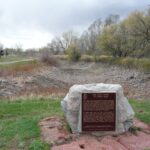
The lake is a short drive from the Jasper townsite inside Jasper National Park, where trails have reopened after the fire. The plaque marking the wreck went down in 1988, at a depth of 85 feet, about 26 metres.