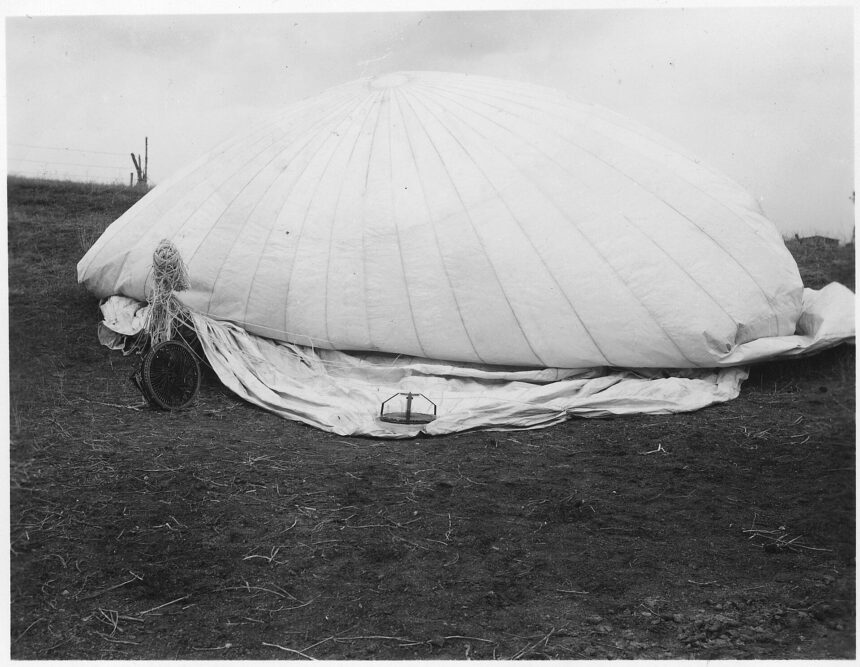
Between 7:30 and 7:45 on the evening of March 20, 1945, two people about five miles north of Delburne heard a dull boom and watched a white object come down into a field. That was the Delburne balloon bomb, a Japanese balloon of the bomb-carrying kind sent across the Pacific that winter, and by the time the RCMP arrived, souvenir hunters had already walked off with much of it.
The account comes from Report No. 28 of the Historical Section (G.S.), Army Headquarters, titled The Japanese Balloon Enterprise Against North America. The army’s historians compiled it after the war, dated it October 15, 1949, and drew on operational research summaries. The Delburne entry sits in paragraph 8 under the heading for balloon incidents, a few lines of typescript about a farm field east of Red Deer.
Did Japanese balloon bombs reach Alberta? Yes. The army’s own report records a balloon recovered north of Delburne and a bomb found near Pine Lake on the same evening in March 1945.
Key facts
- Army Headquarters Report No. 28 records a Japanese balloon coming down about five miles, roughly 8 km, north of Delburne between 7:30 and 7:45 p.m. on March 20, 1945.
- Report No. 28 records two explosions heard near Pine Lake on March 20, 1945, and a bomb later found 6 feet, about 1.8 m, into the ground.
- Report No. 28 places the Delburne and Pine Lake sites 15 miles, about 24 km, apart.
- Appendix C of Report No. 28 lists 88 reported balloon incidents in Canada up to August 28, 1945.
What happened at Pine Lake before the Delburne balloon landed
Earlier that evening, somewhere between 5:45 and 7 o’clock by their own estimate, three observers near Pine Lake heard two explosions about five minutes apart. The second sounded as if it had gone off in the air. A bomb was found afterward, driven six feet into the ground, with the grass burnt for about 20 feet, or 6 metres, in every direction from the point of impact. It was shipped to National Defence Headquarters in Ottawa.
The two places sit about 24 km apart, a short drive on today’s roads, and the army’s investigators asked the obvious question. With one to two hours between the incidents, the meteorological office couldn’t give exact winds for the evening, and the report settles on a careful verdict: that the Pine Lake bomb was dropped by the Delburne balloon “is possible.” A third bomb that came down about 35 miles southwest of Delburne, near Wimborne, at about 7:30 the same evening was judged unlikely to belong to the same balloon, because the timing was too close.
Why the Delburne balloon bomb record is incomplete
The report doesn’t say whether the balloon’s self-destruct charge had fired. The boom the two witnesses heard could have been that charge or something else, and the people who might have settled it, the ones who reached the field first, took pieces home. The investigators wrote it down plainly and moved on: the recovered material was incomplete.
That small gap repeats across the whole file. Appendix C counts 88 reported incidents in Canada up to August 28, 1945, while a map attached to the same report shows only 73 for about the same period, and the difference is the ordinary friction of wartime record keeping in farm districts, where a report depended on who saw what and who phoned the detachment. Alberta’s war left other paper trails that took decades to surface, chemical warfare testing at Suffield among them, and any record of this age is only as complete as the people who kept it, a problem behind Alberta’s history disappearing faster than it can be digitized. Calgary learned the same lesson from Bob Edwards and the Eye Opener, a paper that left no complete set.
Where the Delburne balloon record can be read
Report No. 28 is posted by the Department of National Defence’s Directorate of History and Heritage with the other Army Headquarters reports, free to download. The Delburne paragraph is short. It names no farm and no family, only the distance, the time and the sound, and the white shape still coming down into a field five miles north of town on a March evening in 1945.