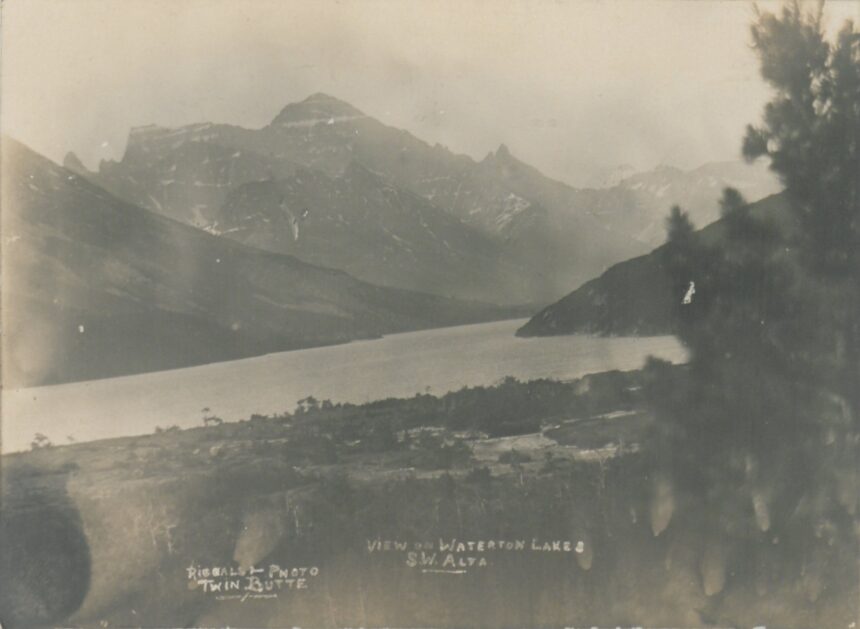
Bert Riggall stands on the shore of Waterton Lakes in a photograph dated 1909, posed beside boats he built with his partner Cyril Watmough. The print is filed at the Whyte Museum of the Canadian Rockies in Banff as V26/VII/A4/PA-43, and it’s one small piece of a much larger record. The museum’s description of the Bert Riggall fonds counts about 13,100 photographs: roughly 7,080 prints, 5,310 negatives and 700 transparencies, along with nine albums and about two metres of diaries, letters and papers.
Where are the Bert Riggall photographs kept? They’re held by the Whyte Museum of the Canadian Rockies in Banff, more than 300 kilometres north of the Waterton country where most of them were made.
Riggall was born in 1884 at Gayton-le-Wold Grange in Lincolnshire and left England in 1904. He spent a year at Craighurst Farm near Calgary, then joined the Correction Land Survey in southwestern Alberta in 1905, and the survey work took him into Waterton Lakes. He married Dorothea Williams, known as Dora, in 1906, and the two homesteaded and ranched near Waterton until 1946.
Key facts
- The Whyte Museum of the Canadian Rockies holds the Bert Riggall fonds, reference M376/V26, with about 13,100 photographs.
- Bert Riggall guided and outfitted hunting and fishing trips in the Waterton Lakes district from 1909, according to the Whyte Museum fonds description.
- Bert Riggall made a 1,000-mile exploratory pack trip from Fort Steele, British Columbia, toward Yellowhead Pass in 1911, recorded in 43 prints at the Whyte Museum.
- The Riggall family moved from the Waterton district to Pincher Creek in 1947, and Bert Riggall died in 1959, according to the Whyte Museum.
- The Whyte Museum exhibited Bert Riggall’s photographs as I to the Hills Will Lift Mine Eyes from April 8 to June 11, 2017.
What Bert Riggall photographs show of Waterton country
The museum calls him “an accomplished semi-professional photographer”, and the catalogue lists what he worked at: wildlife studies, wide panoramas of the foothills and the southern Rockies, and colour transparencies, first on Dufaycolor and later on Kodachrome. Some of his pictures were printed in Department of the Interior reports, which put a working guide’s camera inside federal paperwork.
Horses run through the whole collection, because horses were the business. The 1911 pack trip file holds 43 prints from the summer Riggall went looking for new hunting country after Waterton’s park boundaries grew and his clients’ hunting ground shrank. He rode from Fort Steele north to Edson, with stops at Cranbrook and Banff, and the record says about 150 miles of new trail were cut along the way. Farther north, two decades on, relief crews would build the Icefields Parkway, cut mostly by hand. Riggall’s 150 miles came 20 years earlier, cut by an outfitter who needed the route for paying clients.
Families show up too, and some of the most telling prints came back to him rather than going out. Four Minneapolis families, the Crosbys, Boveys, Bennetts and McKnights, hired Riggall for pack trips and hunting trips year after year, and in 1923 they built a lodge they called the Hawk’s Nest. The four families file holds about 100 photographs those families mailed back to Waterton over the following decades. Bert was chief guide. Dora cooked in camp.
Who kept names on the Riggall panoramas
A photograph without a caption is half a document. The Riggall record kept its captions partly because the family stayed close to it. Kay Riggall Russell, one of two daughters who survived infancy, ran the packtrain and guiding business with her husband, Andy Russell, until 1960. Years later, the museum’s large panorama negatives file notes that Bert Riggall’s grandson, John Russell, supplied the identifications for 14 large panorama negatives: Cloudy Ridge Ranch, sheep on the prairie, the Harwood family and a Harwood wedding, Middle Waterton Lake, the Prince of Wales seen from above the government compound, the Boundary Creek valley, the early townsite.
That kind of memory doesn’t last forever, and collections across the province lose it faster than anyone can scan the prints, a problem the Tribune has looked at in Alberta’s history disappearing faster than it can be digitized. The mountain parks have had their own fights over who did what first, as the Skoki Lodge plaque showed. Riggall’s papers sidestep most of that, because he wrote things down, dated them, and kept them.
Where the Bert Riggall photographs can be seen
Heart trouble moved the family off the Waterton place and into Pincher Creek in 1947, and Riggall died in 1959. The record went to Banff. Today the Bert Riggall fonds sits in the Whyte Museum archives at 111 Bear Street, searchable online by file, with some images posted to the catalogue and the rest available by appointment. Some files carry access and copyright conditions, so a researcher planning a visit should ask ahead. After the 2017 show in Banff, the exhibition travelled to the Galt Museum in Lethbridge, where it hung until February 11, 2018.
The 1909 print is in the online catalogue. Riggall and his boats are still pulled up on the Waterton shore in it, the water flat behind them, the hulls new.