
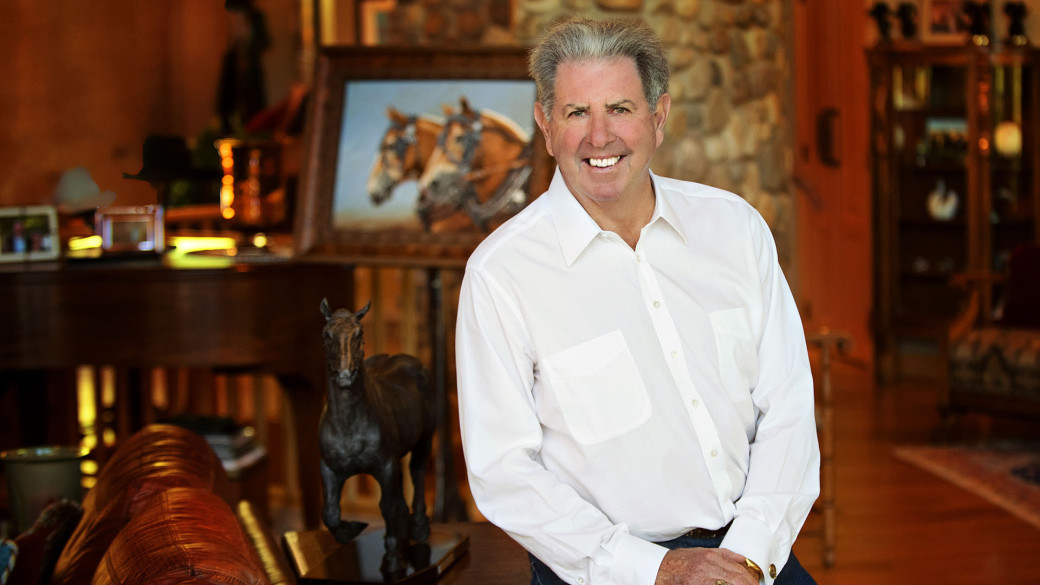

The largest seedstock cattle operation in Canada was built by a petroleum engineer who then spent 14 years chairing an air ambulance service. Alberta produces that combination more often than the rest of the country understands.
Key facts
- Stan Grad, a petroleum engineer, built the largest seedstock cattle operation in Canada.
- He chaired the province’s air ambulance service for 14 years, then co-chaired the national society.
- His land base runs northwest of Airdrie, southwest of Fort Macleod and southeast of Cardston.
- He was a founding member of the Calgary Stampede Foundation.
- SAIT gave him an honorary degree for his work for the petroleum industry and the province.
Stan Grad started with a diploma in petroleum technology from SAIT, then went to Wyoming for an engineering degree. He came home, went into the patch, and with a partner built an oil and gas company that made the TSE 300 index before they sold it in 1997. He co-founded more ventures after that.
The cattle were not a retirement hobby
More than 35 years ago he moved into seedstock, which is the breeding side of the beef business and the least forgiving corner of it. Commercial ranching sells pounds. Seedstock sells genetics, and genetics take a decade to prove and one bad decision to discredit.
The land base he assembled runs northwest of Airdrie, southwest of Fort Macleod and southeast of Cardston, which is a deliberate spread across three very different pieces of southern Alberta country. The operation raises grain alongside several beef breeds, including two it developed itself.
Developing a breed is not a marketing exercise. It is decades of selection, record keeping and culling, carried out by people who will not personally see the finished result pay off. An engineer would recognize the discipline immediately, which is probably why one was good at it.
Fourteen years on the helicopter file
The other half of the story flies. He sat on the board of the province’s air ambulance service and chaired it for 14 years, then went on to co-chair the national society.
Fourteen years as chair of anything is unusual. Fourteen years as chair of an organization that runs helicopters into farm accidents, highway collisions and rural medical emergencies is a different kind of commitment, because the failure mode is not a bad quarter. Anyone who has ranched an hour and a half from a hospital understands exactly what that service is worth, and understands it in a way no annual report captures.
He was also a founding member of the Calgary Stampede Foundation and sat on Mount Royal’s board of governors. SAIT later gave him an honorary degree for what he had done for the petroleum industry and for the province, and southern Alberta’s business hall of fame named him among its laureates.
The pattern underneath the resume
Read that list quickly and it looks like a collection of unrelated interests. Read it slowly and it is one thing repeated. Energy, cattle, emergency medicine and the Stampede are all businesses of long time horizons and physical risk, run by people who cannot control the weather or the price.
Alberta keeps producing this profile. Somebody makes money in one cyclical industry, then puts it into another cyclical industry that most outside investors would consider irrational, and then spends the rest of their time on the volunteer boards that hold the province together. Lee Williams built an empire on a handshake in the same tradition.
It is not charity in the usual sense. It is closer to maintenance. These are people who understood that the institutions they relied on, the hospital, the helicopter, the college, the fair, do not maintain themselves, and who treated that as a personal obligation rather than a government line item.
Why it belongs in the record
Alberta gets described from outside as an oil province, as though that were the whole account. The engineer who reads a seismic section is often the same person who reads a bull’s expected progeny difference, sits on a hospital foundation, and shows up at a rural fundraiser in January.
The breeds he developed remain. So does the air ambulance service he chaired for 14 years, and so do the students at the institutions he supported.
An oil patch engineer breeding cattle and funding an air ambulance fleet is not a contradiction here. It is close to the standard model.
Related from Alberta Tribune: Bar U Ranch and the Brand That Built Cattle Country