


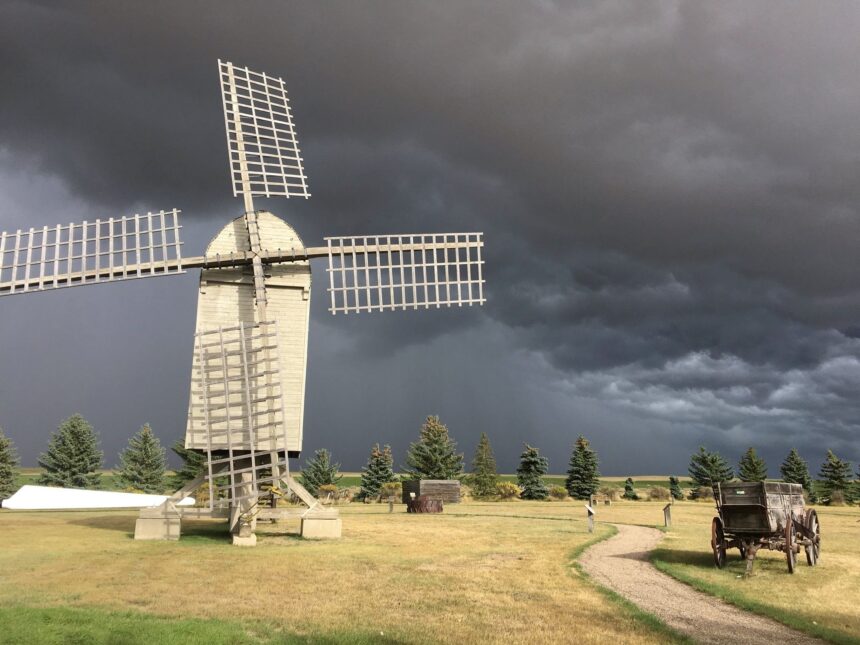
The most important part of a prairie windmill is the part nobody photographs. A steel rod runs down the middle of the tower, through the well casing, to a pump cylinder sitting in water below the grass. The wheel catches the wind and turns a crank at the top. That crank lifts the rod, the rod lifts a column of water, and the water comes up a pipe into a trough. Machines like that stand at Etzikom, a hamlet in the County of Forty Mile No. 8 about 85 km south of Medicine Hat on Highway 885, where a four-acre museum keeps the technology that made dry land settlement possible in this corner of the province. Almost nobody stops.
The site began in an abandoned school. It opens from mid-May to early September, and for the other eight months the towers stand out there on their own.
Key facts
- The Etzikom Museum and Historic Windmill Centre occupies a four-acre site at 62065 Highway 885, 85 km south of Medicine Hat, according to the Travel Alberta listing for the museum.
- The Etzikom Museum and Historic Windmill Centre is open from mid-May to early September each year, according to the Travel Alberta listing for the museum.
- Robert R. Paul took charge of the Etzikom post office on 16 June 1916, and the office closed in 2017 when the store housing it shut, according to the Journal of Alberta Postal History, issue 28, June 2023.
- Etzikom lies in the County of Forty Mile No. 8 and recorded 54 residents in the 1991 Census of Canada compiled by Statistics Canada.
What a prairie windmill was actually built to do
Before a windmill was a picture on a calendar it was a pump, and before it was a pump it was the difference between proving up a homestead and walking away from one. A family on a quarter section in the southeast needed water every day of the year. So did the horses. So did whatever cattle the place could carry. Hand pumping that volume out of a well is a full day of work for a strong person, repeated forever, and the wind here does it for nothing. Travel Alberta’s description of the site names the reason, the sustained and predictable winds that keep the wheels turning. The turbines along those same highways today run on identical physics for another purpose.
The order matters. Water first. Then a house that can be lived in through February. Then a barn. Then, if enough families manage all of that, a store and a siding where the railway stops. The general store is the part everyone photographs and puts on the heritage plaque. The rod in the tower decided whether there would be a store at all.
How a farmer’s windmill collection ended up in an empty school
The collection belongs to Leonard Mitzel, a farmer at Etzikom who gathered antique windmills and, in the late 1980s, bought a property with an abandoned school and a field so the machines would have somewhere to stand. That is the whole origin. No commission and no capital campaign. A man with a growing pile of steel towers and a building nobody else wanted.
Around the windmills the site has since built a street of early 1900s buildings, a general store, a blacksmith shop, a barbershop, a post office, a school house, and a settler’s home with parlour, kitchen and bedroom. The buildings are reproductions. The windmills are the real objects, hauled in from across North America. Adult admission is $10. A child between 6 and 12 gets in for $2.
Why the record of settlement sits in a hamlet almost nobody stops in
The paper trail is short. A crossroads store and post office opened nearby at Endon on 15 March 1911 under W. R. Shields, moved once with a later postmaster, then went to the new railway siding at Etzikom. Robert R. Paul took the Etzikom office on 16 June 1916 and held it into 1926. James Joseph Sergeant took over on 1 June 1927 and, in the words of the postal record, “died suddenly on the job while sorting mail in the post office” on 30 April 1937. Grace Cathryne Stromsmoe started on 1 October 1943 and a local history has her serving until 1977. The office closed in 2017 when the store that housed it shut. By our arithmetic that is 101 years of mail through one small building.
Statistics Canada counted 54 residents at Etzikom in the 1991 Census. The store is gone and the post office is gone, and what remains in a place that once justified a railway siding is a four-acre field of machines explaining how any of it was possible.
The comfortable assumption is that the heritage worth protecting lives somewhere else, in a city museum with a curator on salary. Designation under Alberta’s Historical Resources Act protects places and structures fixed to land. A collection of machines gathered across a continent and stood up in a field is movable property, and movable property survives on the decisions of whoever keeps it. The wind that made this equipment necessary has not gone anywhere. The people who understood the work are going, one funeral at a time, and the machines outlast the memory by about a generation.
In the second week of September the gate at Etzikom closes for the year. The wheels keep turning anyway, through October and January, over ground that no longer needs the water they were built to raise. Out on Highway 885 the traffic goes past at speed. Behind it the towers turn, rods going up and down in the dark, above wells capped a long time ago.