


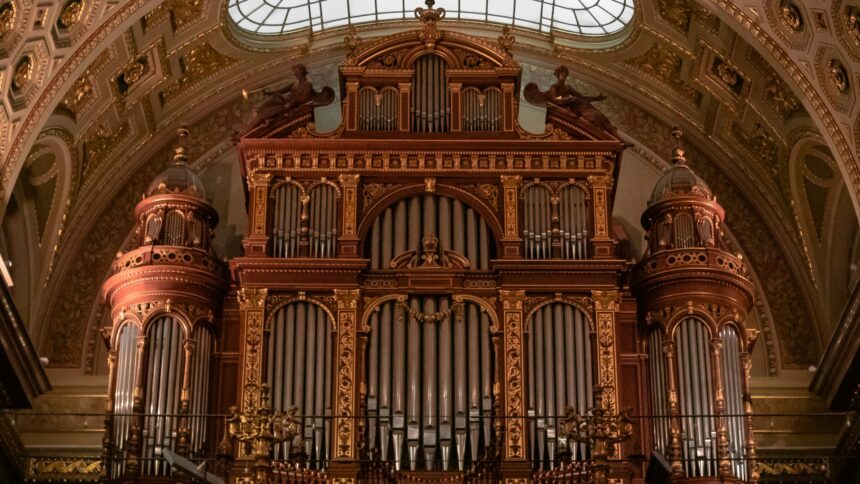
Stand in the Jack Singer Concert Hall in Calgary and look up past the stage, and you are looking at 6,040 pipes held in a case of hand carved solid oak. The Carthy Organ has been in that wall since 1987. On most nights it makes no sound at all.
The name over the room was settled five years before the organ arrived. In 1982 Alan and Stephen Singer paid for the hall and asked that it carry their father’s name. Jack Singer was born in Calgary on 17 December 1917, and by the time his sons wrote that cheque he had spent four decades putting up strip malls and commercial centres across the west.
A concert hall is a machine for moving air before it is a monument to anyone. The oak case and the shape of the ceiling are there to carry a violin to the back row of 1,797 seats. The name is a separate matter. A name is the record of a decision somebody made in a particular year, in a particular city, at a moment when the money could have gone somewhere easier.
Key facts
- The Calgary Centre for the Performing Arts opened on 14 September 1985 with the Jack Singer Concert Hall as its largest venue, according to the Werklund Centre’s own published history of the building.
- The Jack Singer Concert Hall seats 1,797 people, according to the Werklund Centre venue page current in September 2026.
- The Carthy Organ is Casavant Freres Opus 3623, built in 1986 and installed in the Jack Singer Concert Hall in 1987 with 6,040 pipes across 75 stops, according to the Werklund Centre and the Musique et Orgue au Quebec organ registry.
- The Carthy Foundation gave $750,000 for the Carthy Organ in memory of Margaret Mannix, according to the Werklund Centre, and the instrument was first played in public on 6 May 1987.
- The Calgary Philharmonic Orchestra was founded in 1955 and has performed in the Jack Singer Concert Hall since 1985, according to the orchestra’s own about page.
Why the hall carries a Calgary developer’s name
In 1976 the committee behind the building was told by Premier Peter Lougheed to raise $15 million of its own, with the province covering the balance, and construction started in 1981. The centre opened on 14 September 1985 at a total cost of $102.4 million. The Singer gift landed in 1982, midway through the work.
Jack Singer boxed before he built anything. He was a Canadian Golden Gloves fighter with 17 straight wins, according to the death notice his family placed in February 2013, which also records that the Singers helped bring thousands of Polish Jews to Canada before and after the Holocaust. He died on 2 February 2013 at 95.
So the name marks a family that had money in Calgary and spent a piece of it on a room built for sound, in a year when a room built for sound was not the obvious purchase.
What 38 years without a full cleaning did to the Carthy Organ
The organ came later and from somewhere else. Casavant Freres built it as Opus 3623 in 1986, fifteen months of work in the Casavant workshops, then five more months in Calgary to install, voice and tune it. The Carthy Foundation paid $750,000 in memory of Margaret Mannix.
Then it stayed where it was put. Staff dusted it and kept it in tune, but the centre’s own account of the instrument notes that “many parts are completely inaccessible during daily operations”. Most of those 6,040 pipes went 38 years without a full cleaning. In August 2025 a team finally went inside the case. Steve Miller, an organ tuner and technician, worked with Chellan Hoffmann, national president of the Royal Canadian College of Organists, along with three organ students, and tuning the cleaned sections alone took about a week.
Nobody let that happen on purpose. Neglect rarely arrives as a decision, and a building asks for nothing at all until the season it asks for everything, which is why a hall with a full house every Friday looks perfectly healthy from the seats while the back of the oak fills with 38 years of dust.
What the 2028 rebuild means for the 1985 building
The room now sits inside a far larger project. On 26 June 2024 the centre announced a $75 million gift from Dave Werklund and family, and on 1 September 2025 Arts Commons became the Werklund Centre. The plan builds an expansion carrying about 45% more seating first, so the resident companies have somewhere to work, and only then turns to modernizing the 1985 building. Construction on the expansion and on the Olympic Plaza renewal is expected to finish in 2028.
By our own arithmetic that leaves the Jack Singer Concert Hall at 43 years old before any work begins on the structure around it. The Calgary Philharmonic Orchestra was founded in 1955 and moved in when the doors opened in 1985, which means the orchestra will have spent that entire run in the same room.
The order of operations is defensible. The gap it creates is the part that needs watching, because a hall does not fail in a year the way a roof does. It fails the way a gravel road fails, one spring at a time, with nobody able to name the week it stopped being good.
A plaque is cheap. Keeping 6,040 pipes speaking costs something every year and keeps costing it, and that recurring bill is the only form of respect a name on a building ever really receives. The Singers bought a machine in 1982. Whether the machine still works in 2028 is a separate decision, made by people who never met them, one maintenance budget at a time.
The oak runs most of the way to the ceiling. The metal in the facade catches whatever the house lights are doing, and behind all of it, in the dark under the canopy, the dust has already started again.