

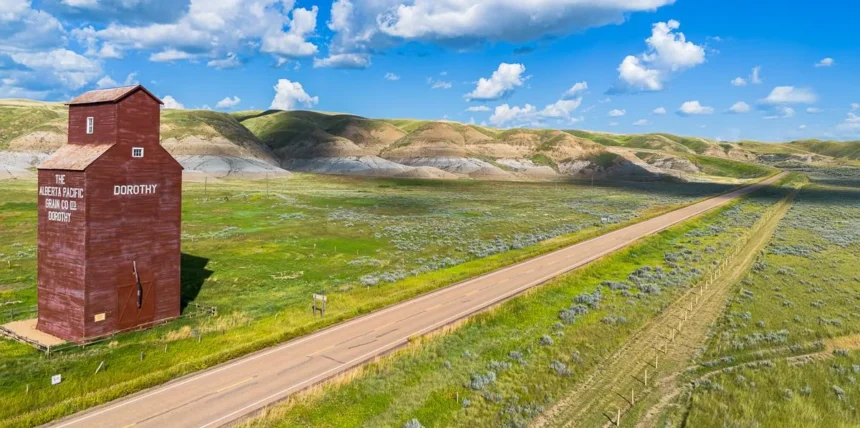
A piece of roof tin from the Dorothy grain elevator came down on Highway 570 in the summer of 2024. The building had been shedding itself since a windstorm tore the roof off its cupola in 2015, and by last summer the pieces were reaching the road. In April 2025 a crew from MAST Construction arrived with a new roof, repairs for the cupola and fresh work on the exterior, paid for by the Special Areas Board with a contribution from the Dorothy Community Association. The elevator is standing this month because it photographs well. Shaune Kovitch, who chairs the Special Areas Board, called it one of the most photographed historic elevators in the province, and the camera is what brought the crew out.
Alberta Pacific Grain Company put the building up in 1928, and it stopped taking grain in 1951. Statistics Canada counted 14 residents at Dorothy in the 1991 census. Everything the elevator has done since the grain stopped has been posing.
Key facts
- The Alberta Pacific Grain Company built the Dorothy grain elevator in 1928, according to the Special Areas Board.
- The Dorothy grain elevator stopped serving the surrounding farms in 1951, according to the Special Areas Board.
- A windstorm in the summer of 2015 tore the roof from the cupola of the Dorothy grain elevator, with more material lost in the summer of 2024, according to the Special Areas Board.
- The Special Areas Board hired MAST Construction through a request for proposal and began repairs to the Dorothy grain elevator in April 2025, with completion expected that June.
- Alberta counted 1,781 wooden country grain elevators in 1934 and 110 standing on railway rights of way in 2017, according to the Alberta Heritage Survey Program.
What the crew actually did at Dorothy
The scope was plain. A new roof, repairs to the cupola frame at the top, and refurbishing on parts of the exterior, starting in early April 2025 and expected to finish by June. The Special Areas Board ran a request for proposal and MAST Construction won it, a firm that had already worked on the Rowley elevator. The Dorothy Community Association put money in. The Community Foundation of Southeast Alberta opened a donation line for it. The ground underneath the building is held under an agricultural lease, which is the sort of arrangement that decides the fate of more heritage buildings in this province than any register does.
No cost figure for the Dorothy work appears in the public notices, and none of the material published about the repair names a heritage designation on the building. That absence is worth sitting with. A building from 1928 that draws photographers from across the country was repaired because a regional board and a community group decided it should be, not because any statute obliged anybody.
Why 1,781 elevators became 110
The province’s own heritage survey has kept the count, and the shape of it is brutal. There were 1,781 wooden country elevators in Alberta in 1934. In 1951, the year Dorothy stopped, there were still 1,651 of them, which means the building did not close because the system was collapsing. It closed the way one shop on a full street closes. The collapse came later. By 1982 the number was 979, by 1997 it was 327, by 2005 it was 156, and by 2017 there were 110 left standing on railway rights of way. Our arithmetic on the province’s figures puts the loss at 1,671 buildings in 83 years.
Branch lines came up. Grain moved to concrete terminals that needed one site where the old system needed ten. Nobody set out to erase the tallest thing in every small place that had one. It happened the way erosion happens, a season at a time, until the horizon line of rural Alberta had been edited down to almost nothing.
What happens to the elevators nobody photographs
Dorothy was saved by being looked at. That is a real preservation mechanism and it works, right up until you ask it to cover the field. The elevator row at Rowley became a Provincial Historic Resource in June 2010, and Rowley is a village that people drive to on purpose with cameras in the back seat. The pattern holds. The buildings that live are the ones that have been photographed enough that somebody would notice their absence.
There are 110 of these left, and there are not 110 famous ones. Most of them stand at the end of a grid road behind a farmyard, on land somebody leases, outside a hamlet too small to have a council of its own. They have no designation, no community association, no regional board that has decided they matter, and no photographer who has made them worth a detour. They have weather. Weather is patient and it is very good at its job.
None of this is anybody’s fault, which is the hard part. Nobody demolished the 1,671. The roof went, then a winter went through the opening, then an assessment made the decision nobody wanted to make out loud. Neglect needs no villain. It needs time and no camera.
Dorothy has a new roof and another few decades, and the people who drive out from Drumheller to shoot it at golden hour will keep doing that. Take the picture. Then drive the back roads north and west of there with the windows down. Somewhere off a road nobody takes for the view, another one stands in a field with its cupola open to the sky. The light comes through it from the east side and goes out the west. No one is coming with a camera.