

A Lake That Holds More Than Scenery
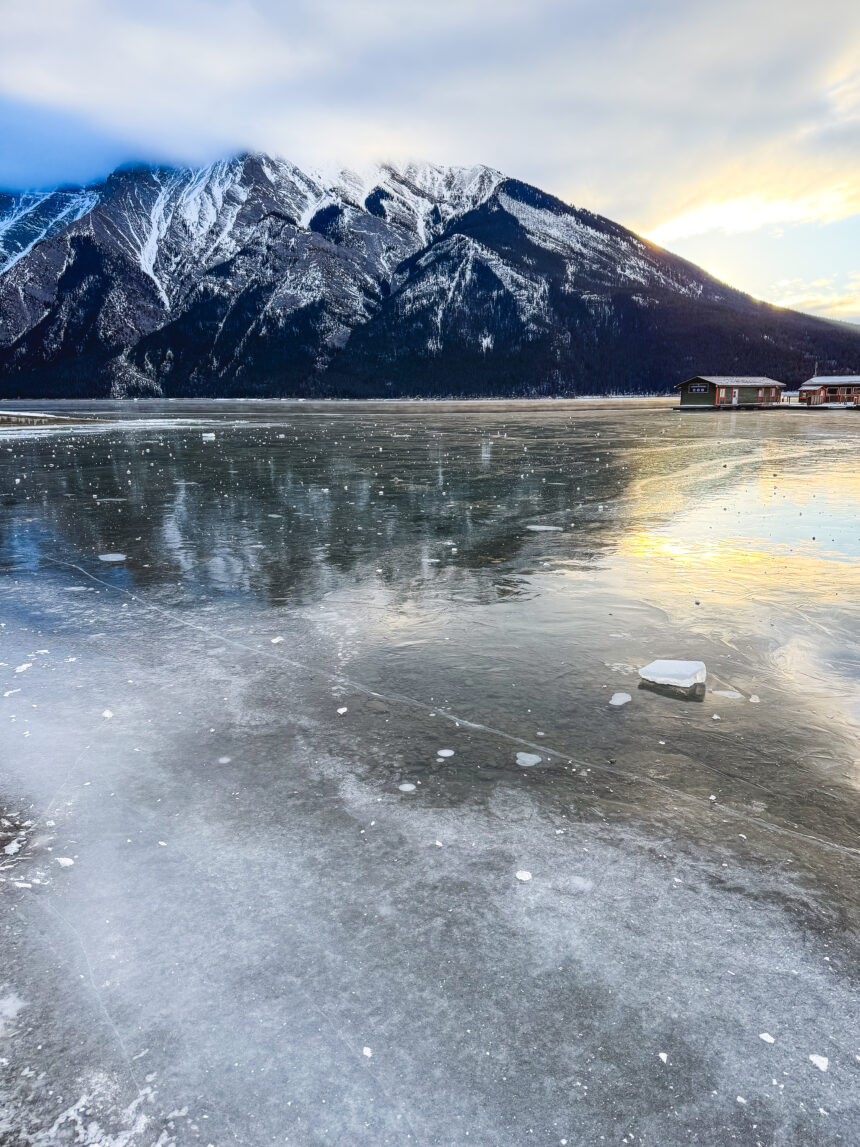
Lake Minnewanka is often introduced as a scenic stop near Banff, a convenient boat cruise on a deep blue reservoir in the Rockies. Its story runs much deeper. For more than ten thousand years, people camped and hunted along its original shores, leaving tools and hearths that place this valley among the oldest known human landscapes in what is now Alberta. The Stoney Nakoda people called it Minn waki, Lake of the Spirits, a place of both spiritual significance and practical sustenance.
Early European visitors later called it Devil’s Lake, borrowing the sense that this was a powerful place that demanded respect.
In the late nineteenth and early twentieth centuries, the lake became part of a new story. A log hotel known as the Beach House and a cluster of cabins and services grew into Minnewanka Landing, a summer resort village with streets, wharves, and excursion boats, catering to visitors drawn by the fresh air and promise of the national park. Today, that community rests beneath the reservoir, preserved as an underwater ghost town visited by divers who follow old roadbeds between submerged foundations and bridge pilings.
The view from the surface hides a long record of how power, in every sense, has been exercised over Alberta’s land and water.
From Minn waki to Minnewanka Landing
The deeper story of Lake Minnewanka begins long before hotels and hydro lines. Archaeological work along the northwest shore has uncovered artifacts dating back around ten thousand years, with some accounts pointing to even older human presence in the valley. Clovis points, hearth stones, and other tools testify to repeated use of this landscape by generations who understood the lake as part of a living territory, not a backdrop. The Stoney Nakoda name Minn waki, Lake of the Spirits, captured both spiritual and practical realities, mixing cautionary stories about powerful spirits with respect for a place that sustained life.
When Banff emerged as a tourist destination, Lake Minnewanka was quickly drawn into the orbit of the Canadian Pacific Railway and the expanding park economy. By 1888 a resort village began to take shape, anchored by the Beach House hotel and its successors. Minnewanka Landing soon featured cottages, restaurants, a dance hall, and a fleet of boats taking visitors along the lake toward Devil’s Gap. This was very much an Alberta story, even inside a federal park. Local workers, entrepreneurs, and guides built a seasonal community that served both the national image of the Rockies and the regional economy of southern Alberta.
From the beginning, however, decisions about the lake’s future were not made solely by the people who lived and worked there. In 1895 the federal government built a small dam to stabilize a boggy shoreline and extend the boating season, the first in a series of engineering choices that would gradually trade shoreline for storage. In 1912 Calgary Power constructed a higher dam to create a reservoir for the downstream Horseshoe Falls plant, addressing the Bow River’s irregular flows and meeting rising electricity demand from Calgary and surrounding communities. Part of the shoreline community was affected as water levels rose, but the village remained, adapting to a new waterline.
Wartime Power and a Submerged Community
The turning point came with the pressures of industrial growth and war. By the 1930s the Bow River system still struggled with seasonal extremes, and engineers and power companies pressed to expand storage and generating capacity, while conservationists and park advocates argued that national parks should be protected from industrial development. The 1930 National Parks Act reflected that protectionist view, banning industrial development in Canada’s national parks and, in theory, closing the door on larger dams at Lake Minnewanka.
War reopened it. In 1940, the federal government approved Calgary Power’s application for a much larger embankment dam at Lake Minnewanka under the War Measures Act, temporarily suspending the National Parks Act provisions that had shielded the valley from further industrial expansion. Construction of the new dam was completed in 1941, raising the lake by roughly thirty metres, flooding the resort village of Minnewanka Landing, the earlier 1912 dam, and the bridge at Devils Creek. Residents and leaseholders were forced to leave as buildings were abandoned, dismantled, or simply left to the rising water, an involuntary resettlement framed as a necessary sacrifice for the war effort and regional power needs.
The new reservoir was tied directly into the Cascade Power Plant, completed in 1942 to replace the earlier coal‑fired Bankhead station and provide a steady supply of electricity to Banff and the broader region. A diversion on the Ghost River directed additional water into Lake Minnewanka, further strengthening the Bow River hydro system that underpins much of southern Alberta’s grid. On paper, this was a technical success. In practice, a distinct lakeside community, earlier Indigenous use along key shorelines, and an entire stretch of original river valley disappeared beneath the reservoir. The decisions that sealed that outcome were taken primarily in Ottawa and corporate boardrooms, then implemented on Alberta ground.
What This History Means for Alberta Now
Lake Minnewanka’s layered history offers more than an intriguing story for divers and tour guides. It is a concrete example of how national priorities, centralised emergency powers, and evolving views of parks and energy can reshape an Alberta landscape in ways local communities must live with long after the headlines fade. The resort that vanished under the reservoir, the Stoney Nakoda sites now under deeper water, and the valley altered for hydro storage form part of the province’s heritage, not a footnote to someone else’s narrative.
Today, Alberta again faces debates about who should decide how land and water are used, how national parks balance protection and access, and how energy policy reflects or ignores regional realities. The Minnewanka story suggests that durable decisions emerge when local knowledge, Indigenous histories, and community impacts are treated as essential, not incidental. It also illustrates the long tail of federal actions taken under broad powers. The War Measures Act approval solved a pressing wartime and grid problem, but its physical consequences remain visible on Alberta’s landscape generations later.
An Alberta‑first approach to history and governance does not reject development or energy infrastructure. It insists that major changes respect the depth of place, acknowledge who bears the cost, and ensure that Albertans have a decisive voice when local heritage and livelihoods are on the line. Lake Minnewanka shows that progress can be real, and reservoirs can keep lights on, but the province is strongest when decisions about its land, water, and stories are anchored close to home.
Remembering Minn waki as Lake of the Spirits, and Minnewanka Landing as more than a curiosity on a dive map, keeps that lesson clear for the choices Alberta faces now and in the years ahead.