

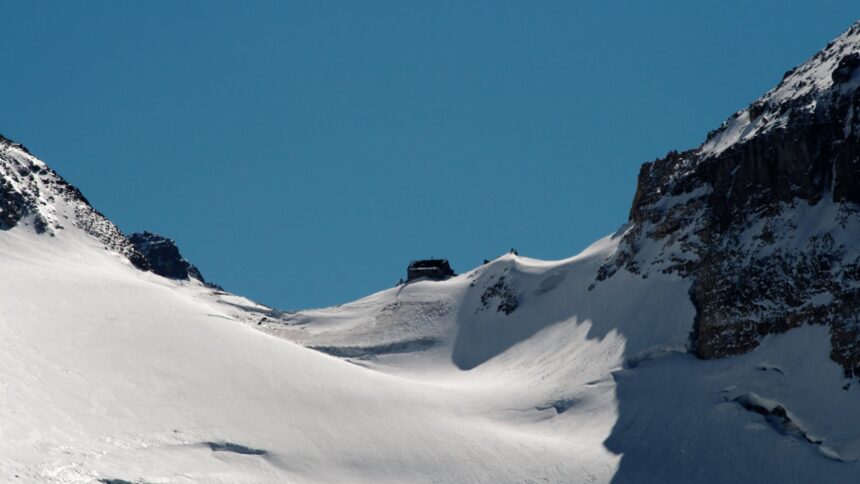
A bronze plaque stands on Abbot Pass, 2,926 metres up on the Continental Divide, at the spot where a stone hut once stood. By one account, two partial walls were left in place beside it. The Canadian Pacific Railway built the hut in 1922 on the pattern of Swiss alpine refuges, and for about a century, by our count, it served as a high shelter in the col between Mount Lefroy and Mount Victoria.
Almost everything came up on pack horses past the Lower Victoria Glacier, and the last stretch to the summit went on the backs of guides, according to Parks Canada. The stone did not travel at all. One account says it was quarried at the pass, and the Canadian Register of Historic Places describes the walls as locally sourced split stone, which is why the masonry reads as part of the mountain. The same account has guides carrying 35 kilogram packs over a crevasse on a ladder and winching sleds up the steep pitches.
Key facts
- Abbot Pass Refuge Cabin stood at 2,926 metres above sea level on the Continental Divide between Lake O’Hara and Lake Louise, according to the Parks Canada news release of February 2022.
- Parks Canada records that the Canadian Pacific Railway built Abbot Pass Refuge Cabin in 1922 and that it opened in 1923.
- Parks Canada designated Abbot Pass Refuge Cabin a national historic site in 1992 for its rustic design and its association with outdoor recreation.
- Parks Canada reports more than $600,000 spent on rock anchors in 2018, a 2021 assessment that found faster permafrost thaw than anticipated, and about 114 cubic metres of material falling from the slope in summer 2021.
- Parks Canada demolished Abbot Pass Refuge Cabin in 2022, according to its national historic site page.
The Walls Came From the Pass Itself
The finished hut had stone masonry outside and plywood inside, with a kitchen, an attic and separate dormitories for men and women, according to State of the Mountains. Parks Canada says the design honours the Swiss guides who first came to the Rockies in 1897 under the railway’s auspices.
The sources do not agree on who built it or when. Parks Canada says the railway built it in 1922 and opened it in 1923. Its 2022 release says Swiss guides built it in 1922. State of the Mountains says guides Edward Feuz Jr. and Rudolph Aemmer built it in 1923. The register says the work was sponsored by the railway in 1922 and records that Parks Canada acquired the hut in 1968 and finished a restoration in 1973.
The last years are no tidier. Parks Canada says the hut closed in 2018. A climbing publication says the Alpine Club of Canada ran it from 1985 until it closed in 2016. The elevation is 2,926 metres in the release and 2,925 metres at State of the Mountains. We use the Parks Canada figures and attribute the rest.
The Slope Under the Hut Gave Way Before the Masonry Did
When the hut went up, permanent snow and ice covered the southeast slope and protected the rock beneath it. Melt exposed that ground to thaw and surface water. State of the Mountains says instability was first reported to Parks Canada in 2016. Anchors went in during 2018, and the 2021 assessment found the thaw running faster than expected. The climbing publication reports cracks in the masonry by then.
Parks Canada weighed taking the hut apart for rebuilding and rejected it, because the limestone was likely to fracture when moved and the unstable ground put workers at risk. Even the season of the removal is reported two ways. Parks Canada’s release planned it for spring 2022, and State of the Mountains describes summer 2022. All of them agree on the year.
A Plaque Cannot Carry a Designation Alone
Parks Canada says the site’s commemorative integrity remained intact after the building went, and its release says heritage recording was completed. That is a defensible reading, since a mountaineering association belongs to a place as much as to walls. It still leaves a gap. The 1992 designation named two reasons, a building in the rustic tradition and its link to outdoor recreation, and one of those now rests on a plaque beside bare rock.
Our position is that a designation without a building owes the public the recording itself, in a form anyone can find. We did not find that recording among the pages we opened, and the same pages give three versions of the hut’s builder and two of its closing year. A hut hauled up a glacier by hand deserves a record that does not vary from page to page.
The plaque faces the ground where the walls were split from the same rock, and the slope below it is no longer held by ice.
Sources
- Parks Canada, Abbot Pass Refuge Cabin National Historic Site, accessed October 2, 2026
- Parks Canada news release, Abbot Pass Refuge Cabin National Historic Site, February 2022
- Canadian Register of Historic Places, Abbot Pass Refuge Cabin National Historic Site, accessed October 2, 2026
- State of the Mountains, The Abbot Pass Refuge Cabin National Historic Site, accessed October 2, 2026
- Gripped, Famous 100-Year-Old Canadian Mountain Hut is Gone Forever, accessed October 2, 2026