

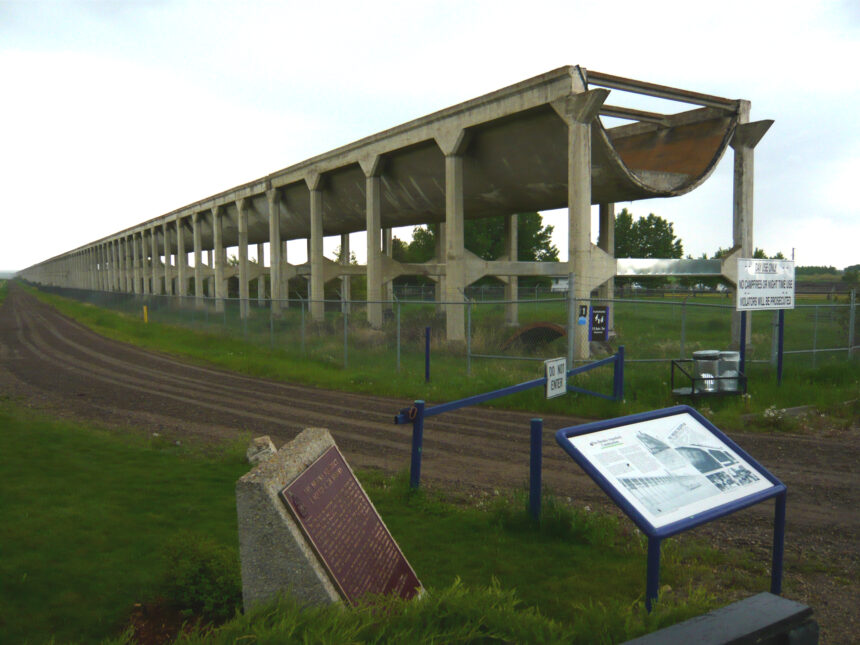
East of the town of Brooks, a long line of pale concrete arches runs across open country, going nowhere and carrying nothing. It has the look of a Roman ruin that wandered onto the prairie. It is in fact one of the boldest pieces of engineering Alberta has ever built, and for 65 years it did one of the most important jobs in the province. It moved water to land that had none.
The problem with dry land
The southeastern corner of Alberta is good country with one serious flaw. The soil is fertile and the growing season is workable, but the rainfall is unreliable, and a farm cannot run on good intentions and a dry sky. In the early 1900s, much of the land east of Brooks was semi-arid rangeland, useful for grazing and difficult for almost anything else.
The Canadian Pacific Railway had a direct interest in changing that. The railway owned enormous tracts of land across the prairies, granted to it during construction, and empty land earned nothing. Farmland sold to settlers and shipped its crops on the railway. So the CPR went into the irrigation business, and the Brooks Aqueduct was the most ambitious single piece of the plan.
Irrigation on this scale was a genuine gamble. It meant betting a fortune in concrete and steel on the promise that, once the water arrived, families would arrive too, break the land, and stay long enough to make the whole scheme pay. The CPR was confident enough to place that bet across a wide stretch of southern Alberta.
An engineering record on an empty prairie
The aqueduct was built between 1912 and 1914, and the numbers still impress.
The largest concrete structure of its kind
When it was finished, the Brooks Aqueduct was described as the largest concrete structure of its kind in existence. It ran for more than three kilometres. It carried its water in a curved channel, a shape the engineers chose deliberately to bear the load, held up on rows of concrete columns marching across the valley. Where it had to cross the railway’s own main line, the water was sent through an inverted siphon, dropping under the tracks and climbing back up the far side. All of it was hauled out to an empty stretch of prairie and assembled into a record.
What the water did
The point of all that concrete was ordinary and enormous at the same time. Water from the aqueduct reached tens of thousands of hectares of dry land east of Brooks and made it farmable. Families settled ground that would otherwise have stayed marginal grazing country. Crops grew where the map had promised very little. An entire farming district exists because the water was made to arrive.
The aqueduct was only the most dramatic piece of a much larger network of canals, ditches, and reservoirs. Together they turned the Brooks area into one of the major irrigation districts in the country, and irrigation remains the foundation of the local economy today. The concrete arches were eventually retired. The idea behind them never was.
Why a triumph became a ruin
A structure that ambitious came with a lifelong problem. Concrete and Alberta winters are old enemies, and the aqueduct spent its entire career fighting frost damage, cracks, and leaks. Keeping it in service took constant repair.
For decades, keeping the water moving was a seasonal ritual. Crews patched the concrete, sealed the joints, and nursed the structure through each winter so it would be ready to carry water again in the spring. The aqueduct worked, and it worked for a long time, but it never stopped asking to be looked after.
Replaced, not defeated
By the 1970s the engineering had moved on. A modern earth-fill canal could carry more water at lower cost and with far less maintenance, and in 1979, after 65 years of service, the aqueduct was retired and the new canal took over. The structure was not torn down. It was recognized for what it had been. The Brooks Aqueduct had been named a National Historic Site of Canada in 1983, and it stands today as a preserved ruin, open to visitors.
It is a strange and genuinely beautiful thing to come across on the open prairie, a great curving line of arches with the sky showing straight through. It is worth stopping for. The Brooks Aqueduct is proof that a good share of Alberta’s farmland was not simply discovered ready to use. It was engineered, poured, and paid for by people willing to build something enormous to make the land do what they needed it to do.