

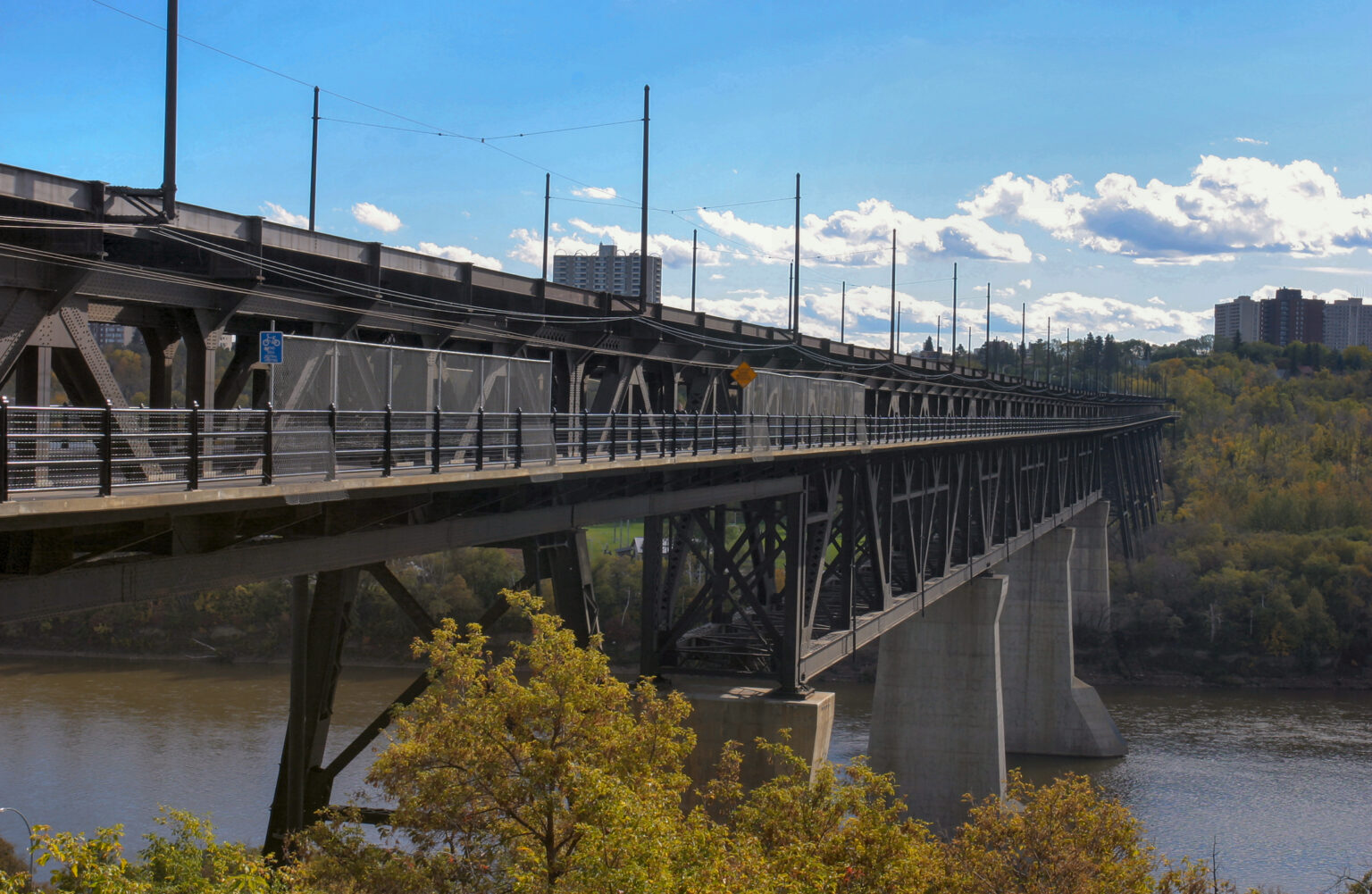
Stand under the High Level Bridge in Edmonton and look up, and the scale of the thing is faintly alarming. It is less a bridge than a steel building laid on its side across the North Saskatchewan River. When it opened in 1913, it was doing something most bridges never attempt. It was carrying trains on its roof, streetcars beside them, and automobiles and pedestrians on the deck below, all at once, all day long. More than a century later it is still standing, still working, and still one of the most recognizable structures in the province.
A bridge for a city in a hurry
To understand the bridge, you have to understand the moment. In 1912 the city of Edmonton and the city of Strathcona, facing each other across the river, agreed to become a single city. One Edmonton needed a serious link between its two halves, and a long streetcar ride down one river bank and up the other was not it.
The Canadian Pacific Railway built the answer between 1910 and 1913, and it built it to do everything at once. The upper deck was laid with three sets of tracks, the centre pair for CPR trains and the two outer pairs for the city’s streetcars. The lower deck carried road traffic and people on foot. The first train crossed on June 2, 1913, seven cars and 200 passengers easing out over open air. Streetcar service began that August. The two halves of Edmonton were finally, properly, stitched together.
The streetcar that would not stay dead
For decades the upper deck rattled with streetcars while the centre track carried trains. Then the city changed its mind about streetcars.
1951, and a useful piece of laziness
On September 2, 1951, Edmonton shut down its entire streetcar system and switched to buses. The streetcars were finished. But when the crews wound the system up, they left the rails on the High Level Bridge in place, and they left the overhead wire poles standing. It was simply easier than tearing them out. That small decision not to quite finish the job turned out to matter enormously.
A heritage line, revived
Because the rails and the poles were still there, a group of volunteers had something real to work with. The Edmonton Radial Railway Society, formed in 1980, set out to restore a heritage streetcar service across the bridge, and in 1997 the streetcars came back to the upper deck. They run there still, every summer, from the May long weekend through to Thanksgiving, carrying something like 90,000 passengers a year across the river. A piece of 1913 Edmonton kept rolling because, seven decades earlier, somebody could not be bothered to pull up the track.
The summer the bridge became a waterfall
The strangest chapter in the bridge’s history has nothing to do with trains at all.
In 1980, to mark Alberta’s 75th anniversary, the artist Peter Lewis designed something genuinely audacious. It was called the Great Divide Waterfall, and it turned the bridge itself into a fountain. On summer holidays, more than 50,000 litres of water were pumped up and sent pouring off the upper deck in a wide sheet, falling some 64 metres into the river below. That is a longer drop than Niagara. For nearly thirty years, on the right weekend, Edmontonians could watch a waterfall thunder off the side of a working railway bridge.
Why the waterfall stopped
The Great Divide ran until 2009, when the city shut it off. The water going over the side was treated, chlorinated city water, and there were genuine concerns about what that chlorine was doing to the river and the fish below it. The spectacle lost to the ecology, which is the right result and a little sad all the same. The pipework is still on the bridge. The waterfall itself is now something Edmontonians of a certain age describe to Edmontonians who are too young to have seen it.
Still on the skyline
The High Level Bridge was named a Municipal Historic Resource in 1995, and it remains in daily use, which is the truest test any piece of heritage can pass. A bridge built for a railway, in a city that has changed almost beyond recognition around it, still carries the cars, the cyclists, the pedestrians, and every summer the old streetcar. Edmonton built it to join two cities that no longer separately exist. It is still quietly doing that job, more than 110 years on.