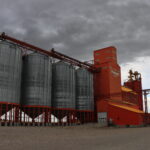
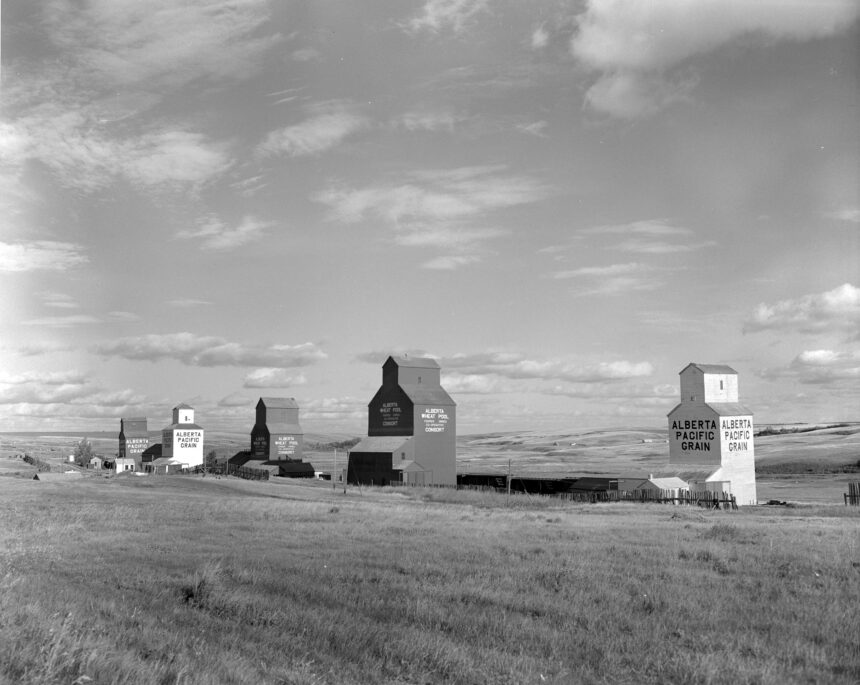
In 1934 Alberta had 1,781 wooden country grain elevators standing along its railway lines. By 2017 the provincial heritage survey could confirm 110, or about 6% of the peak, which by the Tribune’s arithmetic means the province lost roughly 94% of them in 83 years. A tall wooden box with a town’s name across the top used to be the first sign that a community existed. Fewer and fewer horizons have one.
Key facts
- Alberta’s Historic Places, the Government of Alberta’s heritage blog, states that Alberta’s count of wooden country grain elevators peaked at 1,781 in 1934.
- Alberta’s Historic Places states that 110 wooden country grain elevators remained on railway rights-of-way as confirmed in February 2017, about 6% of the 1934 peak.
- Alberta’s Historic Places states that 14 wooden elevators had been designated Provincial Historic Resources across 11 communities, including St. Albert, Leduc, Warner and Rowley.
- Alberta’s Historic Places states that the oldest surviving elevator was built in 1905 at Raley and the newest in 1988 at Woodgrove.
The count fell by 46 elevators in 12 years
The province’s own earlier survey counted 156 in 2005 and 130 in 2012. The 2017 count of 110 means 46 fewer elevators than 2005, by the Tribune’s arithmetic, and the loss has not slowed to a stop. A smaller number of larger terminals is cheaper to run, and neither the survey nor this column disputes that. The cost of that saving fell on the towns that lost their rail stop and then their elevator.
Fourteen elevators carry provincial designation and the rest carry none
The designated elevators sit in 11 communities, and the oldest designated one is at St. Albert, built in 1906. Nanton, by the earlier survey, keeps three. The Raley elevator, from 1905, is the oldest left standing in Alberta, and Woodgrove, from 1988, is the newest, so the whole history of the building type fits inside one lifetime. A designation protects 14 buildings. It does nothing for the other survivors on the rail lines.
The next decision costs less before the demolition than after it
This column’s position is that Alberta should decide about the remaining elevators now, while there are still 110 to decide about. Communities that already hold one should get modest, predictable support, and the tax treatment should reward restoration over demolition. Each elevator brought down for scrap is gone for good, and the record shows the count going the one way it has gone since 1934.
What is left is all there will be.
Updated October 7, 2026. The count of designated elevators was corrected to 14 in 11 communities, and provincial survey counts for 1934, 2005, 2012 and 2017 were added.
Related from Alberta Tribune: Prairie Sentinels and Alberta’s Vanishing Wooden Grain Elevators · The Hunt House and the Oldest Building Still Standing in Downtown Calgary · The Grain Elevator Alberta Saved Because It Photographed Well