


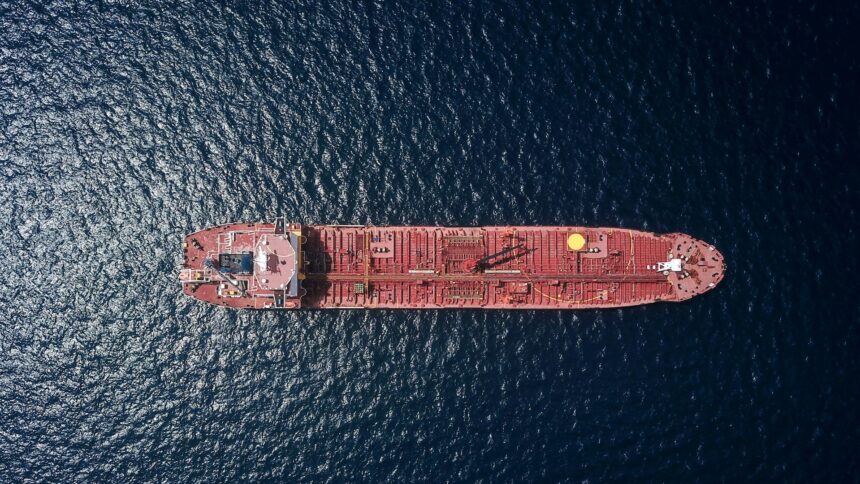
The Oil Tanker Moratorium Act, which received royal assent on June 21, 2019, bars oil tankers carrying more than 12,500 metric tons of crude or persistent oil as cargo from British Columbia’s north coast, from the northern tip of Vancouver Island to the Alaska border. The statute says nothing about price or supply security. It draws a line on a map.
This week the market put a price on lines drawn on maps. On Thursday, July 23, Brent crude settled above $100 a barrel for the first time since May, after a one-day gain of about 7%. Houthi forces had attacked two Saudi oil tankers in the Red Sea, trade through the Strait of Hormuz was close to a standstill, and the Black Sea terminal that loads Kazakh crude from the Caspian Pipeline Consortium had shut after suspected drone strikes.
Each of those disruptions sits on a coast Canada does not control. None of them touches a barrel moving from Hardisty to a refinery in the American Midwest.
Key facts
- Brent crude futures settled above $100 a barrel on July 23, 2026, for the first time since May 2026, after rising about 7% that day, according to ICE Futures Europe settlement data.
- The Oil Tanker Moratorium Act, S.C. 2019, c. 26, received royal assent on June 21, 2019, and prohibits oil tankers carrying more than 12,500 metric tons of crude or persistent oil as cargo on the north coast of British Columbia.
- The Government of Alberta submitted the West Coast Oil Pipeline to the federal Major Projects Office on July 2, 2026, proposing 1 million barrels per day to a deepwater port in southern British Columbia along the Trans Mountain corridor.
- The Bank of Canada’s Monetary Policy Report of July 15, 2026 assumes oil prices decline in line with the oil futures curve as of July 9, 2026.
- The Canada Energy Regulator reports that the United States bought about 90% of Canada’s crude oil exports in 2025, worth roughly $126 billion of $140 billion in total crude exports.
What an overland route is worth in a week like this
Alberta crude reaches its main market by pipe across a continent. No strait lies between the wellhead and the refinery, and no naval escort is needed to keep the flow moving. That property has always existed. It was rarely counted in the federal reviews that decided where new export capacity could go, which weighed emissions, spill risk and marine traffic in detail and treated supply security as a matter for another department.
The Canada Energy Regulator’s own trade figures show how concentrated the arrangement is. About 90% of Canada’s 2025 crude exports went to the United States, roughly $126 billion of $140 billion. The overland route is secure. It also leads almost entirely to one buyer, which is a separate risk and the one federal policy can still do something about.
Our earlier look at energy security as the thing that keeps the lights on made the domestic case. This week made the export case, and it was made by traders rather than advocates.
What the federal forecasts assumed before the spike
The Bank of Canada’s July report credits oil and gas with leading business investment this year, yet the forecast beneath that finding rests on the statement that oil prices “are assumed to decline in line with the oil futures curve as of July 9, 2026,” fourteen days before Brent settled above $100. The Bank is right to use the futures curve, as any forecaster would. The gap is in what federal policy builds on top of that assumption, since infrastructure approved against a calm price path will operate through years that are not calm.
A price spike is no gift to anyone. It arrives because someone else’s supply was cut, and it reverses when shipping resumes. Producers and the provincial treasury will collect more for a few weeks. The durable question is structural, and it sits in federal statute.
What the tanker law now decides about the next pipeline
Because the moratorium closes the north coast, the only new West Coast outlet on the table runs south. Alberta’s July 2 submission proposes a line from the Bruderheim area along the existing Trans Mountain corridor to a deepwater port in southern British Columbia. The route follows the law. The law was written before anyone priced what a single corridor is worth when three supply routes are disrupted in the same week, a point the northern route blocked by federal law raised in June.
If the Major Projects Office lists the West Coast Oil Pipeline and it is built as proposed, every new Alberta barrel sold to Asia will leave from one stretch of the southern coast, and the north coast will remain closed to tankers above 12,500 metric tons until Parliament amends the 2019 Act.