

Strip away the politics and the Alberta pipeline story is almost simple. There is a product the world wants, buyers lining up to sign for it, and private companies offering to pay for the pipe that would move it. What stands between that supply and that demand is not the market. It is a federal statute and a provincial veto.
The Routes Exist on Paper
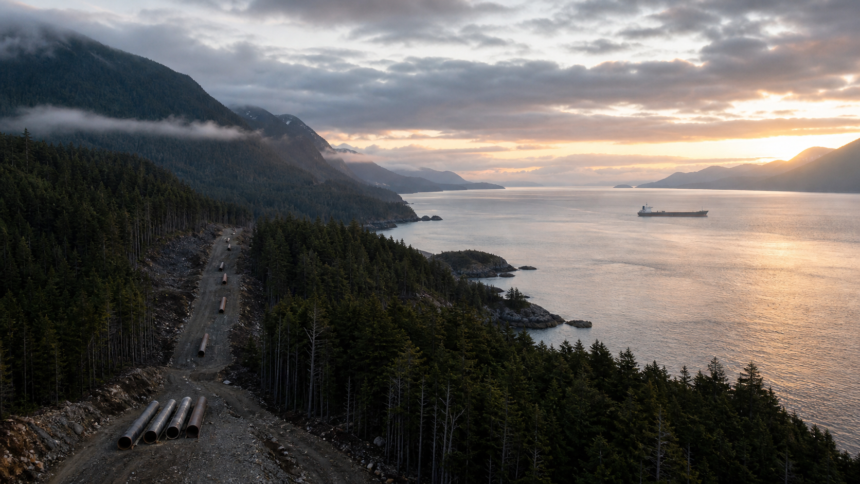
Alberta has drawn up draft maps to the Pacific. Most of the serious options run north, toward Kitimat, Prince Rupert, or the Nass, the same rugged country an earlier project once targeted. There is a southern option toward Vancouver as well. Every northern route shares one problem. It ends at a coastline where the federal government has banned oil tankers from loading, which means the path to the best Asian markets is closed before a single metre of pipe goes in the ground.
A Ban Doing the Work of a Veto
The tanker ban, passed as Bill C-48, was sold as environmental protection. In practice it works as a permanent no to oil shipping off the northern shore. British Columbia’s energy minister has already called a northern route unrealistic, which is an easy thing to say when a federal law guarantees the outcome. Ottawa cannot credibly call a new pipeline a project of national interest while keeping on the books the one law that makes the national-interest version impossible. Both positions cannot be serious at the same time.
The Indigenous Question, Honestly
This is where the conversation has to be careful and specific. Several First Nations on the north coast oppose lifting the tanker ban and travelled to Calgary to say so in person, and those objections are real and deserve a real answer rather than a slogan. It is also true that Indigenous communities are not a single bloc. Many nations across the West have become owners and partners in energy projects because the revenue funds schools, housing, and independence from federal transfers. A project built on equity ownership and genuine consent looks nothing like the top-down pipelines of the past. The path forward runs through those partnerships, not around them.
Align the Law With the Rhetoric
Alberta is doing its share of the work, mapping routes and attracting private capital that did not exist on paper a year ago, capital that earlier stalled promises never managed to secure. The federal government now has to decide whether its enthusiasm for nation-building survives contact with its own tanker ban. A barrel of Alberta crude that has to cross the United States to reach a customer is a barrel sold at a discount, which is exactly the dependence a west coast line is meant to end. The case for reaching Asian buyers directly has never been clearer. The demand is ready. The financing is circling. The wall is a choice, and choices can be unmade.
Should Ottawa revisit the tanker ban to let a privately funded pipeline reach the coast, or are the lost markets a price worth paying?