

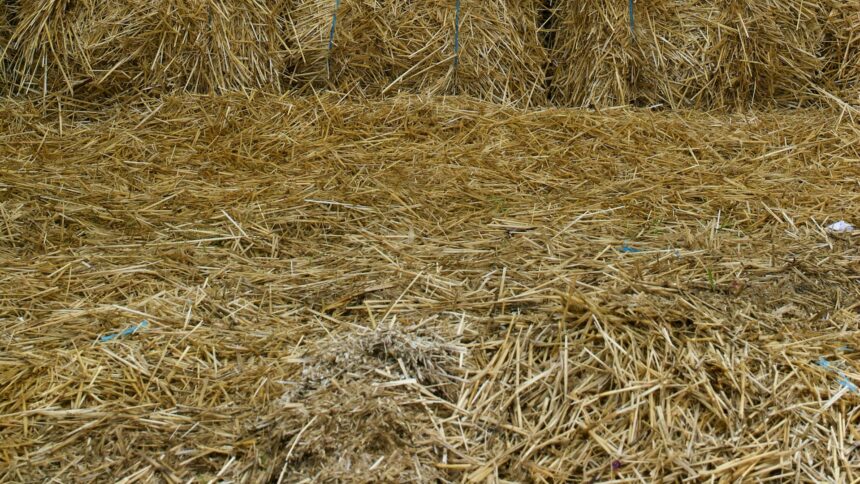
A community that waits for the right materials never builds anything. In 1953 the curlers living around Conjuring Creek, south of Calmar in Leduc County, wanted a sheet of ice under a roof and could not pay what the lumber cost. So they cut trees, stood them in post holes for a frame, stacked square straw bales where the walls belonged, packed the gaps with sawdust and laid slough grass hay over the top. The building ran about 46 metres long and stood about 2.4 metres high. Eighteen teams curled inside it that first winter.
They did not wait for a better year.
What they put up lasted until January 2011, which by our own arithmetic is 58 seasons of curling out of a material most people burn or feed. The rink took a name from a stranger’s mistake. Someone came around wanting to buy the straw, took the building for a haystack, and was told it was not for sale. After that it was The Straw Pile, and the name stuck to it for the rest of its life.
Key facts
- The Conjuring Lake Curling Club built a straw bale curling rink near Calmar in Leduc County in 1953, according to the Government of Alberta heritage blog RETROactive, 15 May 2014.
- The first building measured 150 feet long and 8 feet high, about 46 metres by 2.4 metres, and held a single sheet of natural ice, according to the Conjuring Lake Curling Club history compiled by former club members and published in 2012.
- The club held the 3.03 acre parcel, about 1.2 hectares, on a 99 year lease from Rudolph Joseph Halat and Nora Elizabeth Halat at $5.00 a year, according to the same 2012 club history.
- First prizes at the rink included jam, cigarettes, eggs and chocolate, according to the Government of Alberta heritage blog RETROactive, 15 May 2014.
- The Conjuring Lake Curling Club closed in January 2011 and the building was demolished on 13 March 2011, according to the 2012 club history compiled by former members.
How a farming community paid for a rink it could not afford
Start with the ground. Two neighbours, Rudolph Joseph Halat and Nora Elizabeth Halat, leased the club just over three acres for 99 years at $5.00 a year. By our own arithmetic that is $495.00 for the whole term, which is not a rent so much as a formality with a signature on it. The Halats were not donating land to an institution. There was no institution. There were neighbours who wanted to curl.
Then came the harder part, which was ice. Natural ice in a straw building is a season-long argument with the weather, and the club won it with whatever sat in a farm kitchen. Water pumped out of Conjuring Creek ran dark, so the members whitened it with powdered milk. They set a price ceiling on the practice. The milk went in only while a bag stayed at $5.00 or under.
Hold that detail a moment. A rink built of straw, on land that cost less than a tank of fuel, run by people who costed out the milk. That is not make-do. That is a committee doing arithmetic on a Tuesday night and deciding what the ice is worth. Between games they killed the lights to keep the cold in. Someone scraped the drips and picked the fallen hay off the sheet.
The problems kept coming and kept getting solved. An oily film turned up on the ice and nobody could account for it until the source was traced to beaver working the creek upstream. The club stopped drawing from the creek and hauled water from Wizard Lake instead. One set of rocks served the whole membership, so curlers tied tassels on to tell their own stones apart. The house was painted on by hand before plastic rings replaced the paint.
It grew the way a farm grows. In the 1956 and 1957 season the original straw and sawdust were enclosed inside wooden walls, a second sheet of ice went in, and metal roofing took over from the hay. By 1973 there was fluorescent lighting and a viewing area furnished with bench seats pulled out of cars. Rocks arrived later from the Calmar club after it folded. A heated lounge replaced the bought shack that had served as the reception room. Five generations came through it.
What the Straw Pile settles about building your own things
The temptation with a story like this is to make it tender. Resist it. Nothing about hauling water from a lake because beaver fouled your creek is tender, and the people who did it were not performing rural character for anybody. They wanted to curl in January. Curling requires ice, ice requires a building, and the building required money they did not have. So they substituted labour for capital and got on with it.
That substitution is the whole thing. Straw was not a charming choice. It was the material already sitting in the field after harvest, it insulated better than anything they could buy, and it cost the price of the twine. An honest builder would call that a good decision rather than a sad one.
Which brings me to the straw buyer, who deserves more attention than he usually gets. He drove up, looked at a 46 metre building with a door in it, and saw a haystack. He is the recurring figure in rural life. He is the person who cannot tell competence from poverty, who reads improvisation as deprivation, and who assumes that anything not bought from a catalogue must be a stopgap waiting for real money to arrive. The members told him it was their rink. They were right and he was wrong, and the name they wore for the next 58 years was the joke turned back on him.
I want to be careful about the lesson, because there is a cheap version of it and a true one. The cheap version says rural people are better off without help, which is nonsense and no farmer believes it. The true version is smaller and harder. A group of people decided that a thing should exist, understood that nobody else had any plans to make it exist, and accepted the consequence of that understanding, which was that they would have to do it themselves with worse materials than they wanted. One of the original members called it a real gathering place. That phrase does not come from a brochure. It comes from a man describing a building he helped stack, where his neighbours visited and marked the moments that matter to people, on ice he had a hand in making. The club closed in January 2011 when the numbers finally stopped working, the land sold, and the building came down on 13 March. Former members put the 60 year record into a book and gave it to the libraries in Leduc city and county. Artifacts went to the Alberta Sports Hall of Fame in Red Deer. A mural of the place hangs in the Calmar curling rink, with an original member’s broom beside it.
The straw burned. What it proved did not.