Key facts
- Rowley is a hamlet 38 km north of Drumheller with a population of eight.
- On the last Saturday of most months, Sam’s Saloon hosts pizza night. Up to 150 visitors pack the saloon; the kitchen can make about 350 pizzas in a night.
- The night is a fundraiser, and the money goes to preserving the town. Sam’s Saloon is owned by the Rowley Community Association.
- Scheduled 2026 pizza nights include October 31 and November 28.
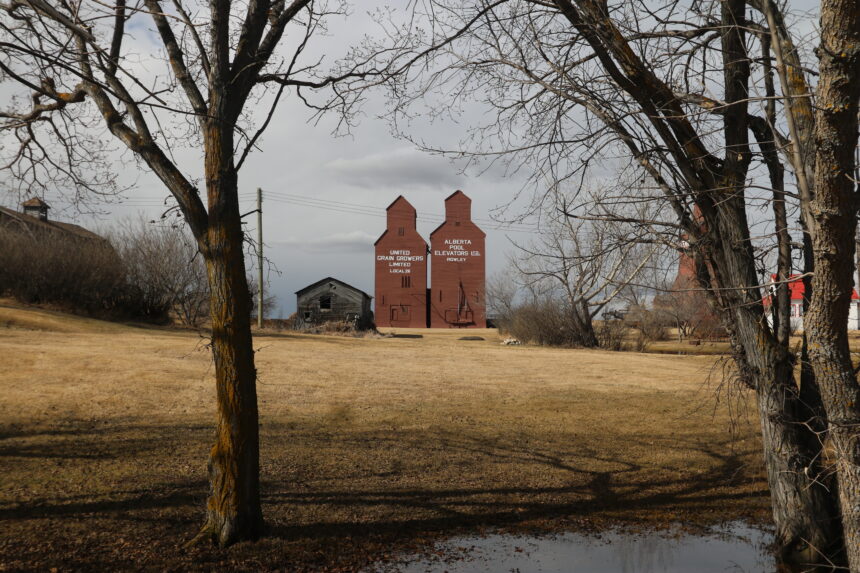
- Two of Rowley’s grain elevators are designated Provincial Historic Resources.
Rowley was about to lose its second chance. The hamlet had already survived the slow fade that empties prairie towns, had already been reborn once when a film crew arrived in 1988 to shoot “Bye Bye Blues” on its main street, and had spent the 1990s hosting thousands of tourists delivered by a private railway excursion operation. Then the railway operation pulled out, and with it went the visitors and the dollars they carried. A town of eight people stood on the edge of becoming a genuine ghost town, the kind with no pulse at all.
What happened next is the reason this column exists. A group of locals, reportedly just looking for something to eat, ended up making a pizza. Somebody had the thought that they should start selling them. On the last Saturday of most months, Rowley, population eight, now becomes one of the busiest ghost towns on the prairies.
The business model is a monthly pizza night
It is almost insultingly simple, which is why it works. Once a month, the Rowley Community Association fires up the ovens in the community hall, sells pizza to everyone who shows up, and pours drinks across the bar at Sam’s Saloon, the lovingly restored saloon on Main Street. In summer the crowd exceeds the building’s capacity; the association can make about 350 pizzas in an evening, and regulars know to order early or wait an hour. Camping on the town’s grounds is by donation. The money stays in Rowley and pays for the unglamorous work of keeping old buildings standing: roofs, paint, boards, the boardwalk.
Consider the economics from the association’s side. The fixed assets, the hall, the saloon, the town itself, are already owned. The labour is volunteer. The marketing is word of mouth and a Facebook page. Plenty of places make better pizza. What Rowley sells is the evening: a ghost town full of people, a saloon with cheap beer and live music. Scarcity does the rest. Nine nights a year, the last Saturday of each month from March to November, creates the urgency that a daily restaurant never could. Miss September and you wait for October.
Customer acquisition costs next to nothing. The retention mechanism is tradition. People who come once bring friends the next time, and the event has now run long enough that it has its own regulars, its own lore, its own stag parties. Marketing consultants charge to teach this, and Rowley does it with a Facebook page.
Pizza night beats the grant application
It is entirely within the town’s control. A grant application puts Rowley’s future in the hands of a program officer in a distant office, on a timeline measured in fiscal years, with criteria written for projects nothing like a ghost town pizza night. Pizza night puts the future in the hands of whoever shows up hungry on Saturday. The revenue arrives monthly, in cash, without reporting requirements.
There is a deeper point. Grants fund projects; pizza night funds a town. A grant pays for one roof, once, with a plaque. Pizza nights pay for whatever needs fixing, whenever it needs fixing, decided by the people who live with the consequences. The flexibility is worth more than the dollars. Small towns do not die from one big problem. They die from a hundred small ones that nobody has the budget to fix, and a steady trickle of unrestricted money is the exact antidote.
The model has limits. The capacity constraint is real: 350 pizzas is a hard ceiling on a summer night, and turning people away is a strange kind of success. The volunteer base is eight residents plus whoever drives in to help, and volunteer labour does not scale and does not retire gracefully. The whole enterprise rests on a handful of people who have been doing this for years, and small towns are unforgiving when key people step back.
Other towns could copy it
Yes, with one condition that most towns will find harder than the pizza. The model requires a town to have something worth visiting and the nerve to charge for the experience without apology. Rowley has the elevators, the saloon, the main street, and a story that tells itself. Plenty of fading towns have equivalents: a hall, a rink, a main street with good bones. What they often lack is the willingness to treat the town itself as the product and to ask visitors to pay, directly and cheerfully, for its survival.
The alternative is the familiar one. Wait for a grant. Wait for the province to notice. Rowley tried waiting, in the years after the railway operation left, and the answer was the pizza oven. There are other Rowleys across Alberta at various stages of the same fade, doing the same waiting. Pizza night is a town deciding that its survival is its own job.
The next hard decision is the one Rowley has not faced yet: who runs the ovens in ten years. Eight residents cannot do this forever, and the model has no succession plan beyond the hope that the regulars become the volunteers. Every small town that copies Rowley will face the same question eventually. But it is a better problem than the one they had before, which was no town at all.
On the last Saturday of the month, the ovens fire up, the saloon fills, and one of the busiest ghost towns on the prairies gets a little less ghostly for one more night.