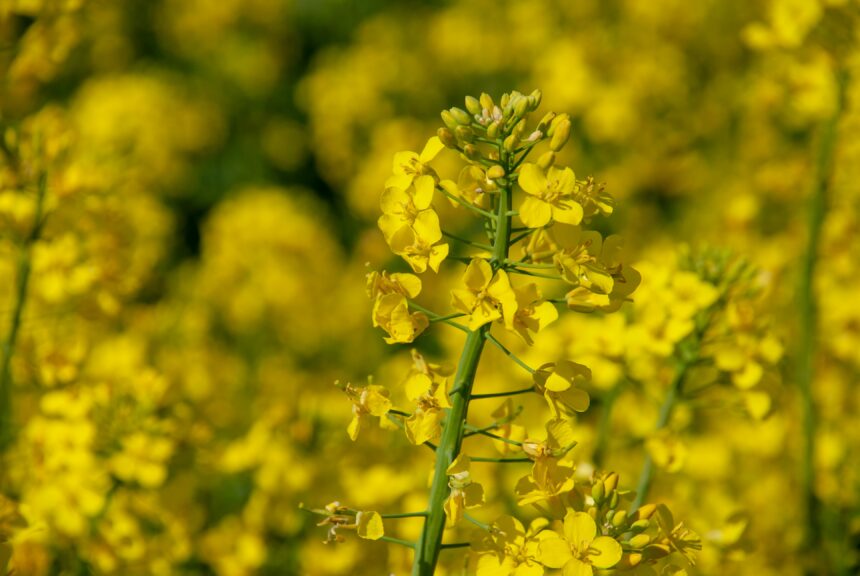
Alberta’s canola is coming off the field right now into a trade arrangement with an expiry date on it. December 31. That is roughly four months of certainty for a crop that has to be marketed over a full year.
Key facts
- The Canola Council of Canada reports that China’s 100% tariff on canola meal was set to 0% for March 1 to December 31, 2026.
- The anti dumping duty on canola seed fell from 75.8% to 5.9%, cutting the combined seed rate from roughly 84% to about 15%.
- The Canola Council says the 5.9% anti dumping duty on seed applies for five years.
- Global Affairs Canada says Canada allows an annual quota of 49,000 Chinese electric vehicles at a 6.1% tariff as of March 1, 2026.
- Global Affairs Canada puts the affected canola seed exports at about $4 billion a year.
China’s tariff wall against Canadian canola came down in stages this year, and the stages did not come down evenly. On March 1 the 100% duty on canola meal was suspended. The anti dumping duty on canola seed fell from 75.8% to 5.9%, which took the combined rate on seed from roughly 84% to about 15%. Two very different pieces of relief arrived on the same morning, and only one of them was built to last.
Five years for the seed and ten months for the meal
The seed ruling carries a five year term. The meal suspension does not. It runs from March 1 to December 31 of this year, and unless somebody negotiates an extension it simply lapses and the old rate is available again.
That distinction never made the headlines the way the tariff relief did, and it should have. A five year ruling lets a crusher sign contracts, finance an expansion and plan a hiring schedule. A ten month suspension lets a marketer sell into the fourth quarter and hope.
The money involved is not small. Seed exports covered by the lower duty run about $4 billion a year, according to Global Affairs Canada.
What Ottawa traded to get it
The relief was not a gift. It came alongside a January arrangement that lets China send an annual quota of 49,000 electric vehicles into Canada at a 6.1% tariff, effective the same day as the canola relief.
Set the terms side by side. The seed duty runs five years. The meal suspension runs ten months. A producer who sells meal got a growing season, and a crusher who sells seed got a half decade.
The suspension runs to the end of 2026, and anything longer has to be negotiated. A suspension is not a contract, and it is not what a lender looks at when a producer near Vermilion or Falher asks about financing next spring’s inputs.
None of this is a reason to run down the negotiators. Getting an 84% wall down to 15% inside a single year is a real result. The criticism is narrower and it is about term length. The meal suspension is the temporary half, and the sector holding it carries the risk alone.
The part nobody can tariff
Domestic crushing is the structural answer. A tonne of canola crushed in Alberta and sold into a North American market is a tonne no foreign ministry gets a vote on.
That is the structural answer, and it is slower than anybody wants. Crush plants take years. Offtake agreements take longer. But every tonne of processing capacity built inside the province is a permanent reduction in how much pull a foreign trade ruling has over an Alberta harvest, and it is the one variable Alberta controls without asking Ottawa for anything.
Producers are already managing enough this year. The province has extended the AgriStability deadline, and Alberta’s harvest has split badly between the north and the south. A trade file with a countdown clock on it is the last thing anyone needed stacked on top.
Four months and a crop to sell
The practical test for the rest of this year is whether the meal suspension gets extended before the calendar runs out, and whether the extension comes with a term that lets a business plan against it.
If it does, this reads as a slow negotiation that landed. If it does not, then Alberta producers spent a season selling into a window somebody else set, and the next round of talks starts from a weaker place because the other side already knows the deadline works.
The crop is in the bin either way. The terms are the only thing still up for grabs.
Global Affairs Canada can say whether the meal suspension will be extended before December 31, and producers need that answer before they book 2027 inputs.
Related from Alberta Tribune: Canada’s Biggest Trade Deal Now Gets Reviewed One Year at a Time