

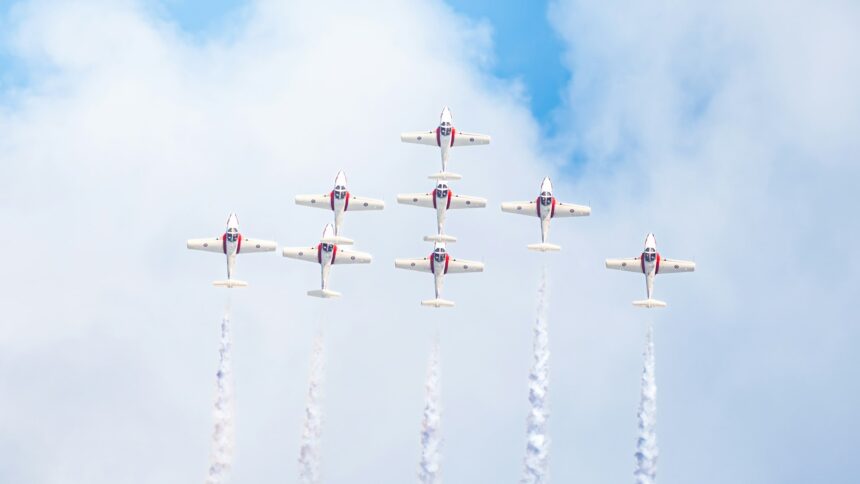
The CT-114 Tutor was never built to impress anybody. It was built to teach. The Royal Canadian Air Force took the aircraft into service in 1963 as its basic pilot training machine and kept it in that job until 2000, which means most of the people who will look up at McMahon Stadium on 15 November learned nothing in one and never met anybody who did. The Canadian Forces Snowbirds have flown the Tutor since 1971. At the 113th Grey Cup in Calgary, the team flies it in public for the last time.
Key facts
- The Canadian Football League awarded the 113th Grey Cup to Calgary on 8 November 2024, setting the game for 15 November 2026 at McMahon Stadium.
- The Royal Canadian Air Force used the CT-114 Tutor as its basic pilot training aircraft from 1963 until 2000, per the Snowbirds information pages published by the Royal Canadian Air Force on canada.ca.
- The Department of National Defence stated on 19 May 2026 that the Snowbirds have flown more than 2,700 air displays for more than 140 million spectators since the team began.
- The same Department of National Defence release named the CT-157 Siskin II, a variant of the Pilatus PC-21, as the replacement aircraft, with Snowbirds capability expected to be operational in the early 2030s.
- SkyAlyne Canada, a joint venture of CAE and KF Aerospace, was awarded the federal Future Aircrew Training contract on 29 May 2024 at $11.2 billion including taxes over 25 years, covering more than 70 aircraft across five fleets.
A training aircraft became the one Canadians actually recognize
There is something worth sitting with in the fact that the most recognizable aircraft in the country is a classroom. The Tutor was designed to be forgiving, predictable and cheap to run, because the job was to take somebody who could not fly and hand back somebody who could, over and over, for thirty-seven years. Nothing about that job asks for beauty. The beauty arrived later, when a group of instructors at Moose Jaw started flying formation in aircraft that were already familiar to every airfield in the country, and the familiarity turned out to be the point.
That is usually how these things go here. The objects Albertans end up caring about were almost never built to be cared about. A grain elevator was a machine for moving wheat. A wooden rink was a cheap way to keep a town from going quietly mad in February. The Alberta flag was a piece of provincial administration before it was a thing anybody hung in a window. Affection attaches itself to the practical, given enough time, and then somebody has to decide what to do when the practical thing wears out.
The replacement does not arrive for years after the retirement
Here is the part of this that will not make the highlight package. The Tutor fleet retires after the 2026 season, and the Siskin II capability is not expected to be operational until the early 2030s. Between those two points the country has no display team. The squadron stands down. Whatever your view of military air displays, and reasonable people hold several, the practical result is that a public ritual which has run every summer since 1971 is about to stop for something on the order of five years, and the decision that produced that gap was taken quietly enough that almost nobody outside the air force noticed.
Nobody did anything wrong. That is what makes it worth writing down. Aircraft age out, contracts take the time contracts take, and the Future Aircrew Training programme is a genuinely large piece of work covering five fleets and more than 70 aircraft, not a single ceremonial purchase. But a country that lets a thing lapse for five years is making a bet that people will still be interested at the end of it, and that bet has been lost before. The small museum that closes for renovations and never reopens. The parade that skips a year for weather and then skips the next one for nobody in particular. Continuity is a thing you either fund or discover you have lost.
What Calgary is actually looking at on 15 November
A Grey Cup flypast usually lasts under a minute, and people who care about it plan their whole afternoon around that minute. This one carries a little more. The aircraft overhead entered Canadian service the year before the Calgary Stampeders last won a Grey Cup at home under the old stadium arrangement, taught several generations of pilots how to hold a heading, and then spent fifty-five years being the thing children pointed at. It goes out over a football field in Alberta in the middle of November, which is a very Canadian set of circumstances for a farewell.
Go if you can. Not for the football, although the football will be there, and not because anybody is asking you to feel a particular way about the air force. Go because this is the last time the thing happens, and because the province has an uneven record on preserving its own record of what it used to have. Somebody will take a photograph. Somebody always does, and forty years on that photograph will be the only evidence a grandchild accepts.
Nine white and red aircraft, a smoke trail thinning out over the Bow, and then an empty piece of November sky that stays empty until the 2030s.