

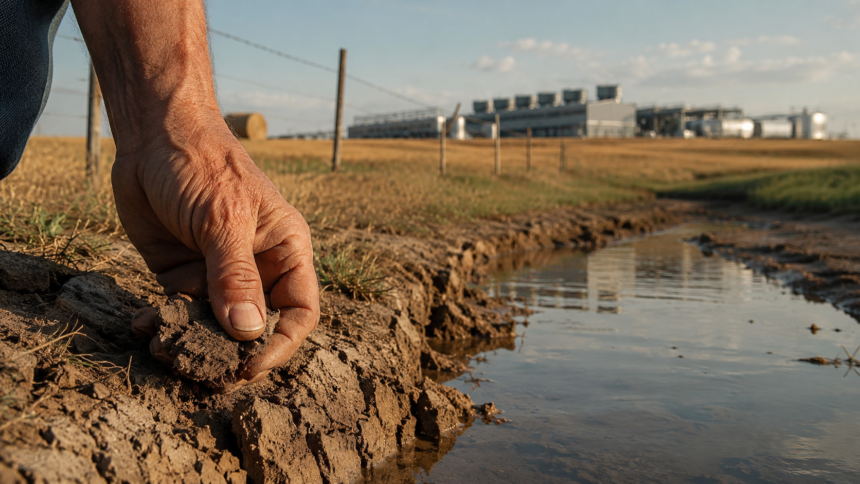
Water is the one thing the prairies never quite have enough of in a dry year. Ask any rancher who has watched a dugout shrink in August, or any irrigation district that has rationed its members through a drought. So it should stop people cold to learn how much of Alberta’s data centre rush is being planned in exactly the places that can least spare a drop.
Many of the data centre campuses proposed in this province sit in regions already rated under high or extremely high water stress. Evaporative cooling at a large facility can draw heavily on local supply, in basins where farmers, feedlots and towns already compete for the same river.
The farm was here first
Alberta can welcome AI and still protect the people who grow its food from paying for it in lost water. Rocky View County is gathering public feedback on a strategy for the data centre sector, and neighbouring landowners are right to ask what it means for their supply. A finite resource has to be counted before it is promised.
The technology to do this right already exists
Here is the part the loudest promoters tend to skip. Data centres do not have to be thirsty. Closed-loop and air-based cooling systems use a fraction of the water of older designs, though they draw more electricity. In a dry southern basin, that should not be a nice-to-have. It should be the price of admission. If a company wants to build here, it can build the version that does not compete with a hay crop. Make it a condition of the licence and let the market sort out who is serious.
Put the watershed in the room
The fix is not complicated. Irrigation districts, municipalities, and the farmers downstream should be at the table before a single water licence is granted, not informed after the fact. Alberta can absolutely chase the largest projects on the continent and still insist that water for people, livestock, and crops comes ahead of water for servers. Those two goals only conflict if they are allowed to. The same principle applies whether the project is a giant in the north or a campus next to a small town that deserves a real say in what happens to its supply.
In a dry year, will Alberta Environment and Protected Areas say whether the feedlot down the road or the server hall on the edge of town gets the water first?