

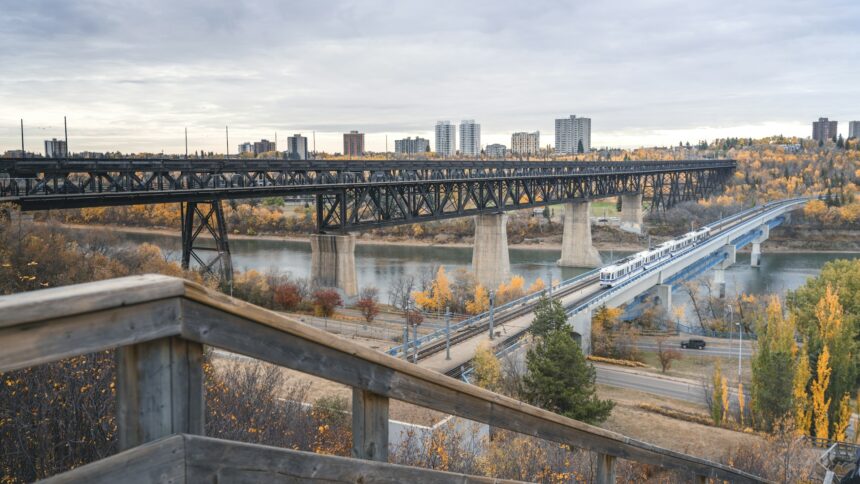
Bylaw 11114 is the line in Edmonton’s books that decides what happens to the High Level Bridge. City council passed it on Sept. 13, 1995, and it made the bridge a Municipal Historic Resource under Alberta’s Historical Resources Act.
- Key facts
- What the heritage designation controls
- What the bridge costs each Edmontonian
- Who uses the bridge besides commuters
- When residents get a say on the bridge
- Frequently asked questions
- What is Bylaw 11114 and why does it decide the High Level Bridge’s future?
- Can the High Level Bridge’s heritage protection be repealed without public notice?
- What would replacing the High Level Bridge cost compared with maintaining it?
- Who uses the High Level Bridge besides commuters?
- Why did the National Trust put the High Level Bridge on its Endangered Places List?
That High Level Bridge designation is why nobody can alter the steel without council saying yes first. Under the same Act, council can also take the designation away, and the section that allows it sets no notice requirement at all.
The timing matters. On Sept. 17 the National Trust for Canada put the bridge on its Endangered Places List for 2026, the only Alberta site on it. The listing followed a city report in May that, as the Edmonton Journal and CBC reported it, put the cost of replacing the High Level and Low Level bridges at $1.3 billion or more. Global News reported a figure closer to $1 billion. A council committee took the report on May 25 and made no decision.
Key facts
- The National Trust for Canada named Edmonton’s High Level Bridge to its Endangered Places List for 2026, released on Sept. 17, 2026, and it was the only Alberta site on the list (National Trust for Canada).
- The City of Edmonton designated the High Level Bridge a Municipal Historic Resource through Bylaw 11114 on Sept. 13, 1995 (Alberta Register of Historic Places).
- The Canadian Pacific Railway built the High Level Bridge between 1910 and 1913, and the Canadian Register of Historic Places records its length as 777.24 metres (Canadian Register of Historic Places).
- Section 26 of Alberta’s Historical Resources Act requires council approval before a designated Municipal Historic Resource is altered, and section 26(10) allows council to repeal the designating bylaw (Historical Resources Act, Alberta King’s Printer).
What the heritage designation controls
Read section 26 slowly, because the whole fight lives there. Subsection 6 says a designated site cannot be altered without council’s approval. Subsection 7 gives council absolute discretion over that approval. Subsection 10 lets council repeal the bylaw that made the designation in the first place, and nothing in it requires the city to tell residents first.
Repeal is meant to be rare. A $1.3 billion price tag has a way of making rare things look practical.
Edmonton has been here before with big steel. The CPR’s other great Alberta crossing, the viaduct at Lethbridge, went up in the same decade for the same railway, and southern Alberta still counts it among the province’s proudest pieces of engineering.
What the bridge costs each Edmontonian
Our arithmetic, built on the reported totals and a city of roughly 1.2 million people from the Alberta Regional Dashboard: replacing both bridges at $1.3 billion works out to about $1,083 for every resident. The maintenance figure in the same reporting, $380 million, works out to about $317 a resident. Over 75 years, the reported cost to rehabilitate the bridges runs past $1 billion.
Those numbers are the argument. Keeping the bridge is not free, and nobody serious says it is. The reported maintenance figure is still less than a third of the replacement figure, and it keeps a structure the province already recognizes as worth protecting.
Who uses the bridge besides commuters
The top deck still carries a streetcar. The Edmonton Radial Railway Society runs the High Level Streetcar across it, and the society reported more than 90,000 riders in 2019. This year’s season runs to Oct. 12. That is a working piece of Alberta history paying some of its own way every summer, which is more than most heritage files can say.
When residents get a say on the bridge
The 2027 to 2030 budget goes to council in November, and deliberations run in December. That is where the maintenance money either appears or does not. Residents who want to be heard can reach the city through 311 and ask for the bridge line in the capital plan by name.
Council could also fix the notice gap on its own by committing to public notice before any heritage repeal comes to a vote. The Act does not demand it. Good practice would.
December will tell us which way this goes. Bylaw 11114 should still be on the books when it ends.
Frequently asked questions
What is Bylaw 11114 and why does it decide the High Level Bridge’s future?
Edmonton City Council passed Bylaw 11114 on Sept. 13, 1995, designating the High Level Bridge a Municipal Historic Resource under Alberta’s Historical Resources Act. Section 26 of the Act says a designated site cannot be altered without council’s approval, and it gives council absolute discretion over that approval. That is why no change to the bridge’s steel can proceed without council saying yes first.
Can the High Level Bridge’s heritage protection be repealed without public notice?
Yes. Section 26(10) of the Historical Resources Act lets council repeal the designating bylaw, and nothing in that section requires the city to tell residents first. A repeal follows the regular bylaw process, with the repeal bylaw served on the registered owner and discharged from the land titles registry. Council could close the gap itself by committing to public notice before any heritage repeal comes to a vote.
What would replacing the High Level Bridge cost compared with maintaining it?
A city report released in May 2026 put the cost of replacing the High Level and Low Level bridges at $1.3 billion or more, as the Edmonton Journal and CBC reported it. Global News reported a figure closer to $1 billion. The same reporting put the maintenance figure at $380 million. Working from those figures and a city of roughly 1.2 million people, replacement works out to about $1,083 for every resident against about $317 a resident for maintenance.
Who uses the High Level Bridge besides commuters?
The top deck still carries a streetcar. The Edmonton Radial Railway Society runs the High Level Streetcar across the bridge and reported more than 90,000 riders in 2019, with this year’s season running to Oct. 12. The Canadian Pacific Railway built the bridge between 1910 and 1913, and the Canadian Register of Historic Places records its length as 777.24 metres.
Why did the National Trust put the High Level Bridge on its Endangered Places List?
On Sept. 17, 2026, the National Trust for Canada named the High Level Bridge to its 2026 Endangered Places List, the only Alberta site on it. The listing followed the May city report pricing replacement of the High Level and Low Level bridges at $1.3 billion or more. The next decision point is the 2027 to 2030 capital budget, which goes to council in November with deliberations in December, which is where the maintenance money either appears or does not. Residents who want to be heard can reach the city through 311 and ask for the bridge line in the capital plan by name.