

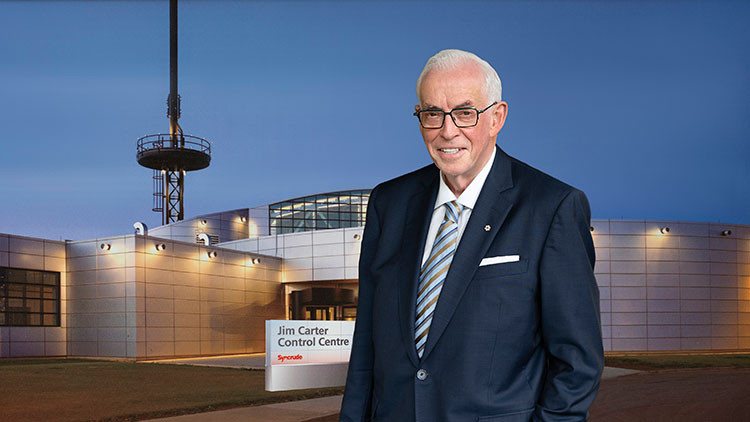
Jim Carter was 29 and one of the youngest managers at Syncrude Canada when his team helped pioneer hydro-transport technology mixing oil sand with water and pumping it through a pipeline so the bitumen separates along the way. The Government of Alberta credits the system with cutting the energy needed to produce a barrel of bitumen by 40%, and says the industry later adopted it widely. It is one marker of a career that took him from a Prince Edward Island dairy farm to the top job at Syncrude. In 2023 he was inducted into the Alberta Order of Excellence.
He came from Glasgow by way of a PEI dairy farm and a Grande Cache coal mine
James Edward Clarke Carter was born on February 4, 1950, in Glasgow, Scotland, the second of five children of a farmer father and a homemaker mother active in community volunteering. When Jim was nine, the family emigrated to Canada so his father could manage a dairy farm on Prince Edward Island, and by age 12 Jim was already repairing farm machinery, an experience he later credited with teaching him nearly as much as his engineering degree. He studied at the University of Prince Edward Island and the Technical University of Nova Scotia, earning his Bachelor of Mining Engineering degree in 1973, then worked for the Iron Ore Company of Canada in Labrador before joining McIntyre Mines’ coal operation in Grande Cache, Alberta, where he was promoted to surface mine manager of a 400-person open pit operation by age 27.
His team changed how Syncrude moved oil sand
In 1979 Carter joined Syncrude to start its overburden operations team and soon made the contested call to double the capacity of the company’s haul trucks and develop far larger shovels, a decision that eventually reshaped the entire mining operation. His team then developed double-roll crushing technology to break down oil sands lumps, which led directly to the hydro-transport breakthrough, mixing oil sand with water and pumping it through a pipeline so the bitumen separated naturally along the way. He rose through Syncrude’s ranks, becoming Vice President of Finance and Administration after completing Harvard’s Advanced Management Program in 1987, then serving as the company’s President and Chief Operating Officer from 1997 to 2007.
He built a workforce and a community alongside the industry
Carter has described building the company, the industry and the community as one job done at the same time. He joined the Keyano College Board of Governors in Fort McMurray and helped launch its Co-op Apprenticeship Program in 1992, which more than 2,000 young people have since completed. In 1997, that program became the foundation for CAREERS: The Next Generation, co-founded with then Syncrude president Eric Newell, which has introduced more than 500,000 high school students to careers in the skilled trades. CAREERS: The Next Generation is still running, and Carter still chairs its board.
After Syncrude he moved into boards and public service
Carter served 12 years on the board of the Mining Association of Canada, including two as chair, where he helped launch the Toward Sustainable Mining program that is now a global standard for the industry. As a director of the Alberta Chamber of Resources for more than 20 years, he rallied the province’s mining industry in 1992 to save the University of Alberta’s Mining Engineering program from being shuttered. After retiring from Syncrude in 2007, then Premier Ed Stelmach asked him to lead the Alberta Carbon Capture and Storage Development Council, and he went on to serve on the boards of Finning International, EllisDon, Irving Oil and the Edmonton Symphony Society. Carter has received three honorary doctorates and was made an Officer of the Order of Canada in 2014. He and his wife Lorraine live on an acreage near Edmonton, where every winter he builds an outdoor rink for a family that now includes 20 grandchildren and one great-grandson.