

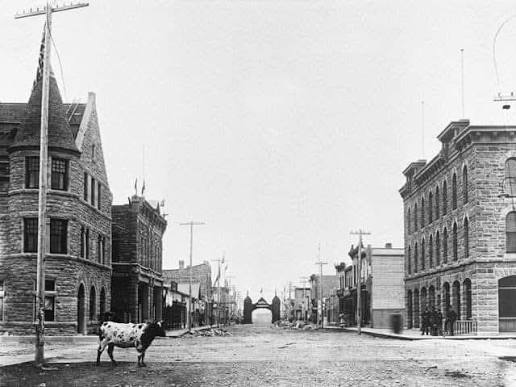
Stephen Avenue in downtown Calgary is a National Historic Site of Canada, recognized in 2002. The Canadian Register of Historic Places describes a commercial district built between 1880 and 1930, a period known as the Sandstone Era, with nearly three dozen commercial buildings, several former banks and one church.
A retail street built around the railway
The register says the district illustrates prairie urban development: a street oriented to the railway, laid out on a gridiron plan and devoted to retail. Its value lies in a distinctive late nineteenth century retail streetscape in a growing prairie city.
Masonry gave the street its look
Early Calgary was built largely in wood, and a fire in 1886 pushed the downtown toward masonry. The buildings that followed are two to six storeys, mostly masonry, with flush facades along the sidewalk, rear alleys and ornate cornices and stone string courses that give the street its unity. The Hudson’s Bay Company store, clad in terra cotta, is the tallest and largest building in the district.
Still a working street
Stephen Avenue was not preserved as a museum strip. Shops, restaurants and offices operate behind the original facades, and that continued use is a large part of why the buildings survived the urban renewal that gutted so many other main streets. Calgary kept the buildings because they stayed useful.
Correction. An earlier version claimed the street holds more sandstone than any other in western Canada, gave a fire date and listed individual buildings with construction dates the register does not support. Those claims were removed.
Related reading from the series. The Hunt House and the oldest building still standing in downtown Calgary. Fort Calgary and how a Mounted Police post became the city of Calgary.
Related from Alberta Tribune: Imperial Bank of Canada Building and How Calgary Got Its First Bank