

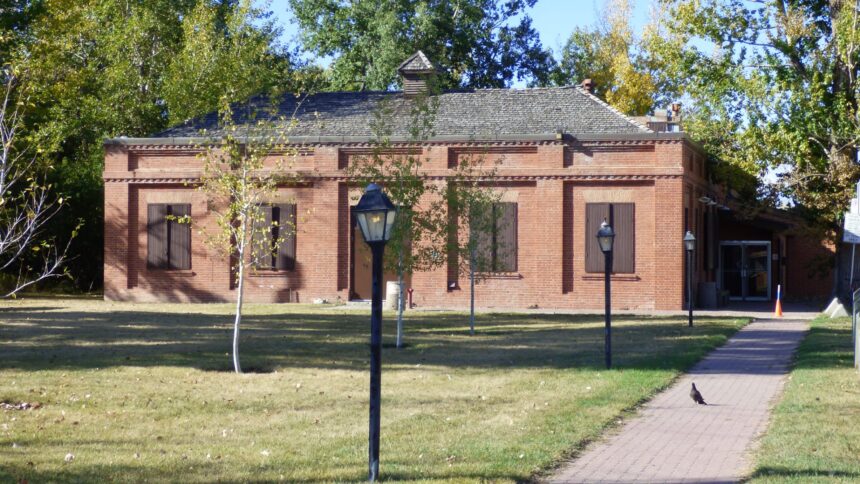
One of the two large original pumps is still in Bow River Pumphouse No. 2 in Calgary, according to the register, and a timber-truss roof spans the whole floor without interior supports. Each pump ran on a 450-horsepower electric motor. The walls are load-bearing pressed brick, with regularly spaced piers down the outside.
It is a Calgary theatre now, which is the part most people know.
Its story starts with a city that had once bought its water by the barrel.
Key facts
- Bow River Pumphouse No. 2 on the south bank of the Bow River in Calgary’s Sunalta neighbourhood was built in 1913 of load-bearing pressed brick, according to the Canadian Register of Historic Places.
- The Canadian Register of Historic Places records that the pumphouse supplied 68,191,350 litres a day, nearly tripling the capacity of the system before it.
- Two centrifugal pumps with 450-horsepower electric motors drew water through a reinforced concrete flume 183 metres long, according to the Canadian Register of Historic Places.
- The Canadian Register of Historic Places lists the pumphouse as a Canadian Water Landmark in 1980.
- The University of Calgary Archives records that the pumphouse was built to house pumping equipment for the city’s 40,000 residents.
The City Had Been Buying Its Water by the Barrel
When Calgary became a town in 1884, residents bought drinking water at $0.25 a barrel, according to the City of Calgary Archives. The Calgary Gas and Waterworks Company installed a modern system in 1890, and the city bought it in 1900, making water its first municipally owned utility. A plebiscite in 1907 paid for a gravity intake on the Elbow River near Springbank, but the archives list low pressure in winter and muddy, fishy water in spring among its faults.
Pumphouse No. 2 changed the arithmetic in 1913. By the register’s figures it supplied 68,191,350 litres a day, nearly tripling what the system had managed before. Water entered through a concrete flume 183 metres long and reached the pumps from there.
The Building Was Made for Machines
The register describes a building planned around its equipment. Load-bearing brick walls carry the roof, the floor is left open, and a steel track encircling the interior could move 9.1 tonnes of equipment when repairs were needed. An avenue of mature poplars leads to it. From 1913 the pumphouse was the city’s main intake, and the register says it became a booster station in 1933 and served that way until 1967.
Nobody Agrees When It Stopped Pumping or Started Performing
The register has the building serving the water system from 1913 to 1967. The theatre’s own history says the pumphouse closed in 1968. The University of Calgary Archives says it operated for about two decades before being abandoned. The first two are a year apart. The third describes a different story altogether.
The theatre dates are no tidier. The register says the building has been the Pumphouse Theatre since 1977. The theatre says Joyce Doolittle saw its potential as a performance venue in 1971, construction began in 1972, and the Calgary Youth Drama Society opened the Shed Theatre in 1973. Municipal designation is 1996 in the register and 1990 on the theatre’s page. The theatre records a provincial architectural heritage award in 1975, the register records provincial registration in 1975, and the archives record a heritage award for architecture in 1984. The society became the Pumphouse Theatres Society in 1988 by the theatre’s account and in 1987 by the archives’.
In 1982 the pump room became the Joyce Doolittle Theatre and the shed became the 300-seat Victor Mitchell Theatre. The theatre counted its millionth patron in 2005.
Reuse Is Not the End of the Research
Calgary is right to celebrate a utility building that found a second life instead of a wrecking ball. By our count the sources reviewed differ on at least five dates, among them the end of service, the start of the theatre, the municipal designation, the heritage award and the renaming of the society. None of the differences is large enough to matter on a stage. Together they matter a great deal to a heritage record, which is only as good as its least checked number.
A pumphouse earns protection by what it documents, so the position here is simple. The society and the city archives should issue a single sheet with the closing year, the opening year and each designation, and cite the file for each. It would take one afternoon with the files.
The pump room is a theatre now, under the same timber trusses, with one of the two big pumps still in the building.