

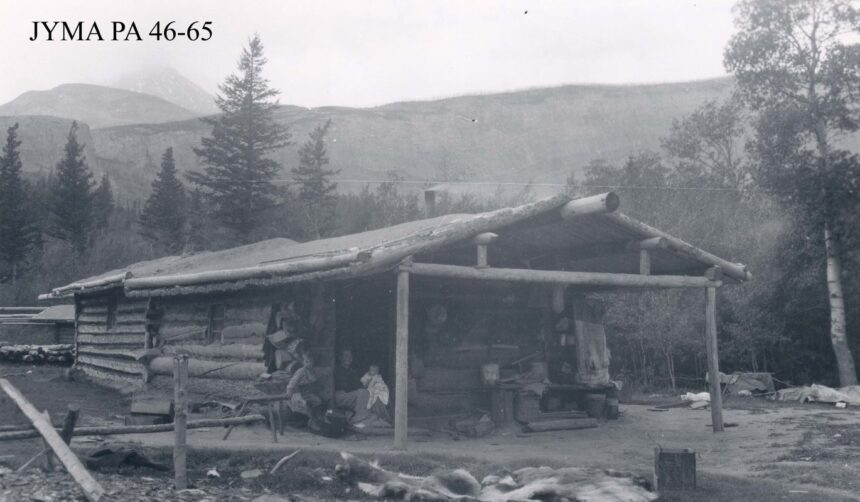
Jasper House is one of those Alberta heritage sites with an outsized job. The post itself was small. The country around it is now national park. There is nothing to see at the original site except a Parks Canada cairn at a roadside pullout 31 kilometres east of the Town of Jasper. The post still earned a National Historic Site designation in 1924 because for fifty-four straight years it provisioned the brigades that crossed the Athabasca Pass. The town of Jasper, the national park, and the railway division all carry the name because of this post.
A small post with a strategic job
Jasper House was built in 1830 by the Hudson’s Bay Company on the upper Athabasca River. It replaced an earlier 1813 NWC post in the same general area called Henry House. The location was chosen for one specific reason. It sat at the eastern foot of the Athabasca Pass and served as the supply station for brigades moving between the western interior of the country and the Columbia District, which at the time covered the modern Pacific Northwest from southern British Columbia down to Oregon.
The Athabasca Pass and what it carried
The Athabasca Pass was the working route through the Rockies during the central decades of the nineteenth century. The Howse Pass that David Thompson had mapped earlier proved too dangerous for regular brigade traffic after a series of incidents in the late 1810s. The Athabasca Pass replaced it. It was higher, harder, and longer than Howse, but it could be reliably travelled.
Brigades, supplies, the Columbia District
Every HBC brigade going west, in either direction, stopped at Jasper House.
- Westbound brigades resupplied for the climb to the pass and the descent into the Columbia.
- Eastbound brigades from the Columbia District restocked at Jasper House before the run down the Athabasca to Fort Assiniboine and on to Edmonton.
- Mail, personnel, trade goods, instructions, and finished furs all passed through.
The post was the bottleneck. Whatever the country needed to move had to come through Jasper House to make the crossing work.
1884 and the railway changes everything
Jasper House closed in 1884. The Canadian Pacific Railway crossed the Rockies further south through Kicking Horse Pass. The HBC reorganised its western logistics around the railway, and the small mountain post on the Athabasca lost its commercial reason to exist. The Town of Jasper that grew up later in the early twentieth century is railway-era construction, located further west along the route the Grand Trunk Pacific Railway built through Yellowhead Pass starting in 1912.
The site was designated a National Historic Site of Canada on June 4, 1924, and is listed on the Canadian Register under ID 7884.
How mountain corridors still decide things
The buff opinion is that every working western corridor traces back to a pass that earned it. Howse, Athabasca, Kicking Horse, Yellowhead, Crowsnest. Each one took its turn being the dominant crossing for some specific period of the western economy. The pattern keeps repeating. Whichever pass works carries the brigades, then the railway, then the highway, then the pipeline. The current Alberta arguments about pipeline corridors to the Pacific are the latest chapter in a story that started at Jasper House in 1830. The country forces the conversation. You can argue about routes for as long as you like, but the mountains are not voting.
Listed on the registry. Jasper House appears on the Canadian Register of Historic Places as Site ID 7884 and was designated a National Historic Site of Canada on June 4, 1924. The site is interpreted today by Parks Canada in Jasper National Park.
Related reading from the series. Fort Assiniboine and Alberta’s first multimodal freight hub. Rocky Mountain House and the maps that built the West.