

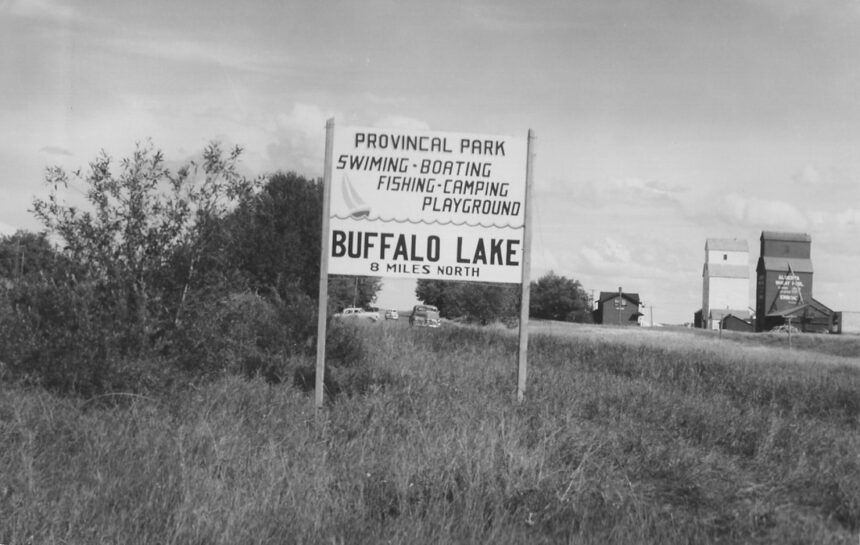
In the winter of 1872 and into the late 1870s, the largest community of any kind in central Alberta was not a fort. It was not a mission. It was a Métis wintering settlement on the south shore of Buffalo Lake, near present-day Stettler. At its peak the settlement held somewhere between four hundred and two thousand people during the winter months. It had wood-frame and log housing, livestock, a working trade economy with Indigenous and European markets, and an internal governance structure that ran without any input from Ottawa or the territorial administration. Most Albertans have never heard of it.
A hivernant village in plain language
The Métis hivernant tradition was the wintering side of the buffalo hunt economy. Métis families spent the summer travelling with the buffalo herds across what is now southern and central Alberta and Saskatchewan, harvesting hides, meat, and pemmican. In the late autumn the families converged on wintering sites that offered shelter, firewood, water, and access to the spring hunt the following year. Buffalo Lake was one of the prime wintering locations because it had all four in abundance and sat at the southern edge of the parkland country where the herds tended to move.
The 1872 to 1878 peak
Several Métis camps had used the Buffalo Lake area in previous decades on smaller scales. The settlement reached its peak between 1872 and 1878 when buffalo populations were collapsing on the open plains and Métis families pushed their wintering grounds further north and west to stay close to the remaining herds. Tail Creek, on the north end of the same lake system, ran in parallel with Buffalo Lake during these years and may have held a similar population at certain points. Together the two settlements made up the largest Métis presence anywhere on the western Canadian plains.
What life in the village looked like
The settlement was not a temporary camp. Period accounts describe permanent log structures arranged along the shore, a Catholic chapel served by Oblate priests on rotating visits, organised hunting parties leaving for the spring run, regular trading parties moving to and from Fort Edmonton and the American trading posts further south, and a community council that handled internal disputes and external negotiations.
The Métis flag flew here, and the rules of the buffalo hunt that had been developed by Métis hunting captains over the previous half century applied to every family in the settlement.
The collapse
The Buffalo Lake Métis Settlement effectively ended in 1878. The buffalo herds had collapsed across the entire western interior, the wintering economy could no longer support the population, and the families dispersed. Some moved south to join other Métis communities along the South Saskatchewan. Some moved east. Some moved north into the Lac La Biche area. Many took road allowance settlements wherever they could find them, beginning the long difficult century of marginalisation that ran through the Métis communities of the western prairies until the political recognition work of the twentieth century began to push back.
The site was designated a Provincial Historic Resource on October 20, 2000, and is listed on the Alberta Register of Historic Places under ID 11558.
Why this site deserves a much bigger profile than it has
Here is the heritage buff opinion delivered straight. The Buffalo Lake Métis Settlement is one of the most important sites in central Alberta heritage and one of the least visited. The site is on private and crown land, with no major interpretive centre, minimal signage, and almost no tourism infrastructure. That is a failure of public history. The settlement represents a working Métis governance system, a functional economic structure, and a population larger than any other community in central Alberta at the time. The buffalo hunt economy did not disappear because the Métis nation gave it up. It disappeared because the buffalo were exterminated, and the consequences are still part of the story of this province. Albertans who want a fuller picture of where the parkland country actually came from should know this name.
Listed on the registry. The Buffalo Lake Métis Settlement appears on the Canadian Register of Historic Places as Site ID 11558 and was designated a Provincial Historic Resource on October 20, 2000. Further context comes from the Métis Nation of Alberta and Alberta Culture and Status of Women.
Related reading from the series. The Victoria Settlement and four cultures on one bend of the river. Fort Augustus and Fort Edmonton, the rival posts that founded the capital.