


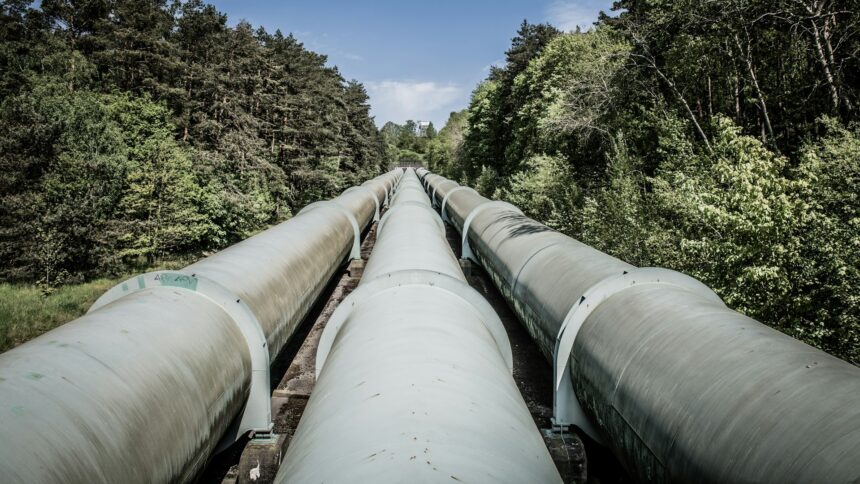
465,000 barrels a day is already committed on a pipeline that has not been approved and does not yet exist. South Bow Corp. reported that number in its second-quarter results on 5 August 2026, next to the detail that decides more than the number does. Nine customers signed for 20 years.
The proposed Prairie Connector would run 530 kilometres from Hardisty, Alberta to the Canada United States border, then connect into Bridger Pipeline Expansion, LLC facilities on the American side and into South Bow’s existing system at Cushing, Oklahoma. Alberta’s other large crude proposal, the West Coast Oil Pipeline, has published no contracted volume at all. One of those projects has told a lender what its revenue looks like for two decades. The other has not, because it has not reached the stage where shippers sign.
Key facts
- South Bow Corp. reported 465,000 barrels a day of firm commitments from nine customers on the proposed Prairie Connector project, in the company’s second-quarter 2026 news release dated 5 August 2026.
- South Bow Corp. stated that the Prairie Connector commitments are 20-year binding commitments for firm transportation service, following an open season that closed 30 March 2026, in the company news release dated 29 May 2026.
- South Bow Corp. described the proposed Prairie Connector as 530 kilometres from Hardisty, Alberta to the Canada United States border, including roughly 380 kilometres of new 36-inch pipeline and roughly 150 kilometres of previously installed 36-inch pipeline, in the news release dated 5 August 2026.
- The Canada Energy Regulator list of applications and projects, last updated 18 August 2026, contained no application entry for the Prairie Connector project.
- The Government of Alberta recorded just over $18 million contributed to early planning work on the proposed West Coast Oil Pipeline, on the provincial project page published 13 July 2026.
What a take or pay contract does for a lender
A firm transportation contract obliges a shipper to pay for reserved capacity whether or not the barrels move. The pipeline company carries that payment stream to the debt market, and the lender prices the debt against the credit quality of the shippers and the length of the term rather than against the price of oil on any given day. Twenty years is long enough to amortise most of the capital. That is why the term sits in the release at all.
Take-or-pay does not promise that oil flows. A shipper who nominates nothing still owes the reservation charge, which turns an uncertain commodity business into a predictable payment for the lender. The risk does not vanish under that structure. It moves onto the producer’s balance sheet, which is where nine companies agreed to carry it for the length of the term.
Two numbers decide whether the structure holds. Contracted volume sets the size of the revenue base. Term sets how long that base lasts, and every other figure in a pipeline file, including the cost estimate, gets negotiated around those two.
465,000 barrels a day held for 20 years works out to roughly 3.39 billion barrels of committed throughput, by our arithmetic. A credit committee reads that figure before it reads anything else in the package.
Why the capital structure changes who carries the risk
When producers underwrite a line, they are putting their own netbacks behind the assumption that the barrels will be there in 2040. Nine of them did that in the same open season, which closed on 30 March 2026. A project funded mainly by government-linked capital is underwritten by a different party answering to a different set of reasons. That is a description of the capital structure and carries no verdict on the engineering.
The Government of Alberta has put just over $18 million into early planning work on the West Coast Oil Pipeline, on the provincial project page published 13 July 2026. The partners named on that page include the federally owned Trans Mountain Corporation and Pembina Pipeline. No capital cost appears there. No contracted volume appears there either.
Be fair about what that means. Early planning money buys route work and a submission, and $18 million is an ordinary figure for that stage of a large line. A project at that stage has nothing to contract yet, because there is no service to sell until the route and the tariff exist. The absence of a contracted volume is a statement about timing rather than about merit.
Where the paperwork stands on each project
Neither project has an application before the Canada Energy Regulator. The regulator list of applications and projects, last updated 18 August 2026, carried no entry for the Prairie Connector. A signed shipper contract and a filed application are separate milestones, and South Bow holds one of the two.
About 150 kilometres of the 530 is 36-inch pipe already in the ground and preserved, with roughly 380 kilometres of new 36-inch pipe and two pump stations still to build. Roughly 28% of the line already exists, by our arithmetic, which is the part of the file that explains why a company will spend real money ahead of a decision. South Bow raised 2026 growth capital guidance to about $80 million on 5 August 2026, including about $65 million of pre-decision development costs across the Prairie Connector and the Liberty Bridge project.
The company project page targets a final investment decision in the second quarter of 2027 and an in-service date of 2029. Chief executive Bevin Wirzba, announcing the open season result on 29 May 2026, pointed to “the ongoing need for market access for Western Canadian crude oil.” Market access is the argument every proponent makes. Signed capacity is the part a bank can discount.
Most of the figures in both files are estimates. One is a signed obligation. 465,000 barrels a day for 20 years.