
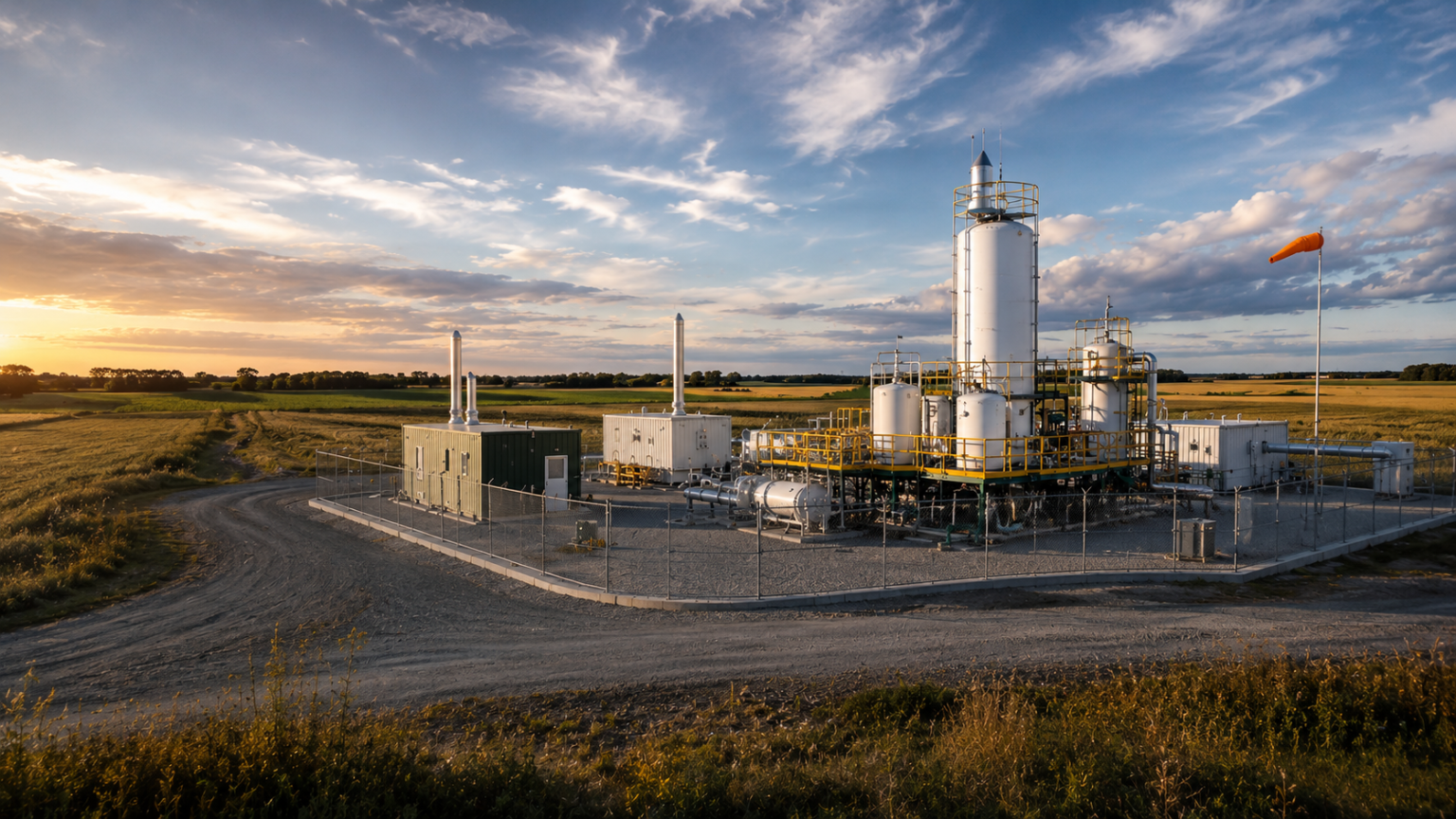

Canada’s first commercial carbon storage hub did not open in a ministry briefing room. It opened in a farm field near Legal, in Sturgeon County, about forty minutes north of Edmonton, where a private Alberta company is now injecting carbon dioxide into deep saline rock.
Bison Low Carbon Ventures built the Meadowbrook Carbon Storage Hub, whose opening phase holds a licence for half a million tonnes of CO2 annually, with a path sketched toward three million tonnes a year. About $17 million of private money financed the opening build, with future phases budgeted toward $150 million. The money behind it includes PrairieSky and two of Japan’s industrial heavyweights, Marubeni and Mizuho.
No federal cheque carried it over the line and no national podium introduced it. The thing was permitted, constructed and switched on.
Why International Capital Chose Sturgeon County
Japanese institutional money does not wander into rural Alberta by accident. It came because Alberta built the conditions over two decades. The province has regulated CO2 injection since the Quest project era, has sequestered upwards of 17 million tonnes since 2015, and in 2022 handed out 25 hub tenures in a single year. Layer on storage capacity under the province estimated at 100 billion tonnes, plus generations of subsurface engineering talent from the oil patch, and Alberta is simply the most credible place on the continent to put carbon underground.
That is what a real climate-and-industry strategy looks like. Regulatory clarity, geological homework, and an industrial base that knows how to drill, complete and monitor wells. The same skills that built the province’s conventional oil industry are now being pointed at emissions.
The Contrast Nobody in Ottawa Wants Drawn
For a decade, the national conversation has treated emissions policy as a choice between taxes, bans and lectures. Alberta’s energy industry was cast as the problem to be managed. Meanwhile, the actual reduction infrastructure, the kind that takes CO2 out of circulation permanently, got built here, by private actors, on provincial rules.
Meadowbrook will not headline a climate summit. It is too practical for that. But a working hub that serves Industrial Heartland customers by pipeline and smaller emitters by truck does more measurable good than another federal framework document, and it does it while creating Alberta jobs and returning value to Alberta landowners and municipalities.
Keep the Formula
There is a policy lesson in this for both governments. The pieces that worked were stable rules, clear tenure, fast permitting and private risk capital. The pieces that were absent were grant programs and political ribbon-cuttings. As the Pathways debate consumes attention this year, Meadowbrook is the quiet proof that Alberta’s model attracts serious money on its own merits.
Alberta was told for years that its industry was the obstacle to climate progress. The first commercial carbon storage hub in the country now operates an hour from Edmonton, financed privately, engineered locally and regulated provincially. The obstacle, it turns out, was never the province.
Is private-capital carbon storage the model Canada should scale, or does Ottawa still need a role? Tell us what you think.